



Table of contents: Removal ↓ Installation ↓
Warning: The fuel system is under pressure. Before disconnecting the system components, the pressure in the system must be relieved. To do this, cover the disconnection point with a clean rag and, being careful, smoothly unscrew the connection.
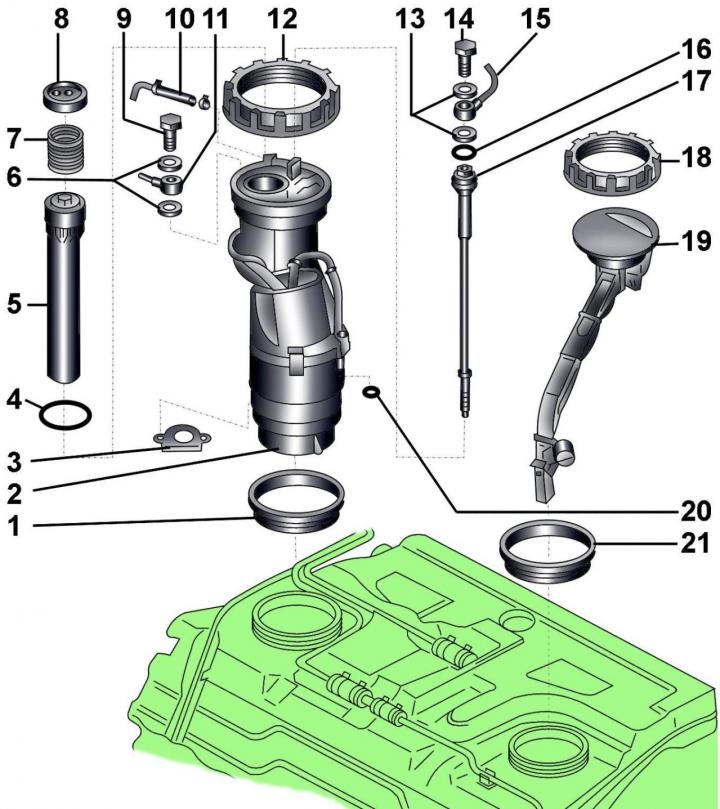
Fig. 4.1–9. Fuel pump/fuel level sensor: 1 – gasket; 2 – fuel pump housing; 3 – plug, 4 – sealing ring; 5 – fuel level sensor; 6 – gaskets; 7 – spring; 8 – fuel level sensor cover; 9 – hollow bolt, 23 Nm; 10 – fuel return pipe; 11 – supply pipe to the fuel filter; 12 – connecting nut, 70 Nm; 13 – gaskets; 14 – hollow bolt, 13 Nm; 15 – supply pipe; 16 – sealing ring; 17 – tubular bolt, 20 Nm; 18 – coupling nut, 60 Nm; 19 – Fuel level sensor G169; 20 – sealing ring; 21 – gasket
On models with petrol engines, the fuel pump together with the fuel level sensor (Fig. 4.1–9) is installed in the fuel tank.
The fuel level sensor design includes a potentiometer and a float connected to it. When the amount of fuel decreases, the float drops, the potentiometer resistance increases, and the voltage on the fuel level indicator located in the instrument cluster decreases.
Note: New gaskets, O-rings and plug must be used during installation.
Removal
Before disconnecting the battery, find out if you have a radio activation code.
Turn off the ignition and disconnect the ground wire from the battery.
Remove the fuel pump/fuel level sensor covers located on the right side under the trunk carpet.
Using special tool 2012A, unscrew cover 8 (see Fig. 4.1–9) of the fuel level sensor by turning it clockwise, remove cover 8 and spring 7 located under the cover.
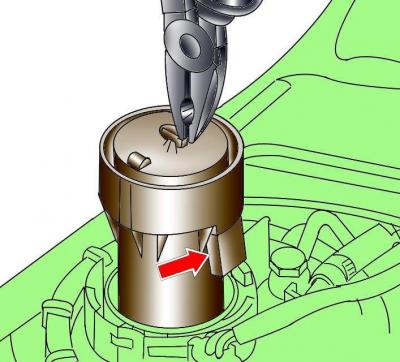
Fig. 4.1–10. Removing the fuel level sensor and locating the electrical connector
Using pliers, remove fuel level sensor 5 and disconnect the electrical connector from it (Fig. 4.1–10).
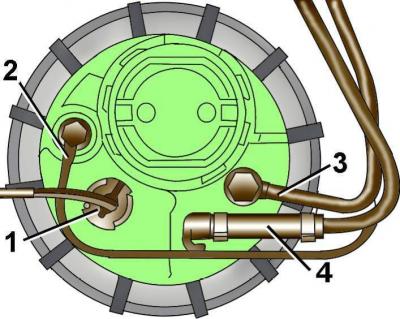
Fig. 4.1–11. Location of electrical connector (1), auxiliary (2), supply (3) and return (4) fuel pipes
Disconnect electrical connector 1 from the fuel level sensor housing (Fig. 4.1–11).
Unscrew the hollow bolt and disconnect the auxiliary pipe 2.
Unscrew the hollow bolt and disconnect the fuel supply pipe 3.
Disconnect fuel return pipe 4.
Using special tool 3242, unscrew union nut 12 (see Fig. 4.1–9) securing the fuel level sensor/fuel pump unit.
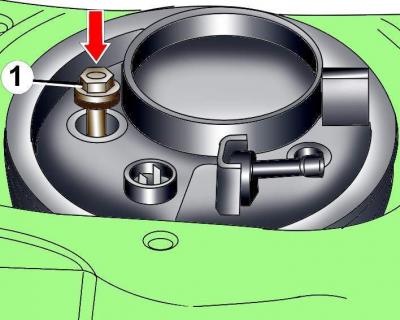
Fig. 4.1–12. Location and direction of pressing the bolt (1)
Loosen bolt 1 a few turns, but do not remove it completely (Fig. 4.1–12).
Press down on the bolt to separate the fuel level sensor/fuel pump from the fuel tank connector board.
Unscrew the bolt completely.
Lift the fuel level sensor/fuel pump and remove the gasket.
To remove the fuel level sensor/fuel pump, move it upward while turning it clockwise.
Installation
Installation is carried out in the reverse order of removal.
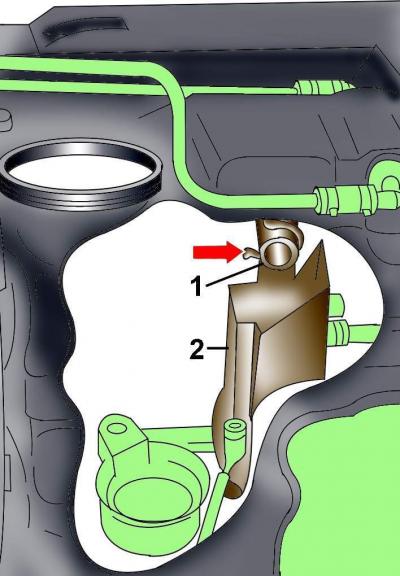
Fig. 4.1–13. Fastening the fuel supply tube (1) to the retainer on the connecting plate (2) of the fuel tank
Before installation, check that the fuel supply pipe is secured with the clamp on the connection board (Fig. 4.1-13). A light bulb and a mirror can be used for this purpose. If the pipe is not secured with the clamp on the connection board, the fuel level sensor/fuel pump cannot be installed correctly and the connection board may be damaged during installation.
Replace the fuel level sensor/fuel pump assembly O-rings.
Make sure the fuel level sensor electrical connector is facing up and does not fall into the fuel tank during installation.
Install the fuel level sensor/fuel pump as follows.
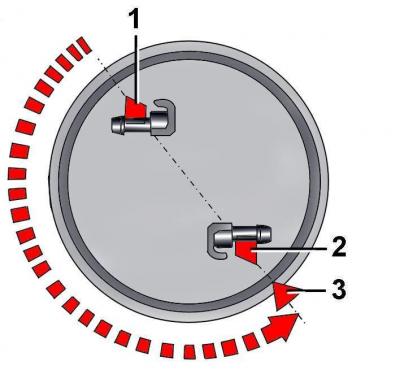
Fig. 4.1–14. Positions of the fuel level sensor/fuel pump during installation: 1 – initial position; 2 – final position; 3 – label
In the initial position, the hose nipple should be located on the left side of the vehicle (Fig. 4.1–14).
When installing the sensor into the fuel tank, turn it 180° counterclockwise, with the hose fitting located on the right side of the vehicle and marks 2 and 3 (see Fig. 4.1–14) aligned.
Press the fuel level sensor/fuel pump down, this will press the fuel supply pipe of the pump against the supply pipe of the connecting board.
The bolt should be easy to install and should screw into the mounting plate without much effort.
After checking that the fuel level sensor/fuel pump is installed correctly, lift it slightly and install a new seal in the fuel tank seat.
Reinstall the fuel level sensor/fuel pump.
Install a new O-ring on the clamp bolt and make sure the restrictor tube is positioned inside the bolt. Note that the restrictor tube is not installed on all models.
Install and tighten the clamp bolt.
Using special tool 3242, tighten the fuel level sensor/fuel pump mounting union nut to 70 Nm.
Tighten the bolt to 23 Nm.
Connect the electrical connector to the fuel level sensor housing (see Fig. 4.1–11).
Connect the auxiliary fuel pipe and secure it with the hollow bolt and new O-rings (see Fig. 4.1–11).
Connect the fuel supply pipe and secure it with a hollow bolt and new O-rings (see Fig. 4.1–11).
Connect the fuel return line.
Using pliers, lower the fuel level sensor into place and connect the electrical connector to it (see Fig. 4.1–10).
Install the spring and, using special tool 2012A, tighten the fuel level sensor cover by turning it counterclockwise.
Connect the ground wire to the battery.
Turn on radio and enter the code into it.
Content source: the specified website: audimanual