



Checking the charging voltage
Usually the generator does not require repair, except for the really rare cases of replacing the generator brushes. More serious damage cannot be repaired with home remedies.
Connect a voltmeter between the terminal of the thick red generator wire and the ground.
Leave the engine running at medium speed.
If the voltage regulator is working properly, the voltmeter should show between 13.3 and 14.6 V.
If this is not the case, check the brushes or replace the regulator.
Otherwise, the generator itself is faulty.
Checking the brushes
Disconnect the negative battery terminal.
Bosch Generators: Remove the cover on the back of the battery (where is there).
Disconnect the regulator from the generator. To do this, unscrew the two screws.
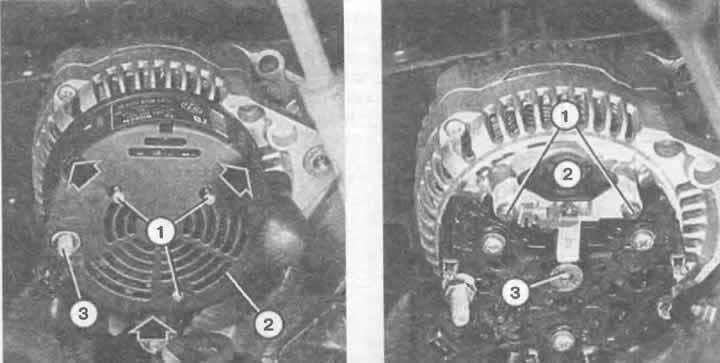
Left: To remove the cover (2) of the Bosch generator, you need to unscrew the three Phillips-head screws (1), remove the B+ wire from the threaded bolt (3) and press out the fastening tabs (arrows).
Right: The voltage regulator (2) is secured with two Phillips head bolts (1). Position (3) indicates the generator rotor axis.
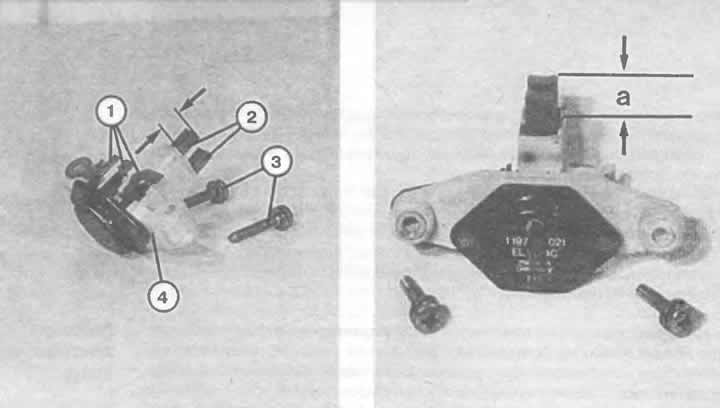
Left: on the removed voltage regulator (4; the illustration shows a new design) the length of the brushes (2) is indicated by arrows. Position (1) shows the voltage regulator contacts, (3) are the mounting bolts.
Right: The illustration shows the measurement of the length of the sliding electrographite contacts on a removed voltage regulator from Bosch of an older design: the brushes should not be shorter than a = 5 mm.
Fold back the regulator so that the carbon brushes do not hang down.
Measure the brush protrusion:
- the length of the new brushes is 13 mm;
- minimum length 5 mm.
Valeo generators: remove both regulator mounting screws on the rear of the generator.
Pull out the regulator.
Measure the length of the protruding brushes.
If the remaining length is 5 mm, the brushes are worn out.
Valeo generator brushes cannot be purchased separately; the entire regulator needs to be replaced.
Replacing brushes
Replacing the brushes on the regulators of the new generation of Bosch generators is no longer possible - therefore, carbon brushes are no longer sold as spare parts. If they are worn out, the entire regulator should be replaced. The same can be said about the Valeo generator; carbon brushes are not sold as spare parts - you need to buy a new voltage regulator if the brushes of the old one are worn out.
However, such replacement is possible for old generation Bosch generators. This will require a soldering iron, solder and, in addition, the ability to work with them.
Remove the voltage regulator according to the diagram described above.
Unsolder the multi-wire flexible wires, pull out the carbon brushes.
Remove the pressure springs from the old brushes and put them on the new ones.
Solder multi-wire flexible wires.
When doing this, use a little tin and work quickly so that the wires do not absorb too much tin. Otherwise, they will become stiff.
Hint: If the brushes are removed, you can check the copper contact rings at the same time (brushes run over them). If deep traces of wear are found on them, then they need to be ground down and polished in an auto electrics workshop.
Disconnect the ground wire from the battery, otherwise there is a high risk of a short circuit.
4-cylinder models: remove cover (where is there) pivot bolt at the front of the timing belt cover.
Disconnect the cable to ground, where available.
Loosen the clamp bolt on the generator adjusting bar.
Disconnect the connecting wire.
Loosen and remove the V-belt or poly V-belt.
Loosen and remove the pivot bolt while holding the generator.
Models with 5-cylinder engines: Remove the lower engine compartment protection.
Disconnect the connecting wire.
Remove the mounting bolts and remove the generator.
Models with 6-cylinder engines: Remove the lower engine compartment protection.
Remove the V-belt (description of the work below in this chapter).
Remove the connecting wire and cooling air flow guide from below.
Loosen the mounting bolts and remove the generator.
Material republished from the website: AudiManual.ru