



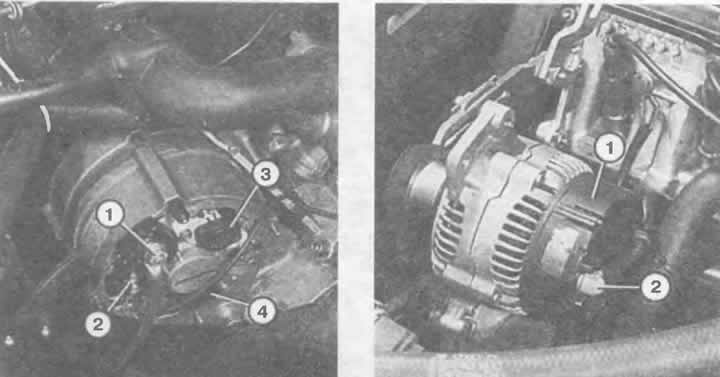
Left: Bosch generator (old version, rear view):
1 - B+ connection (to the battery);
2 - 0+-connection (to the battery charge indicator);
3 - voltage regulator;
4 - noise suppression capacitor.
Right: The new generation Bosch alternator can be identified by the cover (1). Position (2) shows the B+ cable to the battery.
When the ignition is switched on, voltage is supplied to terminal 15. However, the generator is not yet running and therefore the D+ contact, which is not supplied with power, acts as a "minus". The indicator flashes because there is a potential difference between the on-board network, which is supplied by the battery, and the non-operating generator.
If the engine is running and the generator has reached the required number of revolutions for charging, the voltage regulator connects it to the on-board network. Now power comes from terminal 15 and additionally from terminal D+. When there is no potential difference, the charge indicator goes out.
When the ignition is turned on, the lit charge indicator should "pre-excite" the generator. Only in this case will the generator be able to produce current already at low speeds. However, pre-excite is only necessary when the generator is first started.
(This article was previously published on the resource «AUDImanual.ru»)