
Repair Chevrolet Repair Toyota Repair Honda Repair AvtoVAZ Repair Mercedes-Benz Repair BMW Repair Opel
Home  |  Contacts  |  Sitemap  |    
English Русский
Български
Беларускі
Український
Српски
Hrvatski
Română
Polski
Slovenský
Magyar
AudiManual.ru


  • AUDI 80
  • AUDI 100
  • AUDI A3
  • AUDI A4
  • AUDI A6
  • AUDI A8
  • AUDI Q
  • OTHER
  • ARTICLES
C4 (1990-1994) C4 (1990-1994, petrol) C3 (1982-1990) C3 (1982-1990, petrol) C3 (1982-1990, diesel)

Checking the oil level (Continuous monitoring) (Audi 100 C4)

  • Home
  • Audi 100
  • C4 (1990-1994)
  • Power unit
  • Lubrication system
  • Checking the oil level (Continuous monitoring)
            0
Table of contents: Topping up oil ↓ Oil consumption ↓ Quality of watches ↓
The oil level should be checked at least every other refueling. If preparing for a long trip or if you have an old engine with increased oil consumption, the check should be made at every refueling. The oil dipstick is on the left side of the engine, when looking in the direction of travel.

Place the car on a level surface.

After turning off the engine when it is warm, you should wait at least five minutes for all the oil to drain into the oil pan. It is better to check before starting it when the engine is still cold.

Pull out the oil dipstick (when the engine is hot, care should be taken as nearby coolant hoses are very hot), wipe the dipstick with a clean, thread-free cloth or paper towel. Insert it all the way again, wait a bit, and pull it out again.

Use the dipstick to determine the oil level, which should be between the two marks.

If the oil level only reaches the lower mark, add 1 liter.
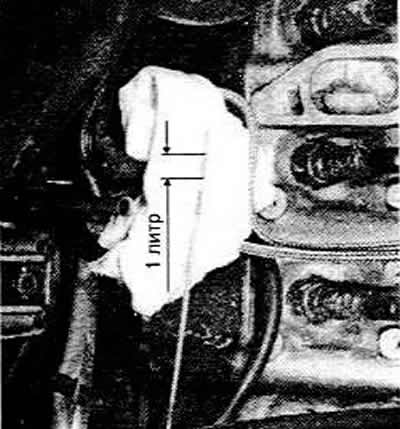
If the oil level only reaches the lower mark, add 1 liter.


Topping up oil


The amount of oil between the upper and lower marks is 1 liter. The oil level should not fall below the lower mark, although a shortage of a quarter of a liter is not yet dangerous for the engine.


If more oil is missing and the vehicle is moving, the oil pressure may drop to a dangerous level, which will be immediately signalled by the dynamic oil pressure monitoring system via a warning buzzer.

It is also undesirable to have too much oil in the engine. At high speeds, it gets through the crankcase ventilation system into the air filter and contaminates the paper filter element (carburetor engines).

In moderate driving conditions, it is sufficient to add oil up to the lower mark.

When driving at high speed, it is recommended to add oil so that the level is in the lower quarter between the two marks on the dipstick. A slightly larger amount of oil will provide better cooling.

It will not do any good to the engine if you fill the oil above the upper mark. At high speeds, oil will get into the air filter or intake system through the crankcase ventilation system.

Can different brands of oils be mixed?


Oils of different brands can be mixed, including seasonal oils with all-season oils. It is important that the oil used is of the required type.

Oil consumption


Some of the oil burns during operation. Thus, oil consumption is natural. A well-functioning engine should consume 0.2 liters of oil per 1000 km. For an Audi, the maximum permissible consumption is 1.5 liters per 1000 km.

Quality of watches


Types of oils recommended for Audi


For relatively long intervals between oil changes (with a mileage of 15,000 km or more) there is a risk of oil foaming, which is why it is necessary to follow the recommendations of the Audi company.


The recommended motor oil should be mineral-based and meet the VW 50101 standard. Such oil has the necessary properties to prevent foaming. Synthetic oils with crumbs and anti-friction properties reduce internal friction in the engine. They must meet the VW 50000 standard.

Only if there is no oil of the specified type, seasonal or all-season oil of the category "API SF" or "API SG" can be used for topping up. Previously, oil could have been poured in that, according to the API standard (American Petroleum Jnsfifute) marked with the letters SF or SG. This designation may also be preceded by the designation of the Association of European Automobile Manufacturers (CC MC) or the US Military Institute (MIL). The use of CCMC-G3 or MIL-L-46152B oils is permitted, however, such grades of oil may be used for topping up only in extreme cases.

Below are guidelines for choosing the right brand of oil. The oil should be:
  • The required type. The absence of a label on the package is very rare.
  • The required viscosity. It depends on the prevailing air temperatures and can be determined from the graph below.
  • Other factors, such as the price of the oil and the name of the manufacturer, say nothing about the quality of the oil.
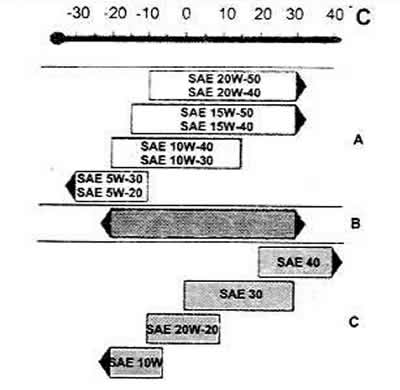
Graph of oil viscosity versus temperature

Graph of oil viscosity versus temperature
A - All-season oil.
B - Synthetic oil according to VW 50000 standard.
C — Seasonal oil The temperatures indicated are the prevailing air temperatures. Short-term fluctuations do not play a role.


Motor oil additives


The use of additives, no matter what kind, in lubricating oils leads to disruption of the operating mode and can lead to an undesirable mixture composition. This is the opinion of VW/Audi. The use of oils with additives that extend their service life remains questionable, especially when using oils for heavy-duty operation.

[This article was copied from an online resource «audimanual»]
The article was checked by auto expert Georgy Rodionov
This article is available at russian, bulgarian, belarusian, ukrainian, serbian, croatian, romanian, polish, slovak, hungarian

Share information:
Previous articles
Audi 100 C4: Lubrication system
Next articles

Engine oil change
Checking the oil level in transmission units
Lubrication of the ignition distributor
Lubrication of rods, hinges and locks


Similar articles on other Audi car models:
Engine Oil — Checking Level Audi 80 B4 (1991-1996)
Checking the transmission oil level of the manual transmission Audi A3 Type 8L (1996-2003)
Checking the oil level Audi A4 B5 (1994-2001, petrol)
Checking the oil level and filling Audi A6 C5 (1997-2004)
Checking the oil level in a manual transmission Audi A8 D2 (1994-2002)
Checking the fuel level sensor «G» Audi Q5 Type 8R (2008-2017)
Engine — Checking Oil Level Audi A2 (1999-2005)
Link to this page in different formats


Visitor comments

No comments yet


How much will 29 + 35 =


100(C4, 1990-1994) 
  • General information
  • User manual
  • Power unit
  • Engine repair
  • Ignition system
  • Fuel system (gasoline)
  • Fuel system (diesel)
  • Lubrication system
  • Cooling system
  • Exhaust system
  • Transmission
  • Clutch
  • Car gearbox
  • Drive shafts
  • Chassis
  • Car suspension
  • Steering
  • Wheels and tires
  • Brake system
  • Body
  • Ventilation and heating
  • Body repair
  • Electrical equipment
  • Power devices
  • Lighting and appliances
  • Electrical circuits
 
100(C4, 1990-1994, petrol) 
  • General information
  • Operation and maintenance
  • Power unit
  • Engine repair
  • Exhaust system
  • Cooling system
  • Supply system
  • Air filter
  • Mono-Motronic injection system
  • Digifant injection system
  • KE-III-Jetronic and KE-Motronic
  • MPI and MPFI injection system
  • Transmission
  • Clutch
  • Car gearbox
  • Chassis
  • Suspension and steering
  • Brake system
  • Wheels and tires
  • Body
  • Exterior
  • Interior
  • Electrical equipment
  • Fuses and relays
  • Power devices
  • Ignition system
  • Lighting and signaling
  • Equipment and devices
  • Electrical circuits
 
100(C3, 1982-1990) 
  • General information
  • User manual
  • Maintenance
  • Specifications
  • Power unit
  • Engines 4-cylinder
  • Engines 5-cylinder
  • Diesel engine
  • Cooling system
  • Power system (carburetor)
  • Power system (injector)
  • Fuel system (diesel)
  • Transistor ignition system
  • Electronic ignition system
  • Transmission
  • Clutch
  • 4 speed gearbox 014
  • 5 speed gearbox 013 and 093
  • 5 speed gearbox 016 and 012
  • Shift mechanism KP 016
  • Automatic transmission
  • Front wheel drive
  • Chassis
  • Front suspension
  • Rear suspension
  • Steering
  • Brake system
  • Body
  • Body elements
  • Electrical equipment
  • Lighting and appliances
  • Power devices
  • Electrical circuits
 
100(C3, 1982-1990, petrol) 
  • General information
  • Maintenance and operation
  • 4 cylinder engine
  • Engine repair
  • Cooling and lubrication system
  • Supply system
  • Ignition system
  • 5 cylinder engine
  • Engine repair
  • Cooling and lubrication system
  • Supply system
  • Ignition system
  • Transmission
  • Clutch and drive shafts
  • 4 speed gearbox 014
  • 5 speed gearbox 013 and 093
  • 5 speed gearbox 016 and 012
  • Automatic gearbox
  • Chassis
  • Steering
  • Front suspension
  • Rear suspension
  • Brake system
  • Body
  • Body elements
  • Doors, locks and windows
  • Body repair
  • Electrical equipment
  • Equipment and devices
  • Power devices
  • Electrical circuits
 
100(C3, 1982-1990, diesel) 
  • General information
  • User manual
  • Maintenance
  • Troubleshooting
  • Power unit
  • Engine in a car
  • Engine removed
  • Cooling system
  • Fuel system
  • Exhaust system
  • Starting and charging
  • Preheating
  • Transmission
  • Clutch
  • Mechanical gearbox
  • Automatic gearbox
  • Drive shafts
  • Chassis
  • Brake system
  • Suspension
  • Steering
  • Body
  • Exterior
  • Interior
  • Electrical equipment
  • Equipment and devices
  • Electrical circuits
 
AudiManual.ru © 2017-2026 · Mobile version · Feedback · Sitemap: EN BG BY UA RS HR RO PL SK HU · Site search · News and articles
80 B2 · 80 B3 petrol · 80 B3 · 80 B4 · 100 C3 diesel · 100 C3 petrol · 100 C3 · 100 C4 petrol · 100 C4 · A3 Type 8L · A4 B5 petrol · A4 B5 · A4 B6 petrol · A4 B6 · A4 B7 · A4 B8 · A6 C4 · A6 C5 · A6 C5 Allroad · A8 D2 · Q5 Type 8R · Q7 Typ 4L · Audi A2 ·
This site uses cookies 🍪. Click the button to accept this fact.