



1. Place the vehicle on a horizontal surface.
2. Turn off the engine and wait at least five minutes for the oil to drain into the pan.
3. Be careful not to burn yourself on the hot engine.
4. Remove the dipstick and wipe it with a lint-free cloth or paper towel.
5. Insert the dipstick back into place and after a while pull it out again.
6. Check the oil level. If it is near the minimum mark on the dipstick, then add oil (see illustration).
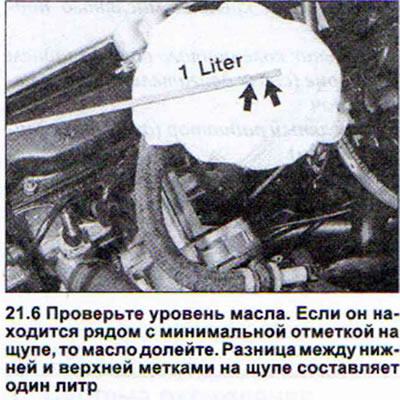
The difference between the lower and upper marks on the dipstick is one liter. Do not allow the oil level to fall below the lower mark. This may lead to a drop in pressure in the system. When this situation occurs, an acoustic signal is given and the oil pressure indicator light comes on.
Adding more engine oil than necessary does not make sense. At high engine speeds, excess oil can enter the combustion chambers through the breather. Excess oil in the system is as dangerous for the catalyst as burnt fuel.
Motor oil, including single-season and all-season, from different manufacturers but of the same specification can be mixed without fear.
Oil consumption
A certain amount of oil burns during the lubrication of the power plant parts. Thus, oil consumption is a natural phenomenon. Well-run-in engines consume approximately 0.2 l of oil per 1000 km. The maximum permissible oil consumption is considered to be 1.0 l per 1000 km.
Oil consumption depends on many factors. By the way, oil consumption increases if there is an excessive amount of oil added. In this case, the excess oil is expelled from the crankcase through the breather. All-season oil that has been in the engine for a long time becomes easily flowing during operation and therefore is consumed faster. In addition, oil loss can occur as a result of leaks or defects, such as oil-deflecting caps, due to wear or improper installation of piston rings, or damage to the cylinder wall.
When operating a car in winter over short distances, it may turn out that the oil is not consumed at all or even increases in volume. This means that fuel has entered the oil, and the volume of condensate has also increased. To bring the oil level and consistency back to normal, it is necessary to take a long trip. During such a trip, the condensate evaporates. After completing the trip, immediately check the oil level, since the oil level may drop sharply as a result of evaporation of condensate. If the car is used exclusively in urban conditions, then change the oil without waiting for the replacement period, every 3000 km of run or every four months.
In winter operating conditions, some fuel content in engine oil should be taken into account. 2-3% is considered acceptable, although in reality this level is lower.
(The text is based on materials from the website audimanual.ru)