



Table of contents: General Provisions ↓ Oil circulation ↓
General Provisions
The engine oil must meet the VW501 01 specification. There are also no restrictions on the use of all-season oils of the VW 500 00 specification. However, light oils of these specifications are not allowed for use in diesel engines.
For gasoline engines, all-season or single-season oil of API SF or API SG specification may be used in the absence of oil of the above specifications. As for diesel engines, if necessary, it is permissible to fill with all-season oil of API CD specification or single-season oil of the same specification.
Mineral all-season oil of specification VW505 00 can be used without restrictions for AUDI 80 cars with a diesel engine.
The main requirement for engine oil is its viscosity. It should not be too viscous, otherwise the starter will have difficulty starting the engine, but it should not be too fluid either. In this case, at high engine temperatures, the oil film may "break".
The American Society of Automotive Engineers (SAE) has divided motor oils into classes depending on viscosity. Thus, the oil palette includes easy-flowing winter oils SAE 5 W, 10 W, 15 W, intermediate SAE 20W/20 and viscous summer oils SAE 30, 40 and 50 (see illustration 19.0).
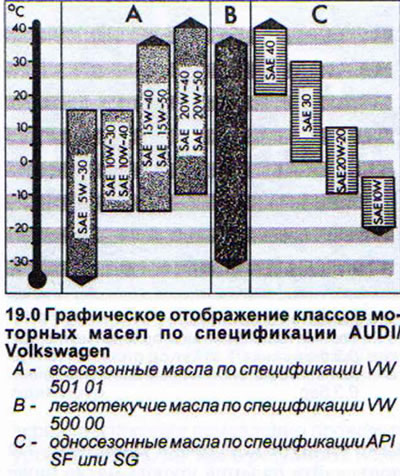
The cheapest is single-season oil. If the viscosity requirements are met and seasonal changes are made in a timely manner, AUDI does not prohibit the use of such oil. Currently, single-season oil has practically disappeared from the market. It has been replaced by all-season oil, which contains a viscosity improver, the molecules of which swell when heated and shrink to their original state when cooled. Thus, this oil easily adapts to temperature changes. SAE 15W-50 oil at a temperature of -15°C corresponds to viscosity class 15W, and at a temperature of 100°C - to class 50.
Some problems arise with all-season mineral oil. In this case, over time, the chains of molecules are "cut" and the oil loses its universal properties. For this reason, SAE 10W-30 and 10W-40 oils are excluded from the list of those approved for use in AUDI cars.
Attention! AUDI strictly prohibits the use of any additives to motor oil. Their use is considered a violation of the vehicle operating instructions and, accordingly, excludes the effect of the relevant warranties.
Oil circulation
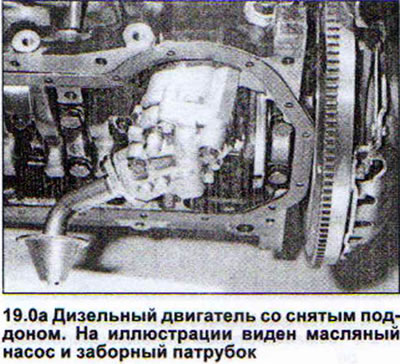
The oil pump sucks engine oil from the oil pan through the intake pipe and pumps it into the oil filter on the oil line (see illustration 19.0a). From the filter, the engine oil flows through the pressure channels in the cylinder block to the lubricated parts of the crankshaft, intermediate shaft, cylinder head and camshaft. Then the oil flows through the holes again into the oil pan and from there is again taken by the oil pump.
Lubrication of the turbocharger parts is carried out by engine oil supplied through a separate oil line.
There is a safety bypass valve on the oil pump. It is designed to supply engine oil to the main oil line in case of clogging of the replaceable filter element. In this case, the bypass valve opens and the oil is supplied bypassing the oil filter.
On the pressure side of the oil pump there is an oil pressure relief valve. This valve opens when the oil pressure is too high and some of the oil can flow back into the oil pan.
In one minute, the oil pump pumps about 30-35 liters of oil at full engine load. The oil pump of four-cylinder gasoline and diesel engines is driven by the intermediate shaft. The oil pump of five- and six-cylinder engines is driven by the crankshaft.
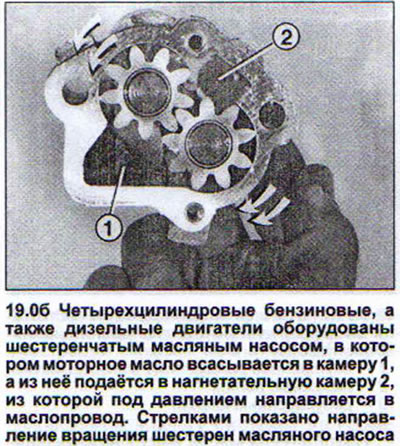
AUDI installs two types of oil pumps on its cars. Four-cylinder petrol and diesel engines are equipped with a gear oil pump, in which engine oil is sucked into chamber 1, and from there it is fed to the pump chamber 2, from which it is directed under pressure to the oil filter and then to the oil line (see illustration 19.0b).
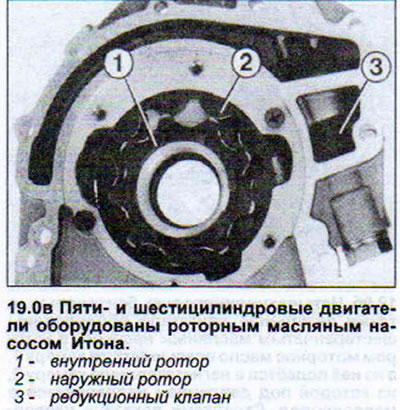
Five- and six-cylinder engines are equipped with an Eaton rotary oil pump with a pressure-reducing valve (see illustration 19.0v).
Oil temperature is important for engine operation. The installation of an engine oil temperature gauge is an optional extra. AUDI considers the engine oil temperature in the oil pan to be 145°C as the maximum permissible temperature.
Too low engine oil temperature has a detrimental effect on the engine. For this reason, it is recommended not to exceed 3500 rpm after starting a cold engine until the oil temperature exceeds 60°C. For gasoline engines, there is an unwritten rule that engine oil needs twice as much time to warm up to operating temperature as the coolant. As for diesel engines, in winter, the oil reaches a temperature of 60°C in about 10 minutes after starting the engine, and in summer - in about 6 minutes.
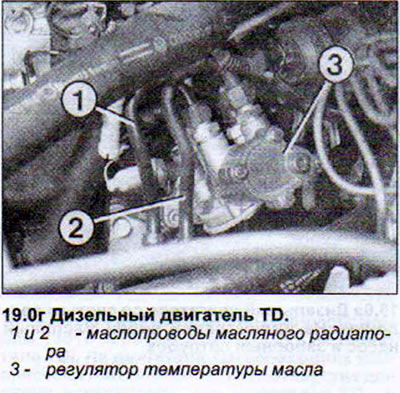
Diesel engines are equipped with an oil cooler, which cools the engine oil. On TD engines, the oil cooler is located on the left side of the engine. Using an oil cooler also has a negative effect, the meaning of which is that in such cases the oil will slowly reach the operating temperature. To avoid this situation, an oil temperature regulator is installed on the oil filter flange. This regulator allows the engine oil to pass through the oil cooler only at temperatures above 110°C. At lower temperatures, the oil access to the radiator is closed. This means that the engine oil temperature regulator itself must heat up to 110°C, which will open the access of the engine oil to the radiator (see illustration 19.0g).
The AUDI 80 TDI cars have an oil radiator that works on a different principle. This oil radiator is constantly "washed" by the coolant. When starting a cold engine, the engine oil is heated by the heated coolant.