
Repair Chevrolet Repair Toyota Repair Honda Repair AvtoVAZ Repair Mercedes-Benz Repair BMW Repair Opel
Home  |  Contacts  |  Sitemap  |    
English Русский
Български
Беларускі
Український
Српски
Hrvatski
Română
Polski
Slovenský
Magyar
AudiManual.ru


  • AUDI 80
  • AUDI 100
  • AUDI A3
  • AUDI A4
  • AUDI A6
  • AUDI A8
  • AUDI Q
  • OTHER
  • ARTICLES
C5 Allroad (1999-2005) C5 (1997-2004) C4 (1994-1997)

Engine lubrication system (Audi A6 C5)

  • Home
  • Audi A6
  • C5 (1997-2004)
  • Power unit
  • Engine repair
  • Engine lubrication system
            0
Table of contents: Oil viscosity ↓ All-season oils ↓ Motor oil specification ↓

Oil viscosity


Viscosity characterizes the fluidity of the oil. Depending on the temperature, the oil tends to decrease in fluidity. As the temperature increases, the oil becomes more fluid. This worsens the oil's ability to adhere and withstand high contact pressures. When cooling, the oil thickens, fluidity decreases and internal friction increases. Because of this property, it is necessary to use motor oil with a viscosity that changes with temperature within the smallest possible limits.

When starting a cold engine, the oil must be sufficiently liquid so as not to overload the engine excessively and so that after starting, the oil quickly penetrates all the places where lubrication is needed.

The fluidity of oil is equivalent to its internal friction and is designated by SAE (Society of Automotive Engineers) units, for example SAE 10 W 40.

10 — oil viscosity when cold. The lower the number, the lower the viscosity of the engine oil when cold.

W — motor oil is intended for winter use.

40 — oil viscosity when hot. The higher the number, the higher the viscosity of the engine oil when hot.

However, oil viscosity does not fully characterize the lubricating properties of the oil.
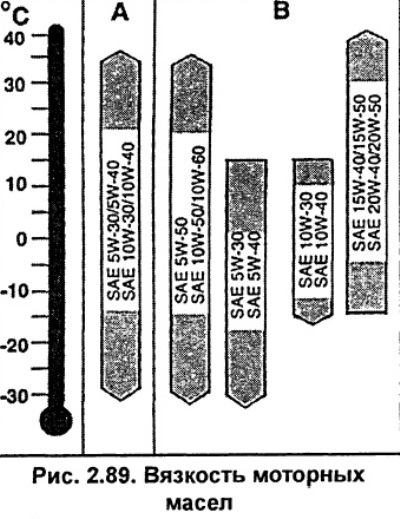
However, oil viscosity does not fully characterize the lubricating properties of the oil.


Petrol engines


A - all-season oils with improved antifriction properties, specification VW 500 00 or VW 502 00.

B - all-season oils, specification VW 501 01, as well as API-SF or SG.

Turbo diesel engines

B - all-season oils, specification VW 505 00

All-season oils


All-season oils are preferable for use in car engines. The advantage of all-season oils is that they do not need to be selected depending on the season. They are made on the basis of liquid single-season oil (type 10W). When heated, this oil is stabilized by a so-called thickener, which ensures the appropriate lubricating properties of the oil at all temperatures. When using all-season oil, modern grades with a wide temperature range of viscosity should be used, for example 10W-40, 15W-50.

The letter W (winter) in the SAE designation characterizes the suitability of the oil for use in winter.

Oils with increased lubricating properties are all-season oils, which, in addition to other additives, contain substances that reduce the coefficient of friction, which ensures a reduction in fuel consumption by 2%. Special starting components are used in their production (synthetic oils).

Since the range of use of adjacent SAE classes overlaps, short-term temperature fluctuations can be ignored. Mixing oils of different viscosity classes is allowed if oil topping up is required and the ambient temperature no longer corresponds to the viscosity class of the oil poured into the engine.

For long-term outside temperatures below -20°C, it is recommended to use SAE 5W-20 oil.


Attention. CD motor oils, which the manufacturer designates as oils for diesel engines, are not suitable for gasoline engines. There are oils that can be used in two types of engines, in which case both designations are indicated on the oil container, for example SG/CD.


Additional additives to oil, regardless of their type and purpose, should not be added to the oil.

Motor oil specification


For modern engines, only HD oils should be used. HD oils are oils with increased lubricating properties, improved by various additives. These additives provide better anti-corrosion protection, more favorable conditions against oxidation, the least tendency to form slags, the best change in viscosity, cleaning and dissolving properties. Cleaning and dissolving additives not only reduce the formation of residues in the engine, but also have the ability to dissolve these residues and all other contaminants in the engine oil and keep them in a suspended state so that when changing the oil, these contaminants are removed along with the drained oil.

The quality of HD oils is determined by the API system (American Petroleum Institut). European manufacturers also adhere to this system.

The oil grade is designated by two letters. The first letter characterizes the area of application: S — Servise, intended for carburetor engines; C — Commercial, designed for diesel engines.

The second letter identifies the grade of oil in alphabetical order.

The highest grade oils according to API classification are SG for carburetor engines and CD for diesel engines.
The article was checked by auto expert Alexey Ivanov
This article is available at russian, bulgarian, belarusian, ukrainian, serbian, croatian, romanian, polish, slovak, hungarian

Share information:
Previous articles
Audi A6 C5: Engine repair
Next articles

V-belt
Removal and installation a poly V-belt
Compression check
Checking hydraulic valve lifters
Motor oil for AUDI A6
Engine oil circuit
Oil consumption
Checking oil pressure and oil pressure sensor


Similar articles on other Audi car models:
Engine lubrication system Audi 80 B4 (1991-1996)
Lubrication system of a 6-cylinder gasoline engine Audi 100 C4 (1990-1994)
Engine Management System 1.6L Audi A3 Type 8L (1996-2003)
Engine lubrication system fault indicator Audi A4 B6 (2000-2006, petrol)
Central section of the cooling system pipe of a 2.5L diesel… Audi A8 D2 (1994-2002)
Lubrication system Audi Q5 Type 8R (2008-2017)
Engine lubrication system — design description Audi A2 (1999-2005)
Link to this page in different formats


Visitor comments

No comments yet


How much will 42 + 25 =


A6(C5 AR, 1999-2005) 
  • General information
  • User manual
  • Maintenance
  • Troubleshooting
  • Power unit
  • V6 petrol engines
  • V8 petrol engines
  • Diesel engines
  • Cooling and heating system
  • Injection system (gasoline)
  • Fuel system (diesel)
  • Supply system
  • Exhaust system
  • Ignition system
  • Transmission
  • Clutch
  • Mechanical gearbox
  • Automatic gearbox
  • Chassis
  • Brake system
  • Car suspension
  • Steering
  • Body
  • Body elements
  • Doors, locks and windows
  • Electrical equipment
  • Equipment and devices
  • Power devices
  • Electrical circuits
  • Schemes (petrol engine 2.7 l)
  • Schemes (petrol engine 4.2 l)
  • Schemes (diesel engine 2.5 l)
 
A6(C5, 1997-2004) 
  • General information
  • User manual
  • Maintenance
  • Power unit
  • Engine repair
  • Cooling system
  • Fuel system
  • Engine management
  • Fuel system (diesel)
  • Exhaust system
  • Transmission
  • Clutch
  • Car gearbox
  • Chassis
  • Front suspension
  • Rear suspension
  • Steering
  • Wheels and tires
  • Brake system
  • Body
  • Exterior
  • Interior
  • Electrical equipment
  • Air conditioner
  • Equipment and devices
  • Electrical circuits
 
A6(C4, 1994-1997) 
  • General information
  • User manual
  • Maintenance (gasoline)
  • Maintenance (Diesel)
  • Gasoline engines
  • 4 cylinder engines
  • 5 cylinder engines
  • 6 cylinder engines
  • Diesel engines
  • 4 cylinder engines
  • 5 cylinder engines
  • Engine repair
  • Removal and reassembly
  • Cooling system
  • Single point injection system
  • Multipoint injection system
  • MPI/MPFI injection system
  • Fuel system (diesel)
  • Exhaust system
  • Ignition system
  • Transmission
  • Clutch
  • Manual transmission
  • Automatic transmission
  • Drive shafts
  • Chassis
  • Brake system
  • Front suspension
  • Rear suspension
  • Steering
  • Body
  • Exterior (external elements)
  • Interior (internal elements)
  • Electrical equipment
  • Power devices
  • Lighting and appliances
  • Electrical circuits
 
AudiManual.ru © 2017-2026 · Mobile version · Feedback · Sitemap: EN BG BY UA RS HR RO PL SK HU · Site search · News and articles
80 B2 · 80 B3 petrol · 80 B3 · 80 B4 · 100 C3 diesel · 100 C3 petrol · 100 C3 · 100 C4 petrol · 100 C4 · A3 Type 8L · A4 B5 petrol · A4 B5 · A4 B6 petrol · A4 B6 · A4 B7 · A4 B8 · A6 C4 · A6 C5 · A6 C5 Allroad · A8 D2 · Q5 Type 8R · Q7 Typ 4L · Audi A2 ·
This site uses cookies 🍪. Click the button to accept this fact.