



Table of contents: Gasoline engine ↓ 6-cylinder petrol engine ↓ 6-cylinder petrol engine ↓ Diesel engine ↓
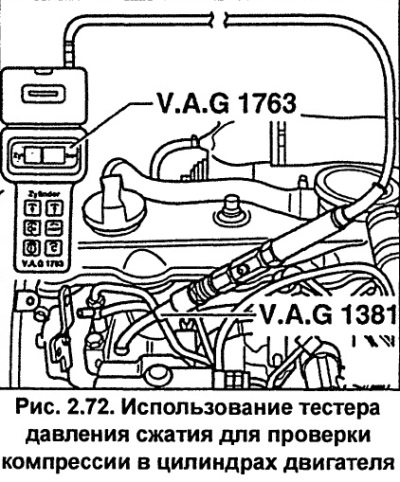
Compression testing allows you to determine the condition of the engine, as well as establish the condition of the valves or pistons (piston rings), or their wear exceeds the maximum permissible values. If this check is carried out regularly, then it is possible to know in advance the beginning of engine wear, without waiting for the moment when engine wear manifests itself in low engine efficiency. To carry out the control, a compression pressure tester is required, which is for gasoline engines, sold in specialized stores and is inexpensive.
Please note: Diesel engines require a compression pressure tester with a larger measurement range, up to approximately 40 bar.
The pressure difference between individual cylinders should be no more than 3.0 bar (in a diesel engine 5.0 bar). If the pressure difference in one or more cylinders in relation to the others is more than 3.0 bar (in a diesel engine 5.0 bar), then this indicates a loose cylinder head gasket, faulty valves, worn piston rings and/or cylinder running surfaces.
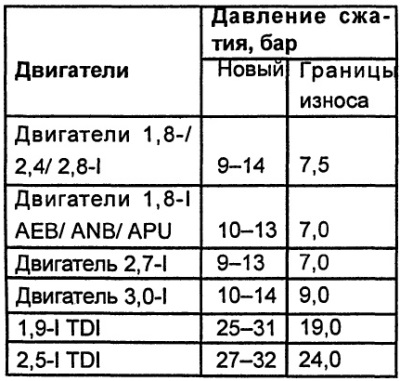
- When checking compression, the engine oil temperature should be at least 30°C. The oil filter should be warm, warm up the engine if necessary.
- The battery must be fully charged.
Gasoline engine
- Turn off the ignition.
- Disconnect the electrical connectors from the ignition coils.
- Remove all spark plugs.
- Disconnect the electrical connectors from all injectors.
6-cylinder petrol engine
- Disconnect the electrical connectors from the switches, which are located in the housing with the ignition coils.
Safety Notice
- When checking the compression, do not lean over the engine. Flying soot particles can cause injury.
- Turn the engine over with the starter to flush out the soot particles from the cylinders. Set the gearshift lever to neutral and apply the parking brake.
- According to the instructions in the owner's manual, insert a compression pressure tester into the spark plug holes.
- The assistant must fully depress the accelerator pedal and hold it in this position until the entire test is completed.
- Turn the engine crankshaft eight revolutions until the pressure increase recorded by the instrument stops.
- Check all cylinders in turn and compare the results with the specified parameters.
- Connect the electrical connectors to the fuel injectors.
6-cylinder petrol engine
- Connect the electrical connectors to the switches.
- Screw in the spark plugs and tighten them to a torque of 30 Nm.
Caution: After disconnecting the electrical connectors, a fault message is stored in the engine control unit memory. It is recommended to erase this stored information as soon as possible at an AUDI service station.
Diesel engine
- Disconnect all electrical connectors from the fuel pump.
- Remove all glow plugs.
- Screw in a compression pressure tester with a flexible connecting hose in place of the glow plugs.
Please note: The compression pressure specified in the table only applies when testing with the VAG 1763 compression pressure tester and adapter 1381/12 (2.5-I engine: adapter 1763/5). When using other measuring instruments, you can only check the deviation of compression in one cylinder from another.
- Turn the engine crankshaft eight revolutions until the pressure increase recorded by the measuring equipment stops.
- Screw in the glow plugs and tighten them to 15 Nm. Connect the wiring.
- Connect all electrical connectors to the fuel pump.
The original article is located on the online resource AUDIMANUAL.ru