Table of contents: Four-cylinder engines ↓ Five-cylinder engine ↓ Six-cylinder engine ↓ Checking the status ↓ Checking the tension ↓
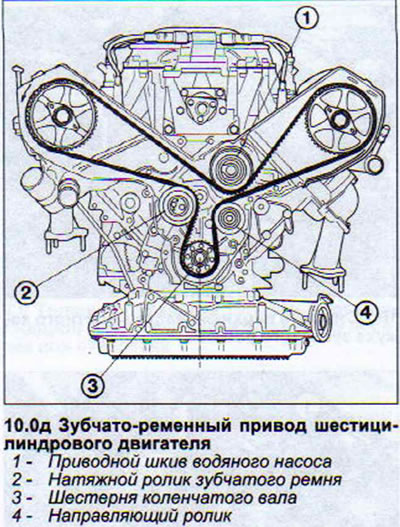
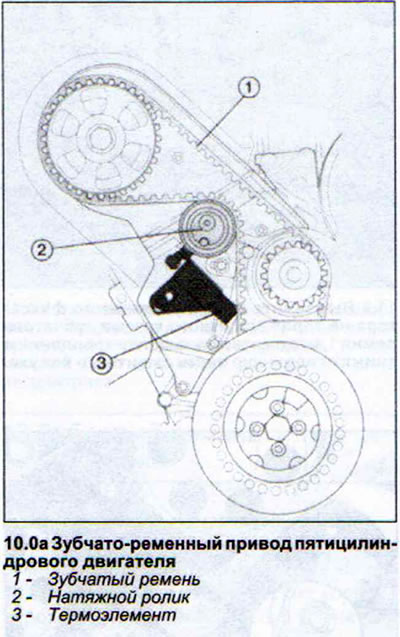
The drive of the gas distribution mechanism of the power unit is carried out by means of a toothed belt. In addition, in gasoline engines, the water pump is driven by a toothed belt (5 and 6 cylinders) and intermediate shaft (4-cylinder engines). 4- and 5-cylinder engines are equipped with a temperature-resistant timing belt tensioner roller, which ensures constant timing belt tension (see illustrations 10.0 and 10.0a).
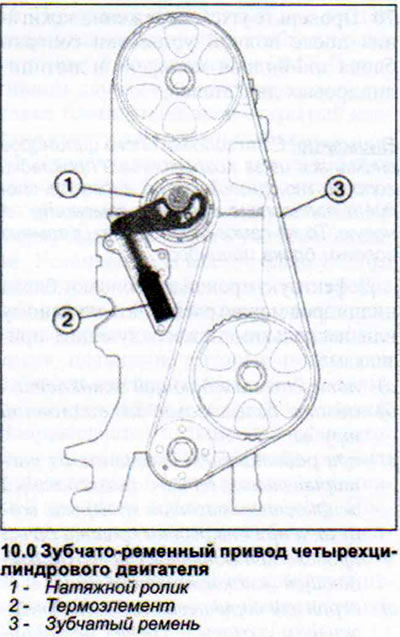
Four-cylinder engines
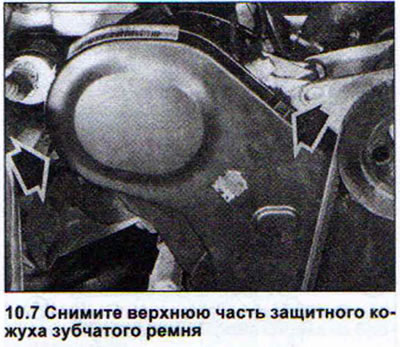
1. Release the timing belt cover by pressing the fastening latches (see arrows in the illustration).
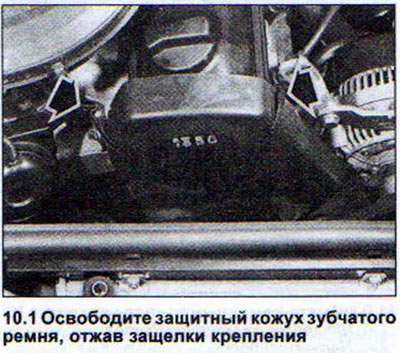
2. Remove the upper part of the timing belt guard by pulling it upward.
Caution: When installing the top part of the protective cover, make sure that its lower edge fits into the corresponding recess on the bottom of the protective cover.
Usually, to perform the necessary work on the toothed belt, it is sufficient to remove only the upper part of its protective cover. However, if it is necessary to remove the lower part as well, do the following:
3. Remove the V-belt, see the relevant chapter.
4. Unscrew the mounting bolts and remove the V-belt pulleys on the crankshaft and on the water pump.
5. Unscrew the bolts and fasteners of the lower part of the toothed belt protective cover and remove it. When installing it later, tighten the bolts of the V-belt pulleys on the crankshaft and on the water pump to a torque of 20 Nm, and the bolts and nuts of the lower part of the toothed belt protective cover to a torque of 10 Nm.
Five-cylinder engine
Release the timing belt cover by pressing the fastening latches
7. Remove the upper part of the timing belt guard (see arrows in the illustration).
8. Unscrew the bolts securing the lower part of the protective casing and remove it. When installing, tighten the bolts securing the lower part of the protective casing to a torque of 10 Nm.
Six-cylinder engine
9. Remove the V-belt and the V-belt tension roller, see the relevant chapter.
10. Press down one clamp on each part of the timing belt guard (see arrows in the illustration).
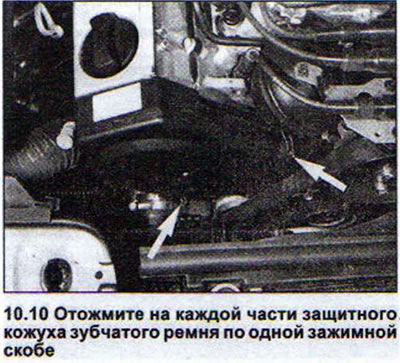
11. Remove the protective cover.
Checking the status
12. Make sure that there are no traces of oil or cracks on the timing belt. The belt teeth should be intact and without signs of wear.
13. Turn the engine over to check the condition of the belt along its entire length. A belt with defects must be replaced with a new one.
Checking the tension
The timing belt tension is checked in the following places:
For a four-cylinder engine - on the section between the camshaft gear and the intermediate shaft gear. The toothed belt of a four-cylinder engine is tensioned correctly if it can be turned 90° on the section between the camshaft gear and the intermediate shaft gear (see illustration 10.0b).
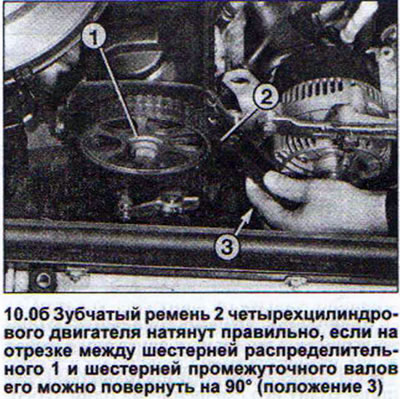
For a five-cylinder engine, it is located on the section between the camshaft gears and the water pump shaft. Illustration 10.0b shows the locations and method for checking the toothed belt tension - it, like on a four-cylinder engine, should also turn 90°.
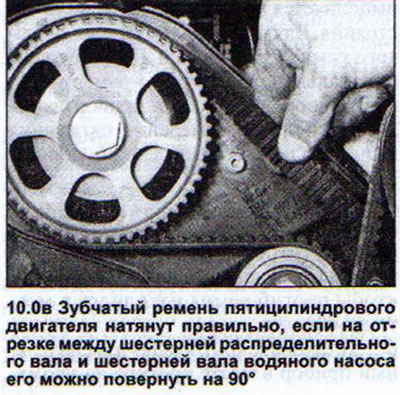
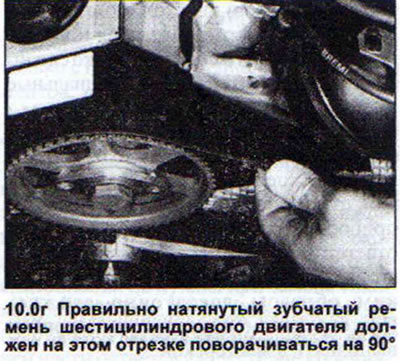
For a six-cylinder engine, this is the section between the camshaft gear and the upper guide roller. A correctly tensioned toothed belt should rotate 90° in this section (see illustration 10.0g).
Attention! A whistle after starting a cold engine, which intensifies with increasing engine speed, indicates excessive tension of the toothed belt.