



The camshaft is located in the upper part of the cylinder head. By means of eccentric cams, depending on the position of the cylinder pistons, the shaft opens and closes the valves, thus controlling the valve timing. The camshaft is driven by a toothed belt from the crankshaft.
The camshaft does not act directly on the valves, but indirectly, through the plate tappets (see illustration 7.0).
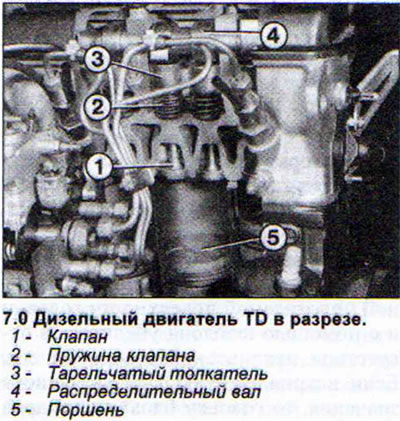
The plate tappet is an inverted cup placed on the valve stem. Plate tappets have hydraulic compensators installed, so there is no need to adjust the valve clearance.
Attention! A fairly strong knock in the engine, which appears immediately after starting, may be the result of the operation of hydraulic tappets. This phenomenon may occur after starting the engine of a car that has not been used for a long time. This occurs as a result of oil leaking from the hydraulic tappets, which in turn leads to the formation of play in the valve drive. In this case, there is no reason to worry. After some time, the noise in the engine will disappear. But if one of the plate tappets continues to knock after some time, including with a warmed-up engine, then this is a reason to check the valve.
When the valve is in the closed position, oil from the engine lubrication line enters the plate tappet through the groove. After passing through the tappet check valve, the oil fills the high-pressure chamber, in which there is no pressure at this point. Simultaneously with this process, the pressure spring tightly presses the plate tappet to the camshaft cam. When the camshaft rotates, its eccentric cam presses on the plate tappet, thus creating excess pressure in the high-pressure chamber. The check valve closes the hole through which the oil enters, ensuring that the amount of oil received is preserved. And since the oil is not compressible, a rigid barrier appears between the plate tappet and the cylinder and the valve is pressed down by the force of the cam pressure.
After the valve closes, a small valve gap is created as a result of oil leakage, which is compensated by the pressure spring, which pushes the plate tappet upwards. Oil begins to flow into the freed space in the high-pressure chamber after the check valve opens, and the cycle repeats.
The camshaft cams do not touch the plate tappets at their center, but slightly to the side. This leads to the valve shifting slightly around its axis with each press of the cam. This avoids uneven impact on the valves and their loose fit.
A gasket is installed between the cylinder block and the cylinder head, ensuring tightness and preventing mixing of the coolant and engine oil. The gasket is resistant to high temperatures and pressure drops.
Diesel engines are equipped with gaskets of different thicknesses. The thickness of the gasket depends on the piston protrusion.