



Table of contents: Checking the status ↓ Checking the tension ↓
Proper functioning of the timing belt in diesel engines is of great importance. If the belt breaks or is displaced by one tooth, it leads to significant damage to the engine, because the valves do not close in time and the pistons begin to hit the valves.
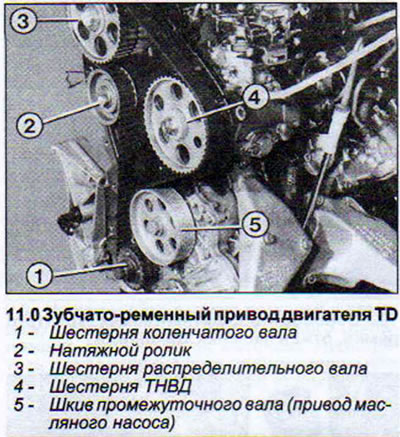
The toothed belt drives the camshaft, the high-pressure fuel pump (HPFP), the oil pump, and the brake booster pump.
The timing drive mechanism, as well as the high-pressure fuel pump in diesel engines, require very precise adjustment. After changing the belt tension or replacing it, it is necessary to adjust it, which in turn requires knowledge, experience and time. Therefore, when performing service, the main work concerning the toothed belt is limited to checking its condition and tension.
When adjusting the tension of the timing belt or when removing it (for example, for replacement or when dismantling the cylinder head) it is necessary to adjust the valve timing and the start of the injection pump. Only a specialist can do this and, in addition, special tools and devices are needed.
The tools required for adjusting the valve timing can be ordered from a specialized workshop, but it is quite difficult to manufacture a control and measuring device with an arrow indicator and a corresponding adapter for adjusting the start of the injection pump supply in this way. Therefore, it is recommended to perform these adjustments in a workshop.
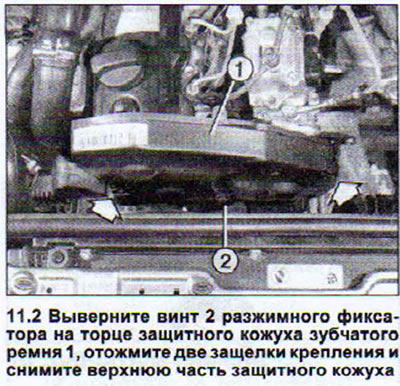
1. Loosen the screw of the expansion clamp on the end of the toothed belt protective cover.
2. Press the two fastening latches and remove the upper part of the protective cover (see arrows in the illustration). The lower part of the protective cover can only be removed after dismantling the crankshaft belt pulley by unscrewing the two mounting bolts.
Checking the status
3. Make sure that there are no traces of oil or cracks on the timing belt. The belt teeth should be intact and without signs of wear.
4. Turn the engine over to check the condition of the belt along its entire length. A belt with defects must be replaced with a new one.
Checking the tension
The timing belt tension is checked together with its condition. To check the timing belt tension on TD engines, a special VW 210 measuring device is required. This device allows you to measure the tension of a timing belt of a certain length.
TD Engine
5. Press the toothed belt with your hand on the section between the camshaft gears and the injection pump shaft so that the belt deflection is at the measurement location.
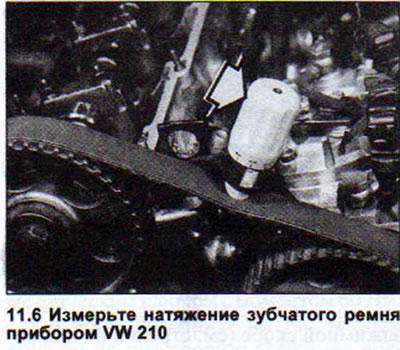
6. Install the measuring instrument at the point of deflection on the mentioned section and record the instrument reading (see illustration).
7. Turn the crankshaft once.
Caution! Rotate the crankshaft only using the crankshaft pulley or the alternator pulley. Do not rotate the crankshaft using the camshaft pulley!
8. Repeat the measurement of the toothed belt tension and record the obtained value. If the device shows a value of 12-13, then the tension is normal. Otherwise, adjust the belt tension.
TDI engine
The TDI engine has a tensioner pulley with automatic adjustment of the toothed belt tension. The tension is checked as follows:
9. Install the tension roller so that the notch (recess) and the flange on it are opposite each other. In this position of these marks, the tension of the toothed belt corresponds to the norm (see illustration).
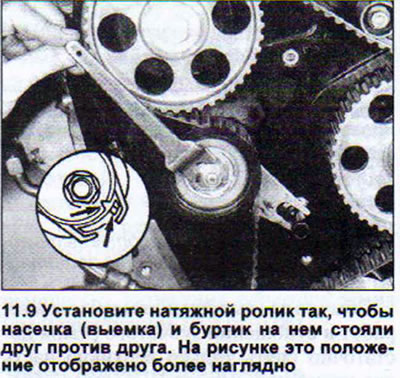
10. Check the operation of the tension roller mechanism. To do this, press the toothed belt with your hand. The notch and the flange on the tension roller should shift relative to each other.
11. Release the belt. The notch and the shoulder of the tension roller should be opposite each other again. If this is not the case, adjust the tension of the toothed belt or replace the tension roller.
The original text is available on the website: AudiManual.ru