



1. Four-cylinder engine with a displacement of 2.0 liters and an output of 66 kW (90 hp)
2. Four-cylinder engine with a displacement of 2.0 liters and an output of 85 kW (115 hp)
3. Five-cylinder engine with a displacement of 2.3 liters and a power of 98 kW (133 hp)
4. Six-cylinder engine with a displacement of 2.6 liters and a power of 11 kW (150 hp)
5. Six-cylinder engine with a displacement of 2.8 liters and a power of 128 kW (174 hp)
The four-cylinder engines are a modification of the previous models of power units installed in earlier AUDI cars. The increase in the working volume of these engines to two liters has had a positive effect on torque. Both engines differ in the method of preparation and injection of the fuel-air mixture. If the 66 kW (90 hp) engine consumes unleaded gasoline with an octane number of up to 92 according to the research method, and the injection is carried out through one injector under the throttle valve, then its 85 kW (115 hp) version has a Digifant injection system. In this case, Euro Super gasoline is injected into the combustion chamber of each cylinder by valve injectors. Selective regulation of the detonation combustion of the fuel-air mixture in the combustion chamber of each cylinder of this engine allows the use of regular gasoline with an octane number of up to 92 according to the research method without damage to the engine.
There are also some new features. This time it is a tension roller that is resistant to engine temperature changes and holds the timing belt under constant tension. The valves of both engine models are operated by hydraulic tappets that do not require maintenance.
Four-cylinder engines have an overhead camshaft. The valves are driven by plate tappets. The oil pump is driven by an intermediate shaft. The drive is carried out from the camshaft and intermediate shaft by means of a toothed belt.
The five-cylinder in-line engine with a capacity of 2.3 liters has become more advanced. It is also equipped with a toothed belt tension roller, resistant to changes in engine temperature. This engine has a KE-III-Jetronic fuel injection system and an ignition system controlled by an electronic unit, which contains nominal values determined during testing. Selective regulation of the detonation combustion of the fuel-air mixture allows for optimal consumption of gasoline with an octane number of 96 - 98 according to the research method with a compression of 10.0: 1. Refueling with gasoline with an octane number of up to 92 according to the research method is allowed.
The camshaft is driven by a toothed belt, as in four-cylinder engines. The valves are also driven by plate tappets. The water pump is also driven by a toothed belt.
Of particular interest is the design of the crankshaft of the five-cylinder engine. The crankpins of the crankshaft are located at an angle of 72° relative to each other, and the shaft itself has two counterweights for each cylinder. In addition, a special imbalance on the flywheel and a vibration damper located next to the flywheel provide damping of residual vibrations.
The V6 engine has an automatic multi-point fuel injection system and a hot-wire air mass meter. The system injects fuel into the combustion chamber of each cylinder, which ensures economical fuel consumption and reduces the content of harmful substances in the exhaust gases. Selective regulation of the combustion of the fuel-air mixture is controlled by two knock sensors, which in turn prevents engine damage in the event of using fuel with a lower octane number.
The V6 engine has two overhead camshafts driven by toothed belts. The camshaft valves are controlled by plate tappets. A fairly large intake manifold is located in the space between both rows of cylinder heads.
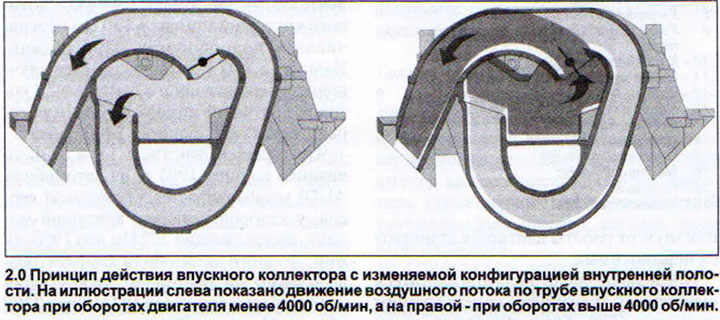
The 2.8-liter V6 engine features a variable intake manifold that provides high torque across a fairly wide range of engine speeds. For this purpose, the V6 engine's intake manifold is equipped with six flaps that are actuated by low pressure and, depending on engine speed, close or open the manifold's pipe openings, thereby changing their active length. At engine speeds of up to 4,000 rpm, the flaps remain open, creating a so-called long intake manifold, to provide high torque. At engine speeds above 4,000 rpm, the flaps close, as if shortening the intake manifold pipes, which simultaneously increases the engine's effective power (see illustration 2.0). The maximum torque of 245 Nm is achieved by the V6 engine at 3000 rpm and with Euro Super petrol. When refueling with Super Plus petrol, the maximum torque is 250 Nm.
The V6 engine ignition system does not have a mechanical ignition distributor and is controlled by an electronic unit.
The exhaust gases from the left and right cylinder banks are fed to two independent catalytic converters. Two heated lambda probes, which also function independently of each other and are connected to the left and right cylinder banks, respectively, ensure that exhaust gases are emitted with a minimum content of harmful substances.
The 2.6-litre six-cylinder engine with a modified MPFI fuel injection system has a different air mass flow meter than the 2.8-litre engine. It also lacks a variable-configuration intake manifold. However, these differences have not affected the power characteristics in any way and amount to 110 kW at 5,750 rpm, and torque is 225 Nm at 3,500 rpm.
All AUDI 80 vehicles are equipped with a five-speed manual transmission as standard. Four models with front-wheel drive and a petrol engine have a four-speed automatic transmission with two programs as a special equipment: "E" (economy mode) and "S" (sports mode).
All AUDI power units provide a mileage of over 100,000 km without any problems. Diesel engines can have a mileage of at least 130,000 km, especially if operating conditions allow for a minimum of cold engine starts and the owner does not abuse high revs. Driving style and engine maintenance also affect the service life. As for maintenance, regular replacement and use of only the engine oil prescribed by the manufacturer are of particular importance. If no mechanical damage has been observed on the diesel engine during operation (destruction of valve, piston, connecting rod), then, as the mileage approaches the above-mentioned one should take into account the emergence of difficulties when starting the engine during the cold period of operation.
An internal combustion engine operates at maximum efficiency only at a certain number of revolutions, the so-called nominal speed. Exceeding the nominal engine speed has no effect. Increased engine speed is only useful when shifting into a higher gear.
AUDI engines have a design that can withstand high engine speeds. The valves are actuated by plate tappets directly from the overhead camshaft. This means that relatively small masses are involved in the valve timing process and therefore high engine speeds are tolerated quite easily by the engine, if this occurs for a short time. The engine speed can be increased to 6,300 rpm for a while. In this state, the noise from the engine becomes unbearable.
The maximum engine speed is limited to approximately 6,700 rpm. Going beyond this value leads to such an increase in the oscillations of the valve springs that the valves cannot open and close properly. The valve spring may break and the corresponding valve may break the piston.
For this reason, all AUDI engines are equipped with a speed controller, which, when the engine reaches a certain speed range, limits their further increase by shutting off the fuel supply. Therefore, if at high speeds the engine suddenly starts to work with misfires, the reason for this is not a malfunction of the engine, but the activation of protection, namely, the speed controller of the engine.
The crankshaft of four-cylinder engines has five main bearings, while the five-cylinder engine has six. The crankshaft fastening of six-cylinder engines has its own peculiarities, due to space saving. The crankshaft of this engine has four main bearings, which means that between the two bearings there are two connecting rod journals, and not one as in four-cylinder engines.
Gasoline engines of cars with a manual transmission are started by a starter, the pinion of which engages with the teeth of the flywheel pinion. The clutch mechanism and gearbox operate in conjunction with the flywheel. In cars with an automatic transmission, a driven clutch disk with a torque converter is installed instead of a flywheel. At the front end of the crankshaft are the drive pinion of the toothed belt and the belt pulley.
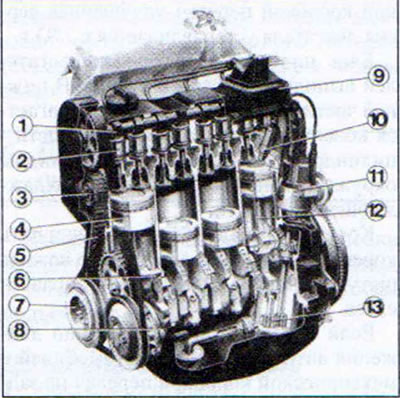
2.0a Four-cylinder petrol engine in section
1 - Camshaft
2 - Hydraulic tappets
3 - Timing belt tensioner
4 - Piston
5 - Toothed belt
6 - Intermediate shaft
7 - Crankshaft belt pulley
8 - Water pump
9 - Cylinder head cover
10 - Spark plug of the fourth cylinder
11 - Ignition distributor
12 - Connecting rod
13 - Oil pump
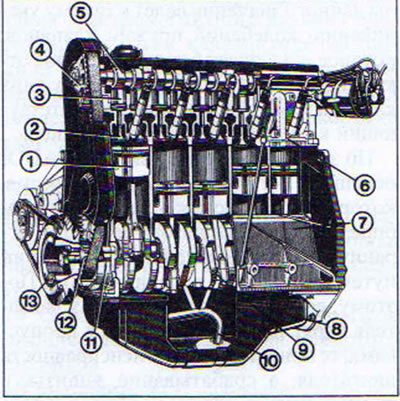
2.0b Five-cylinder petrol engine in section
1 - Piston
2 - Valve
3 - Hydraulic pusher
4 - Camshaft drive gear
5 - Camshaft
6 - Cylinder head
7 - Cylinder block
8 - Oil pan
9 - Crankshaft
10 - Oil pump intake pipe
11 - Oil pump
12 - Crankshaft timing gear
13 - Crankshaft V-belt pulley with vibration damper

2.0v Six-cylinder V-shaped petrol engine in section
1 - Intake manifold pipe
2 - Ignition coils
3 - Toothed belt
4 - V-belt
5 - Crankshaft belt pulley with vibration damper
6 - Oil pump
7 - Oil pump intake pipe
8 - Crankshaft
9 - Connecting rod
10 - Piston
11 - Hydraulic pusher
12 - Valve
13 - Camshaft
(This publication is borrowed from the resource AudiManual)