



Table of contents: ASN six-cylinder V-shaped engine… ↓ ALT engine with a working volume of… ↓ 2.0L FSI engine with direct petrol… ↓ 1.8L AVJ turbocharged engine ↓ ALZ engine with a working volume of… ↓ Engine Identification ↓ Engine parts ↓
Powerful yet economical engines ensure the impressive driving characteristics of the Audi A4 in all its variants: saloon, Avant and quattro all-wheel drive. This also applies to the convertible (since 2002). The engines meet the strict European exhaust gas standard EU 4 with reserve. In the six-cylinder engine, for example, this is achieved by two additional ceramic catalytic converters with a high cell density and three layers of precious metal located near the engine, as well as two main catalytic converters, which are located in the lower part of the body.
In developing the power units for the new generation of "fours", the manufacturer worked hard to improve the internal combustion engines. Their inventor Otto would certainly have liked this. For the first time in this series, two completely new petrol engines with an aluminum crankcase are used: a four-cylinder in-line engine with an output of 96 kW (130 hp) with a displacement of 2.0 liters and a six-cylinder V-shaped engine with an output of 162 kW (220 hp) with a displacement of 3.0 liters. The range of petrol engines is supplemented by the proven Turbo engine with an output of 110 kW (150 hp) with a displacement of 1.8 liters and a redesigned engine with an output of 75 kW (102 hp) with a displacement of 1.6 liters.
The large-capacity Avant version was equipped with 2.4-liter (165 hp) and 2.8-liter (193 hp) engines before the new model was launched in July 2001. Now, the new A4 Avant is equipped with the same petrol engines as the sedans, which received them in October 2000, i.e. the Avant comes with a new 1.6-liter engine.
With the exception of this basic engine with a displacement of 1.6 liters, Audi relies on five-valve technology to speed up gas exchange in gasoline engines. Two intake and three exhaust valves are designed to ensure better gas consumption. It is clear that more gas mixture passes through three valves in the same time than through two or one valve. The filling of the cylinder in one intake stroke is significantly improved.
ASN six-cylinder V-shaped engine with a displacement of 3.0 liters
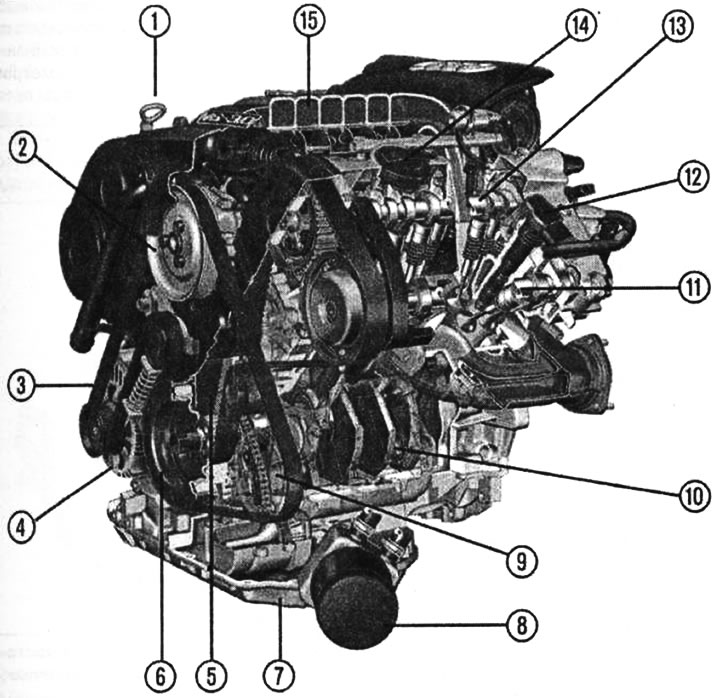
Details of the 3.0L, 5-valve, V-6 engine: 1 - dipstick oil level, 2 - pulley for driving the steering pump, 3 - poly V-belt, 4 - generator, 5 - toothed belt, 6 - vibration damper, 7 - oil pan, B - oil filter, 9 - pulley for the air conditioning compressor, 10 - crankshaft, 11 - exhaust camshaft, 12 - single-spark ignition coil, 13 - intake camshaft, 14 - oil filler neck, 15 - intake manifold with variable geometry.
Aside from the basic concept, i.e. the cylinder banks being positioned at 90° relative to each other and the identical bore diameter, the new top-of-the-range engine shares very few components with the previous 2.8-liter engine. The V6, five-valve engine accelerates the front-wheel drive A4 sedan with a five-speed manual transmission from 0 to 100 km/h in 6.9 seconds. The top speed is 245 km/h, and the average fuel consumption for this version is just 9.5 liters.
The most important innovation in this engine is the aluminum cylinder block (thanks to this, the engine weighs only 163 kg), lighter pistons, balance shaft, continuously variable intake camshaft, variable exhaust camshaft, new two-stage variable valve timing and Bosch-Motronic ME 7.1.1 engine management with electronic accelerator pedal.
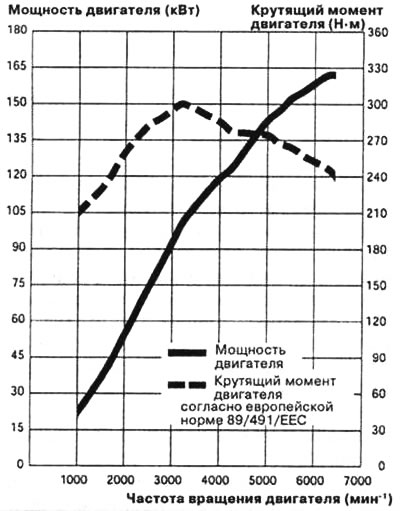
Power and torque dependence on the rotation speed of a six-cylinder V-shaped five-valve engine with a working volume of 3.0 liters
The intake camshaft can be continuously adjusted up to 42' towards early ignition. On the exhaust side, the camshaft can be adjusted by 22' towards late ignition if necessary. Already at 1900 rpm, the system sets the maximum overlap, which allows the maximum possible torque to be achieved. The maximum torque of 300 Nm in this case is already created at 3200 rpm. In the range from 2200 to 5200 rpm, 90% of the maximum torque is provided.
In addition to the clever camshaft adjustment, the ASN engine has a newly designed two-stage intake manifold with variable geometry. From 4,200 rpm, the resonance intake manifold switches to a short tract. The maximum output of 162 kW (220 hp) is achieved at 6,300 rpm.
ALT engine with a working volume of 2.0 l
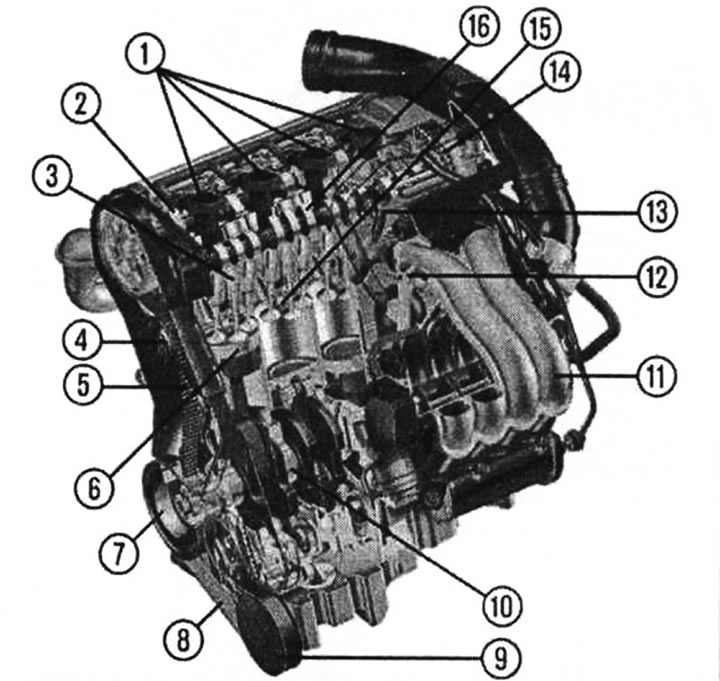
2.0L (5V) engine parts: 1 - single spark ignition coil, 2 - intake camshaft, 3 - hydraulic tappet, 4 - timing belt tension roller, 5 - timing belt, 6 - piston, 7 - vibration damper (crankshaft pulley), 8 - poly V-belt, 9 - power steering pump pulley, 10 - crankshaft, 11 - variable geometry intake manifold, 12 - oil level indicator rod, 13 - injector, 14 - intake camshaft drive chain, 15 - exhaust camshaft, 16 - spark plug
As the second newcomer to the range of petrol engines, Audi has introduced an in-line engine with a displacement of 1984 cm³. This five-valve engine with an aluminium cylinder block and balance shafts for improved running accelerates the A4 saloon to 100 km/h in less than 10 seconds. The maximum speed is 212 km/h. Considering that the fuel consumption is only 7.9 litres, it can be said that this engine will compete with other power units. Testers praise this engine for its very good revving and the revving up is not accompanied by unpleasant vibrations.
The most important technical innovations indicated by the manufacturer include continuous adjustment of the intake camshaft to achieve optimal engine filling, a software-controlled cooling system to increase efficiency, a new two-stage intake manifold with variable tract geometry to provide greater torque and high power, as well as balance shafts to improve engine operation.
2.0L FSI engine with direct petrol injection
The four-cylinder 2.0-litre engine was chosen by Audi to move on to the new generation of direct petrol injection (FSI) engines. The cylinder block and dimensions of the FSI engine correspond to those of a conventional engine with the same displacement. The only new thing is that it has a common rail fuel injection system and a single-plunger injection pump. Unlike Audi engines with manifold injection, the cylinder head has four valves instead of five. This frees up space for the injector, which doses the fuel with millisecond precision at an injection pressure of 110 bar. The four-valve cylinder head has a valve timing mechanism with rocker arm valve drive and roller tappets. The variable geometry intake manifold in the FSI engine is also two-stage, meaning the intake tract can have different lengths for high and low revs. Continuous adjustment of the intake camshaft in this engine also ensures appropriate control of the valve opening time.
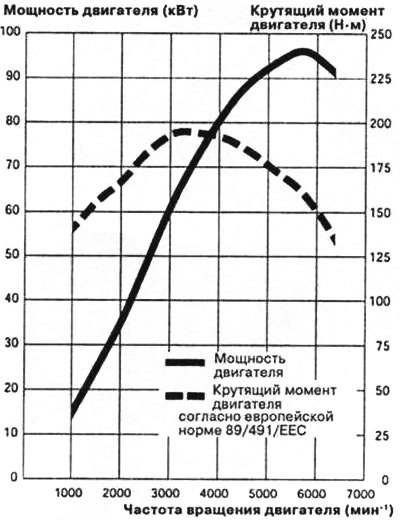
Power and torque versus speed of a 2.0-liter, five-valve FSI engine
The MSI engine also uses two catalytic converters to clean the exhaust gases. Behind the exhaust manifold, near the engine, there is a three-way step catalytic converter, and in the lower part of the body there is a storage catalytic converter, in which nitrogen oxides are stored and converted. The storage catalytic converter is designed to meet the special requirements of the direct injection engine. This converter binds nitrogen oxides in a barium layer.
1.8L AVJ turbocharged engine
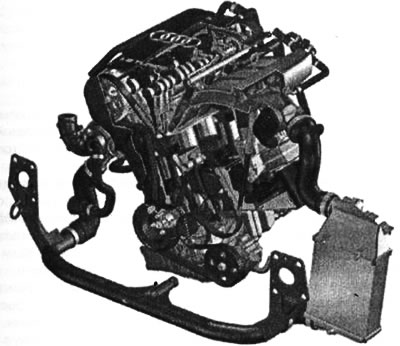
Proven turbocharged engine with a displacement of 1.8 liters
The 1.8-litre turbocharged four-cylinder engine, which is the classic engine of the previous generation, was also taken into account in the development of the new A4 models. The engine has been tested a thousand times over. This unit is valued for its high torque (210 Nm), which is already generated at low engine speeds (1,750 rpm) thanks to the turbocharger. This torque does not change up to 4,600 rpm. The maximum torque is thus available across the entire engine speed range, which is mainly used when driving. This kind of power development is usually only found in engines with a large engine displacement.
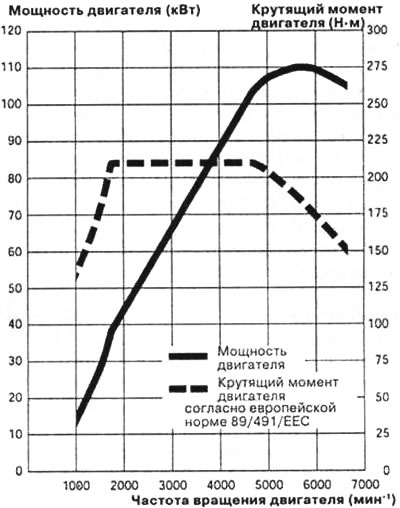
The 1.8-liter turbocharged engine delivers high torque even at low revs
The front-wheel drive A4 1.8T with manual gear shifting consumes only 8.2 liters of "Super" gasoline per 100 km (unleaded gasoline with an octane rating of 95). Acceleration from 0 to 100 km/h with this engine is achieved in just 8.9 seconds. The maximum speed is 222 km/h.
ALZ engine with a working volume of 1.6 l
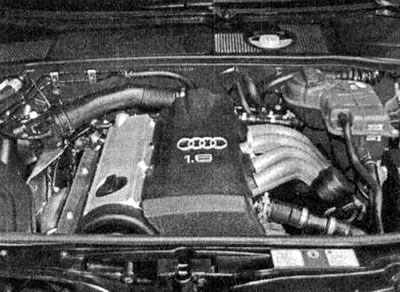
Eco-friendly engine with high torque: 1.6 l basic engine (general view of the engine compartment)
A great deal of brainpower went into the development of the basic engine with a displacement of 1.6 litres. Thanks to a new valve train with roller rockers and low friction losses, as well as fine grinding of many components, the two-valve engine is now more powerful and also less polluting. The four-cylinder in-line engine has an overhead camshaft, maximum power is 102 hp, and the top speed is 190 km/h. Like the eight other engines, which are controlled by Bosch Motronic ME, the ME 7 is now used for electronic engine management. Earlier ALZ models are equipped with the proven Simos 3.4 from Siemens.
| Model | Working volume (cm³) | Power (kW/hp) |
| 4-cyl. 2-valve engine ALZ 1.6 l | 1595 | 75/102 |
| 4-cyl. 5-valve AVJ 1.8 l turbo engine | 1781 | 110/150 |
| ALT 2.0 l | 1984 | 96/130 |
| 6-cyl. V-shaped 5-cl. ASN 3.0 l engine | 2976 | 162/220 |
Engine Identification
You can find out what engine your car is equipped with from the table with the characteristics of the vehicle, which is in the service book, and, naturally, from the official documents for the car. The most reliable way to identify the engine is to find the engine letter designation on the cylinder block or at the place where the engine and gearbox are separated (i.e. ASN, ALT, AVJ or ALZ). Somewhere in these places you will definitely find embossed letters. For complete identification, the serial number of the unit is also necessary. The following sketches show where to look.
Engine number (engine letter designation and serial number) in a four-cylinder, two-valve engine, it is located on the left front at the junction of the engine and gearbox.
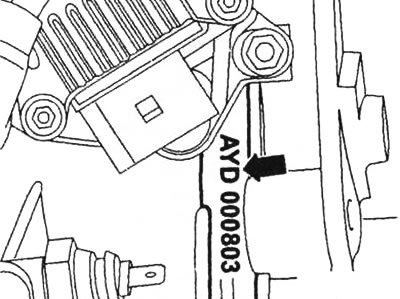
Engine number for a four-cylinder, five-valve engine (working volume 1.8 with turbocharging or 2.0 l) is located on the left rear side of the cylinder block.
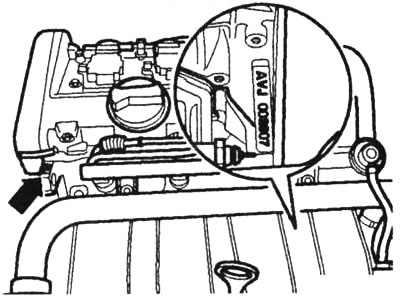
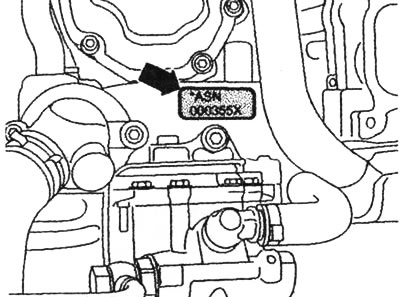
The engine number on the six-cylinder, five-valve engine (3.0 L) is stamped on the front top (between the cylinder head and the hydraulic pump). In addition, the letter designation is located on the left rear part of the cylinder head. The ASN designation can be seen only after some manipulation. To do this, you must at least remove the front engine cover. On the housing of the vacuum membranes for regulating the intake manifold, there is a sticker with letters and a number. If it is not there, remove the rear engine cover so that you can see the letter designation on the cylinder head. If you need to know the full engine number, after unscrewing two screws and removing the pressure spring, remove the vacuum membranes and put them aside with the pipes attached. After that, you can see the corresponding designation on the cylinder block.
Engine parts
Cylinder block. The cylinder block contains the moving parts. In addition, the cylinder block serves as a support for such units as the generator, starter and ignition system.
Cylinder head. The cylinder head covers the cylinders from above. It contains the intake and exhaust ports, water passages, valve seats, bearings and guides for the valve timing components, as well as threads for the spark plugs and the combustion chamber. The gasket between the metal surfaces of the cylinder head and the cylinder block prevents air and coolant from entering the cylinders.
Cylinders. The cylinders together with the cylinder head form the combustion chamber (working cavity). They are polished smooth (honed) and are precisely matched to the piston diameter. Cooling is provided by water that flows through channels in the cylinder wall.
Pistons. The pistons absorb combustion pressure and transmit it through the connecting rods to the crankshaft. The main parts of the piston include the piston crown, the piston ring belt, and the piston pin boss. The two upper piston rings (sealing rings) prevent gas from escaping from the combustion chamber into the cylinder block. Bottom ring (oil scraper ring) drains excess lubricating oil from the cylinder wall back into the oil pan.
Connecting rods. The connecting rod connects the piston to the crankshaft. Connecting rod components: connecting rod head (covers the piston pin), connecting rod, connecting rod small end and connecting rod cap (covers the crank pin).
Crankshaft. Converts the up and down motion of the pistons into rotational motion. Crankshaft Parts: Main Journals (for support on the cylinder block), connecting rod journals, crankshaft cheeks (connect the crank journals to the main journals).
Valves. Fresh gas is admitted into the cylinders through the intake valves, and exhaust gases are released into the exhaust pipe through the exhaust valves. The set of all the parts that participate in the opening and closing of the valves is called the valve mechanism.
Camshaft. The camshaft opens and closes the valves at the appropriate time. Each valve is driven by a cam via a plate tappet or roller rocker. The camshaft is driven by a toothed belt from the crankshaft.
The article is a reprint of material from AudiManual.ru