



Inlet (1st stroke). The piston goes down to the bottom dead center. The intake valve opens and the fuel-air mixture rushes into the cylinder.
Compression (2nd stroke). The piston moves from bottom dead center to top dead center. The intake valve closes. The piston compresses the mixture.
Combustion (3rd stroke). Shortly before reaching the top dead center, the spark plug fires. The mixture burns and presses on the piston, which moves to the bottom dead center. The crankshaft is set in motion by means of the connecting rod.
Release (4th stroke). The piston moves upward again. The exhaust valve opens, the burnt gases are pushed into the exhaust system.
Working volume of the cylinder. The volume that the pistons travel through as they move from the bottom dead center to the top. When the piston reaches the top, there is still a combustion chamber containing the fuel-air mixture. The working volume and combustion chamber together form the volume of the cylinder.
Compression ratio. The ratio between the cylinder volume and the combustion chamber volume. This value indicates to what part of the cylinder volume the fuel-air mixture is compressed. In gasoline engines, the compression ratio is usually about 10:1 (in diesel engines about 20:1).
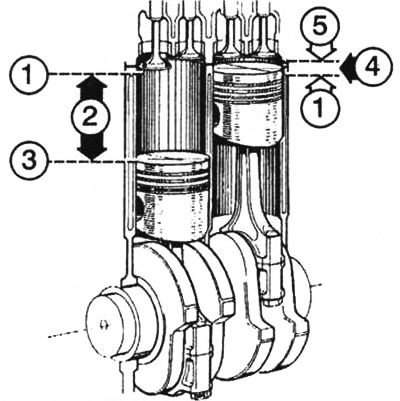
The working volume of cylinder 2 extends from the top 1 to the bottom dead center 3. Between the top dead center, where the piston bottom is located in the right cylinder in this figure, and the arch of the cylinder head 5, the combustion chamber 4 is located.
Over rated speed and engine life
Exceeding the nominal rotation speed reduces the service life of the engine. If the engine rotates too fast, a characteristic sound is produced, the cause of which is the vibration of the crankshaft or the vibration of the valve train parts. If the vibrations become too strong, then as a result, one of the tappets may break. The corresponding valve falls out of operation, and the cylinder stops giving off power. This manifests itself in the form of a decrease in engine power. In the worst case, the valve springs may break, as a result of which the valve falls on the piston, which moves up and down. As a rule, this means serious damage to the engine.