
Repair Chevrolet Repair Toyota Repair Honda Repair AvtoVAZ Repair Mercedes-Benz Repair BMW Repair Opel
Home  |  Contacts  |  Sitemap  |    
English Русский
Български
Беларускі
Український
Српски
Hrvatski
Română
Polski
Slovenský
Magyar
AudiManual.ru


  • AUDI 80
  • AUDI 100
  • AUDI A3
  • AUDI A4
  • AUDI A6
  • AUDI A8
  • AUDI Q
  • OTHER
  • ARTICLES
B8 (2007-2015) B7 (2004-2008) B6 (2000-2006) B6 (2000-2006, petrol) B5 (1994-2001) B5 (1994-2001, petrol)

Poly V-belt — inspection and replacement (Audi A4 B6)

  • Home
  • Audi A4
  • B6 (2000-2006, petrol)
  • Power unit
  • Engine repair
  • Poly V-belt — inspection and replacement
            0
Table of contents: Checking the belt surface ↓ Checking the belt tension ↓ Replacing and tensioning the poly… ↓
The poly V-belt, with longitudinal ribs, is wider than the old V-belts. This belt drives all the important units: the generator, the oil pump for the power steering, the coolant pump and the air conditioning compressor. A belt break would mean the most dangerous accident for the engine, so the belt is made very strong. It is not prescribed to check the belt, but it is a good idea to look at it sometimes, since the belt with a V-shaped cross-section is subject to quite high loads. The belt runs over pulleys, i.e. over wheels with a deep groove located around the circumference. The side walls of the groove touch the sides of the belt. Due to this, the force is transmitted, for this the belt must be taut. The belt tension should not be too strong, otherwise the bearings of the driven units will be destroyed. However, the tension should not be too weak, otherwise the belt will slip with a terrible squeal. Over time, the sides of the poly V-belt wear out, the belt sinks deeper into the groove, and the belt tension decreases. The change in tension is corrected by an automatic tensioner, but it is still worth checking the belt.
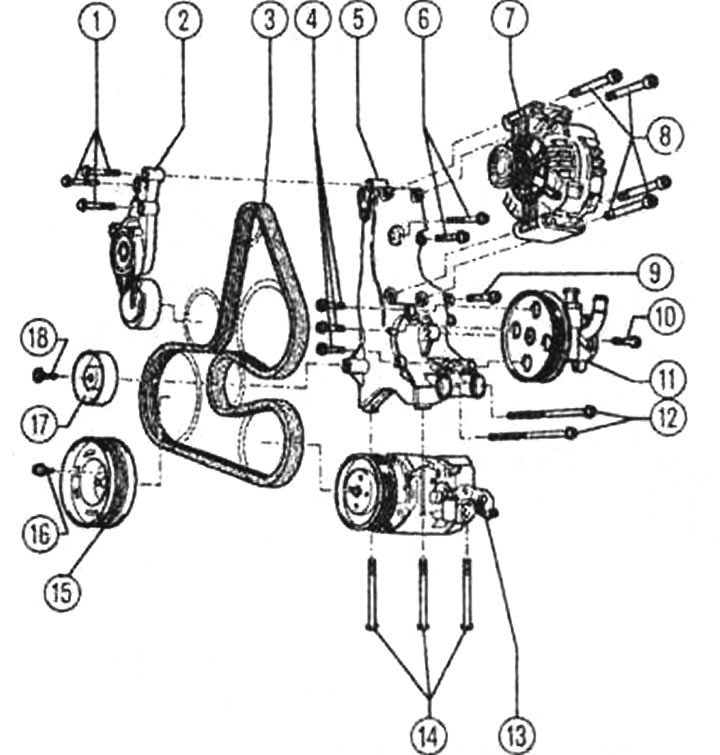
Poly V-belt for 4-cylinder engines: 1, 4, 6, 8, 9, 10. 12 and 14 - screws (20, 25 and 40 Nm), 2 -…

Poly V-belt for 4-cylinder engines: 1, 4, 6, 8, 9, 10. 12 and 14 - screws (20, 25 and 40 Nm), 2 - tension roller, 3 - poly V-belt, 5 - holder, 7 - generator, 11 - vane pump (for power steering), 13 - Air Conditioning Compressor, 15 - Vibration Damper/Pulley, 16 - Flange Screws, 17 - Guide Roller (mounted on a holder for the generator, vane pump and air conditioning compressor), 18 - special screw for guide roller (25 Nm).
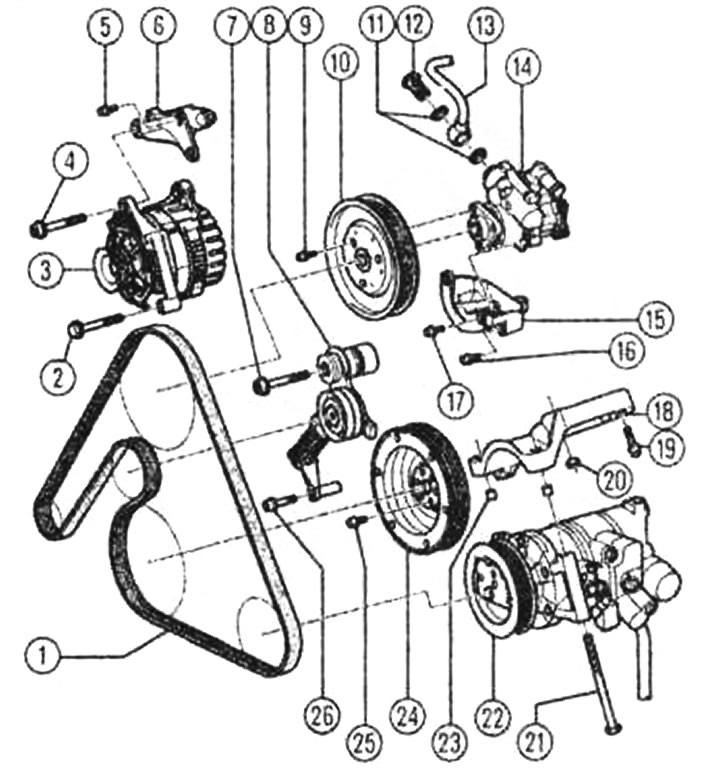


Poly V-belt for 6-cylinder engine: 1 - poly V-belt, 2, 4, 5, 7, 9, 16, 17, 19, 20, 21, 25, 26 -…

Poly V-belt for 6-cylinder engine: 1 - poly V-belt, 2, 4, 5, 7, 9, 16, 17, 19, 20, 21, 25, 26 - screws(23, 25, 40 and 45 Nm), 3 - generator, 6 - generator holder, 8 - tensioner for poly V-belt, 10 - pulley for drive pump, 11 - sealing ring, 12 - hollow screw (40 Nm), 13 - power steering pressure pipe, 14 - power steering vane pump, 15 - vane pump holder, 18 - air conditioning compressor holder, 22 - air conditioning compressor, 23 - two bushings for air conditioning compressor, 24 - vibration damper.


Checking the belt surface


1. Turn the engine over several times, this is the only way you can see all the surfaces of the V-belt. Often there is one, but deep crack on the belt, when checking this crack can get right on the pulley.

2. If, when checking the V-belt, uneven traces of wear are found on the side surfaces of the belt, a porous or frayed surface, or even cracks in the belt, the V-belt must be replaced with a new belt or a belt in good condition.

Checking the belt tension


1. Press firmly with your thumb (with a force of approximately 5 kg) on a stretched belt in the middle between two pulleys. The belt should deflect no more than 1.5 cm.


2. Press the belt with more force. The belt should bend with resistance, and the tension roller should move to the side. When you release the belt, the roller returns to its previous position and tightens the belt. If the belt lies loosely on the wheels, this indicates a defective tension roller. The second possible reason: You may have forgotten to remove the locking pin from the tensioner.

Replacing and tensioning the poly V-belt


4-cylinder engines


1. Dismantling: Using a felt-tip pen or wax pencil, draw an arrow on the belt in the direction of belt rotation. When viewed from the belt side, the engine rotates to the right, i.e. clockwise. Marking the direction of rotation is important if the same belt is to be installed later. Installing in the opposite direction increases belt wear and may cause the belt to break.
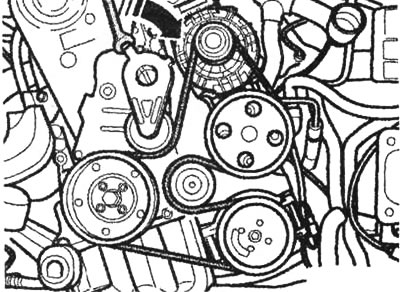
Turning the tensioner

Turning the tensioner


2. To loosen the poly V-belt, turn the tensioner (shown by arrow).

3. Using a marking mandrel (for example, T10060) lock the tensioner in the place indicated by the arrow.
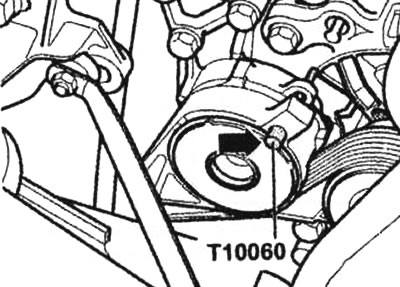
Locking the tensioner

Locking the tensioner


4. Remove the poly V-belt.

5. The belt is installed in the reverse order. Pay attention to the reliability of the installation of all units (generator, vane pump, air conditioning compressor). Pay attention to the direction of the belt movement, as well as the correct placement of the belt on the pulleys. The belt is first placed on the air conditioning compressor.

6. Start the engine and check the belt operation.
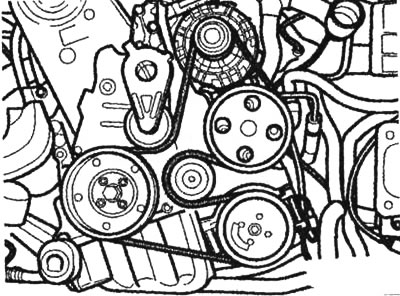
Belt routing in 4-cylinder ALZ, ALT and AVJ engines

Belt routing in 4-cylinder ALZ, ALT and AVJ engines


6-cylinder engines


1. Dismantling: Remove the top engine cover. Using a felt-tip pen or wax pencil, draw an arrow on the belt in the direction of belt rotation. When viewed from the belt side, the engine rotates to the right, i.e. clockwise. Marking the direction of rotation is important if the same belt is to be installed later. Installing in the opposite direction increases belt wear and may cause the belt to break.
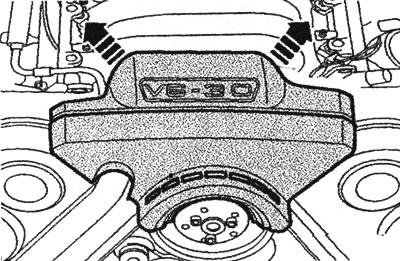
Removing the engine cover

Removing the engine cover


2. To loosen the belt, use the lever (it is recommended to use lever 3299 with attachment 3299/1) turn the tensioner for the poly V-belt in the direction of the arrow.
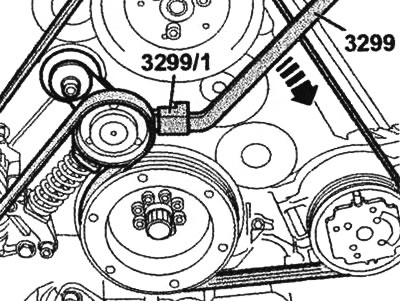
Turning the tensioner

Turning the tensioner


3. Remove the belt from the power steering pump pulley.

4. Install the belt in the reverse order. First, place the poly V-belt on the crankshaft pulley. The belt routing ends on the tension roller. Make sure the belt is seated correctly on the pulleys. Start the engine and check the belt movement.
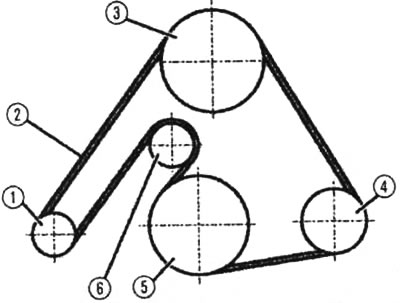
Belt routing in 6-cylinder ASN engines: 1 - generator, 2 - poly V-belt, 3 - power steering pump, 4…

Belt routing in 6-cylinder ASN engines: 1 - generator, 2 - poly V-belt, 3 - power steering pump, 4 - air conditioning compressor, 5 - crankshaft (vibration damper), 6 - tension roller


If the vibration damper was removed, then during installation you should pay attention to the following:


4-cylinder engines


The lock mounting bracket is in the service position, the poly V-belt is removed. The vibration damper (pulley) must be installed using original screws only. Installation is possible in only one position. The hole (arrow) of the vibration damper must be above the protrusion on the toothed belt wheel.
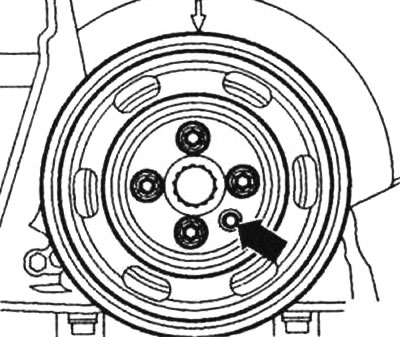
Vibration damper (pulley) for ALZ, AVJ and ALT engines

Vibration damper (pulley) for ALZ, AVJ and ALT engines


6-cylinder engine


The lock mounting bracket is in the service position, the poly V-belt is removed. (To remove the vibration damper, it is not necessary to loosen the central screw). Installation using original screws only. The notches (arrows) in the vibration damper must match the locking protrusions on the toothed belt wheel.
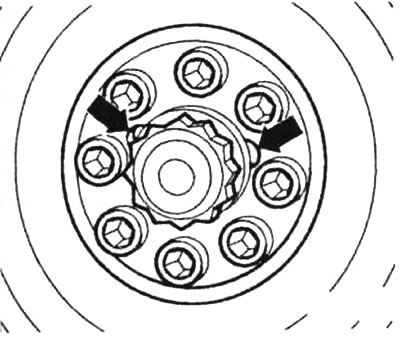
Vibration damper for ASN engines

Vibration damper for ASN engines


[Text provided by the online resource: AudiManual.ru]
The article was checked by auto expert Alexey Ivanov
This article is available at russian, bulgarian, belarusian, ukrainian, serbian, croatian, romanian, polish, slovak, hungarian

Share information:
Previous articles
Audi A4 B6: Engine repair
Next articles

Adjusting the camshaft
Checking hydraulic tappets
Removal and installation the cylinder head cover
Hydraulic tappets — general information
Toothed belt — design description
Valve noise
Cylinder head gasket


Similar articles on other Audi car models:
Timing Belt (Gasoline Engines) — Replacement Audi 80 B4 (1991-1996)
Toothed drive belt — removal, inspection and installation Audi 100 C3 (1982-1990, diesel)
Visual inspection of the seat belt and airbag unit Audi A3 Type 8L (1996-2003)
Checking the condition of the poly V-belt Audi A6 C5 (1997-2004)
Checking the condition of the poly V-belt Audi A8 D2 (1994-2002)
Removal the poly V-belt Audi Q5 Type 8R (2008-2017)
Poly V-belt — checking condition (petrol engines) Audi A2 (1999-2005)
Link to this page in different formats


Visitor comments

No comments yet


How much will 23 + 41 =


A4(B8, 2007-2015) 
  • General information
  • Operating instructions
  • Power unit
  • Petrol engines 1.8 l
  • Petrol engines 1.8/2.0 l
  • Petrol engines 3.0 l
  • Petrol engines 3.2 l
  • Fuel system (petrol)
  • Diesel engines 2.0 l (CA*)
  • Diesel engines 2.0 l (CJCB)
  • Diesel engines 2.7/3.0 l
  • Diesel engines 3.0 l
  • Fuel system (diesel)
  • Transmission
  • Manual gearbox 0B1
  • Manual gearbox 0B2
  • Manual gearbox 0B3
  • Manual gearbox 0B4
  • Automatic transmission 0B5
  • Automatic transmission 0B6
  • Automatic transmission 0AW
  • All-wheel drive system
  • Chassis
  • Front suspension
  • Rear suspension
  • Brake system
  • Steering system
  • Body
  • Exterior
  • Interior
  • Seats
  • Doors, locks and windows
  • Security system
  • Heating and air conditioning
  • Electrical equipment
  • Audio system
  • Power devices
  • Equipment and devices
  • Lighting and lamps
  • Electrical circuits
 
A4(B7, 2004-2008) 
  • General information
  • Introduction to manual
  • Troubleshooting
  • Operating instructions
  • Maintenance
  • Power unit
  • Petrol engines 2.0 (ALT)
  • Petrol engines 2.0 (TFSI)
  • Petrol engines 1.8 (MPI)
  • Diesel engines
  • Cooling system
  • Air conditioner
  • Fuel and exhaust system
  • Ignition system
  • Starting and charging
  • Transmission
  • Clutch
  • Manual gearbox
  • Automatic gearbox
  • Drive shafts
  • Chassis
  • Brake system
  • Front suspension
  • Rear suspension
  • Steering
  • Body
  • Exterior
  • Interior
  • Electrical equipment
  • Equipment and devices
  • Lighting and signaling
  • Windscreen wipers and washers
  • Electrical diagrams
  • Electrical diagrams (since 2007)
 
A4(B6, 2000-2006) 
  • General information
  • Vehicle Description
  • User manual
  • Maintenance
  • Power unit
  • Gasoline engine
  • Diesel engine
  • Lubrication system
  • Cooling system
  • Supply system
  • Injection system
  • Exhaust system
  • Ignition and control
  • Transmission
  • Gear box
  • Clutch and drive shafts
  • Chassis
  • Brake system
  • Car suspension
  • Steering
  • Body
  • Heating and ventilation
  • Exterior (external elements)
  • Interior (internal elements)
  • Electrical equipment
  • Power devices
  • Lighting and appliances
  • Electrical circuits
 
A4(B6, 2000-2006, petrol) 
  • General information
  • Introduction to the guide
  • Car care
  • Power unit
  • Engine repair
  • Lubrication system
  • Cooling system
  • Injection and control system
  • Ignition system
  • Power and exhaust system
  • Transmission
  • Clutch and drive shafts
  • Car gearbox
  • Chassis
  • Suspension and wheels
  • Steering
  • Brake system
  • Body
  • Interior
  • Exterior
  • Electrical equipment
  • Equipment and devices
  • Lighting and signaling
  • Power devices
  • Electrical circuits
 
A4(B5, 1994-2001) 
  • General information
  • Introduction to the guide
  • Car care
  • Maintenance (gasoline)
  • Maintenance (diesel)
  • Power unit
  • Gasoline engines
  • Diesel engines
  • Engine overhaul
  • Cooling system
  • Fuel injection (gasoline)
  • Fuel system (diesel)
  • Exhaust system
  • Ignition system
  • Transmission
  • Clutch
  • Mechanical gearbox
  • Automatic gearbox
  • Drive shafts
  • Chassis
  • Brake system
  • Car suspension
  • Steering
  • Body
  • Exterior
  • Interior
  • Doors, locks and windows
  • Heating and ventilation
  • Electrical equipment
  • Power devices
  • Equipment and devices
  • Electrical circuits
 
A4(B5, 1994-2001, petrol) 
  • General information
  • Vehicle description
  • Maintenance
  • Power unit
  • Engine repair
  • Turbocharging
  • Exhaust system
  • Cooling system
  • Ignition system
  • Fuel system
  • Motronic injection system
  • MPI and MPFI injection system
  • Transmission
  • Clutch
  • Gearbox and shafts
  • Chassis
  • Steering
  • Car suspension
  • Brake system
  • Wheels and tires
  • Body
  • Heating and ventilation
  • Body parts
  • Electrical equipment
  • Fuses and relays
  • Power devices
  • Lighting and lamps
  • Tools and devices
  • Electrical circuits
 
AudiManual.ru © 2017-2026 · Mobile version · Feedback · Sitemap: EN BG BY UA RS HR RO PL SK HU · Site search · News and articles
80 B2 · 80 B3 petrol · 80 B3 · 80 B4 · 100 C3 diesel · 100 C3 petrol · 100 C3 · 100 C4 petrol · 100 C4 · A3 Type 8L · A4 B5 petrol · A4 B5 · A4 B6 petrol · A4 B6 · A4 B7 · A4 B8 · A6 C4 · A6 C5 · A6 C5 Allroad · A8 D2 · Q5 Type 8R · Q7 Typ 4L · Audi A2 ·
This site uses cookies 🍪. Click the button to accept this fact.