



The engine can be turned in different ways. The first method requires that the front side of the car be mounted on jack stands. Then engage fifth gear, apply the handbrake and turn the raised front wheel. This method, together with an assistant, allows the crankshaft to be rotated slowly and evenly.
If the car is on a level surface, the engine can be turned over after engaging fifth gear by pushing forward or backward (second way).
And finally, with the third method, the gearbox must be shifted to neutral, the handbrake must be applied and the crankshaft must be rotated clockwise using the central pulley screw (vibration damper). The engine must not be turned using the camshaft timing gear screw, as this will subject the timing belt to excessive loads.
Top dead center of the engine
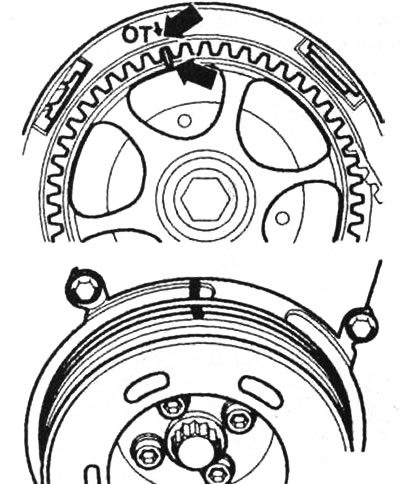
The piston of cylinder No.1 is in the position that corresponds to the ignition timing if the TDC mark on the camshaft gear coincides with the reference mark on the toothed belt protective cover (bearing cap in case of AVJ engine). In the case of an automatic transmission, the picture is somewhat different.
The TDC mark for cylinder #1 on the camshaft gear is visible from the front (see the attached drawing). In this case, the narrow flange of the gear wheel faces outward (arrows).
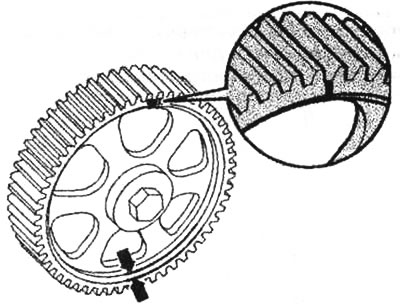
The TDC marks for cylinder No.1 on the camshaft gear and crankshaft are opposite each other (arrows).
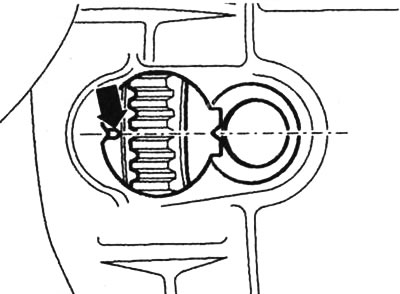
For a stepped gearbox: the TDC mark on the flywheel and driven disk must be opposite the mark near the round inspection hole.
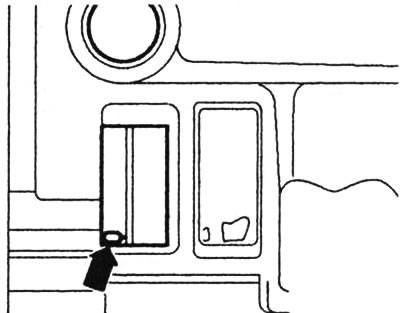
For an automatic transmission: the TDC mark on the flywheel and driven disk is located at the edge of the rectangular inspection hole in the gearbox housing.
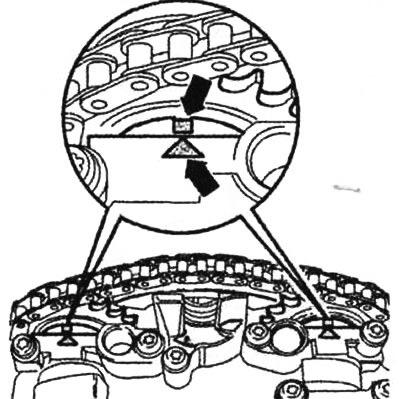
The camshafts of the AVJ turbocharged engine are in the TDC position when both marks on the shafts are opposite the arrows on the bearing caps.
(This article was copied from the website: audimanual.ru)