The following systems are used to control fuel injection into the cylinders of a diesel engine.
For swirl or pre-chamber injection, fuel is injected into the pre-chamber of the corresponding cylinder, and the hot mixture ignites immediately. However, the amount of oxygen in the pre-chamber is only sufficient to burn part of the injected fuel. The rest, unburned part, is blown into the combustion chamber by the flow that occurs during combustion and burns completely there.
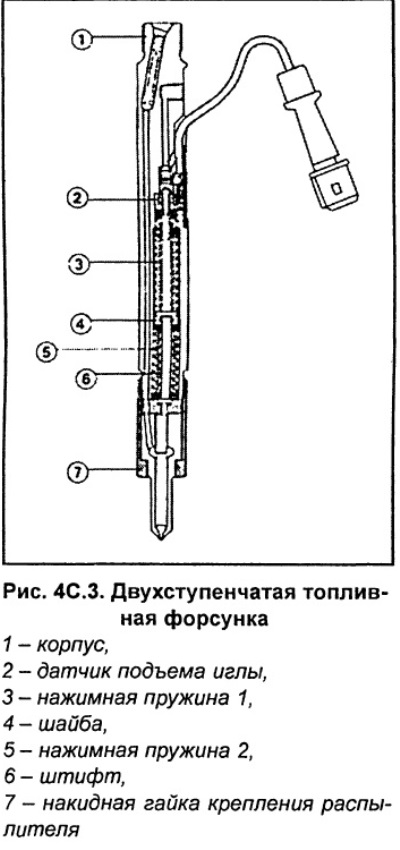
With direct fuel injection, the fuel supplied by the high-pressure fuel pump is directly injected into the combustion chamber, namely, into the recess in the piston. In this case, the fuel pump compresses the fuel to a pressure of 900 bar, and the fuel is injected in two stages. First, a small amount of fuel is injected, which improves the ignition conditions of the main part of the fuel. As a result, softer combustion, similar to combustion during injection into the pre-chamber. In this case, the amount of fuel supplied to the engine is regulated by the electronic control system of the diesel engine, which ensures optimal engine operation with reduced fuel consumption.
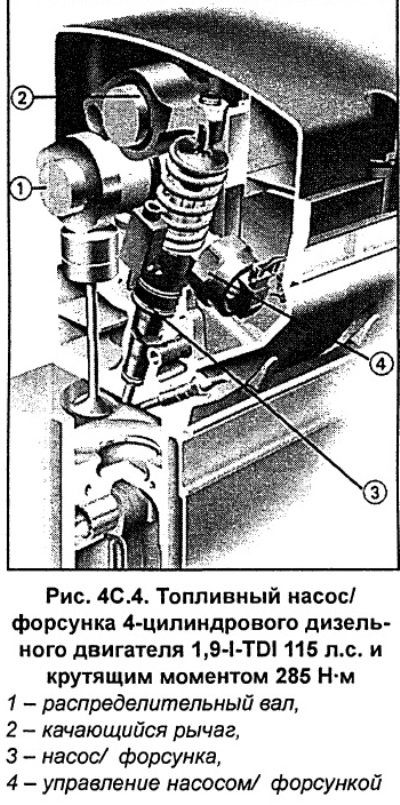
With pump/injector (engine 1.9-I 115/130 hp) each cylinder has its own fuel pump. The fuel pump and injector are a single unit, the so-called pump/injector (see Fig. 4C.4). The pump/injector is driven by the camshaft cam via an additional lever and creates a pressure of about 2000 bar, which ensures very fine atomization of the fuel. To cool the fuel, which heats up very much, a radiator is installed in the fuel return circuit.
Before the fuel enters the fuel pump and injectors, it is cleaned in the fuel filter from water and dirt. Therefore, it is necessary to remove water from the filter and replace it during maintenance.
The fuel pump is maintenance-free. All moving parts of the pump are lubricated with diesel fuel. The fuel pump is driven by a toothed belt.