



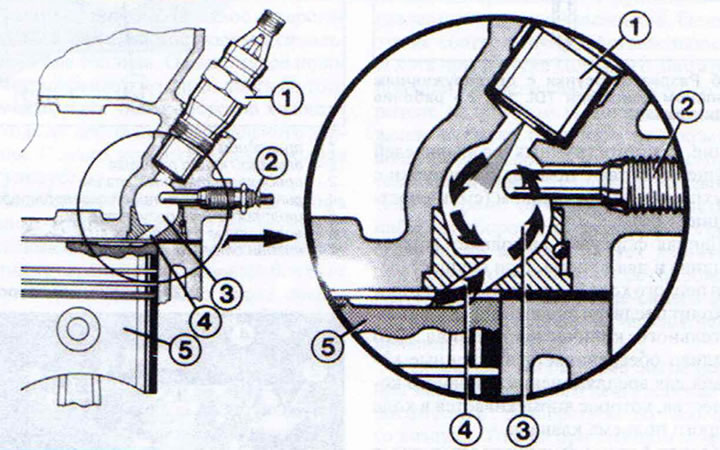
1.0 TD engine swirl chamber. On the right is a close-up of the swirl chamber. The arrows show the swirl of air in the chamber, which is then mixed with the injected fuel.
1 - nozzle
2 - glow plug
3 - vortex chamber
4 - cut-off channel
5 - piston
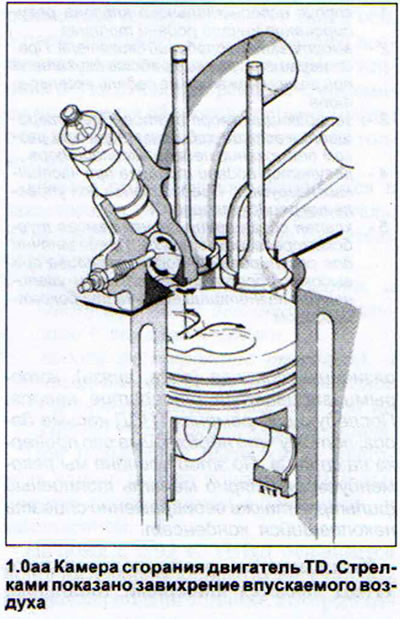
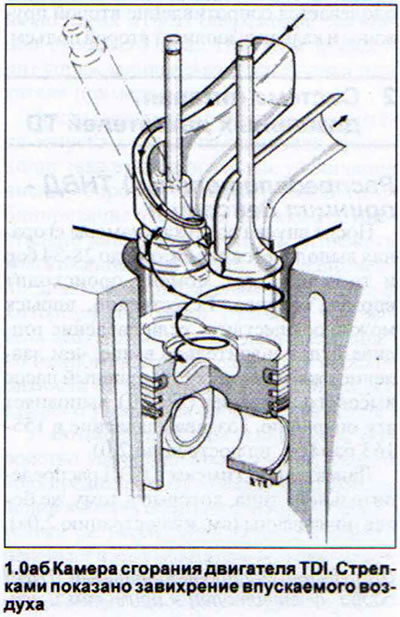
In TDI engines, fuel is injected directly into the main combustion chamber, namely into the combustion chute in the piston. In order to ensure good combustion of the mixture, the air must first be swirled. For this reason, the air is swirled in spiral-shaped intake ports on its way to the combustion chamber (see illustrations 1.0a).
The high-performance distributor injection pump generates an injection pressure of up to 900 bar. This allows for short injection times. High pressure also ensures a high degree of atomization of diesel fuel. This is also facilitated by the new design of the fuel injectors, which have five holes with a diameter of 0.21 mm.
The advantage of direct injection is lower fuel consumption. The disadvantage of this method is increased engine noise. To eliminate this disadvantage, preliminary injection in multi-jet sprayers is carried out using a nozzle with a two-spring valve (see illustration 1.0b).
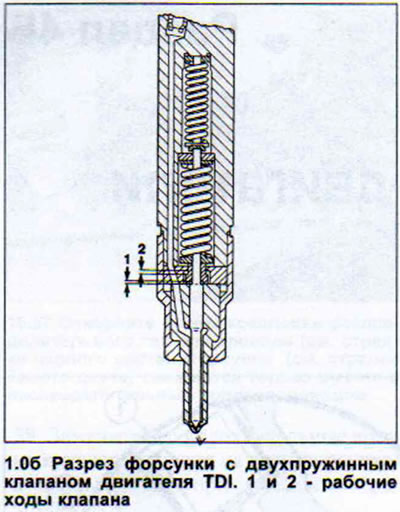
This injector injects fuel in two stages. During the first stroke (lift) of the valve, a preliminary injection of a small amount of fuel occurs. This fuel provides improved conditions for ignition of the main amount, which is injected during the second lift of the valve.
The injector valve is held by two springs, which act in such a way that when performing a preliminary fuel injection, the resistance of only one spring is overcome and the injector opens by 0.06 mm. After the completion of the preliminary injection, a higher pressure is created in the injector, caused by the need to inject a larger volume of fuel. As a result of the increased pressure, the resistance of the second spring is overcome and the valve performs a second lift.
(The original article is available on the website: AudiManual.ru)