



If you hear knocking in the cylinder head, this is evidence of a malfunction of one or more hydraulic tappets. Knocking in the valves is also possible with serviceable hydraulic tappets. But this is possible:
- a) immediately after starting the engine. The reason for the knocking in this case is the insufficient supply of oil to the hydraulic tappets at this stage of engine operation.
- b) when the engine is running, if the vehicle has previously been exposed to high external temperatures for a long time.
- c) when starting the engine after it has been parked for a long time or has not been used. As soon as the engine warms up, these knocks will disappear.
- d) when the oil level is very low, when the oil pump "sucks in" air.
1. Start the engine and let it idle until the radiator fan comes on.
2. Increase the engine speed to approximately 2500 rpm and let the engine run for approximately 2 minutes at this speed.
3. Turn off the engine if the knocking noise does not stop.
4. Remove the cylinder head.
5. Set the piston of cylinder No.1 to the TDC position.
6. Press both plate tappets of cylinder #1 down with a wooden wedge. If the play is greater than 0.1 mm, replace the tappets. The tappet cannot be repaired (see illustration).
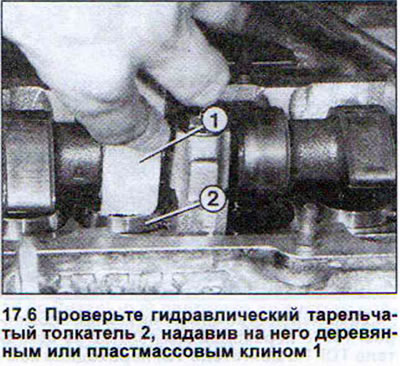
Caution: Do not use metal tools when performing this operation to avoid damaging the plunger.
7. Repeat the same procedure with the tappets of the other cylinders, setting the piston of the cylinder of the tappet being tested to TDC. In this position, the camshaft cams on the cylinder being tested are facing upwards.
8. Remove the camshaft.
9. Remove the pusher.
10. Lubricate the guides of the new tappet with fuel and install the new tappet in place.
11. Install the camshaft in place.
After installing new tappets, the engine should be started only after approximately 30 minutes. The tappets must "settle". Otherwise, the valve and piston may collide.