



Table of contents: What are hydraulic tappets used for? ↓ Valve noises ↓ Determining a defective hydraulic… ↓
What are hydraulic tappets used for?
Due to the engine heating, individual valve mechanism components expand and lengthen. Therefore, in order for the valves to remain sealed despite their slightly longer stems, there must be a small play or clearance between the camshaft and the tappets. This play – the so-called valve clearance – had to be adjusted at certain intervals in older car models. In the Audi A4, this happens automatically with each valve actuation due to the so-called hydraulic valve clearance equalization, which is carried out by the tappets. Hence the name "hydraulic tappets".
Valve actuation using hydraulic tappets: high-pressure oil is shown in red. Pink indicates the amount of oil not used to actuate the valves. The numbers indicate:
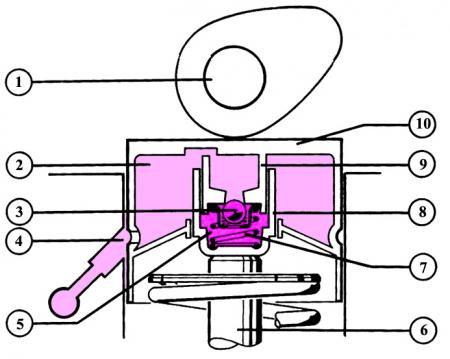
- 1 - camshaft cam;
- 2 - oil collector space;
- 3 - check valve;
- 4 - oil supply;
- 5 - high pressure chamber;
- 6 - valve stem;
- 7 - pressure spring;
- 8 - cylinder;
- 9 - piston;
- 10 - hydraulic pusher.
Valve noises
A knocking noise in the valves in the cylinder head area may indicate one or more faulty hydraulic lifters.
But noise in the valve can also occur with serviceable hydraulic tappets if:
- shortly before starting the engine, the oil supply to the hydraulic tappets was not yet ensured;
- the vehicle was previously driven at full load at high outside temperatures;
- the car has not been driven for a long time. The noise should disappear when the engine reaches operating temperature;
- when the oil level is extremely low, the oil pump sometimes sucks in air.
Determining a defective hydraulic lifter
1. Start the engine and let it run until it reaches operating temperature.
2. Increase the speed for 2 minutes to approximately 2500 rpm.
3. If the noise in the valves does not disappear, turn off the engine and remove the cylinder head.
4. Turn cylinder No.1 to TDC of ignition timing.
5. Press down all the plate tappets of cylinder No.1 with a wooden wedge. If, with the hydraulic tappet pressed down, it is possible to insert a 0.20 mm thick template between it and the camshaft, replace the tappet.
6. Repeat the same process on the other cylinders. To do this, set each cylinder to TDC. This is the position when all camshaft lobes of the cylinder being checked are facing upwards equally.
Advice: To replace a defective hydraulic tappet, you need to remove the camshaft. After installing a new tappet, do not start the engine for 30 minutes! The tappet must "settle". Otherwise, the valves will hit the piston.
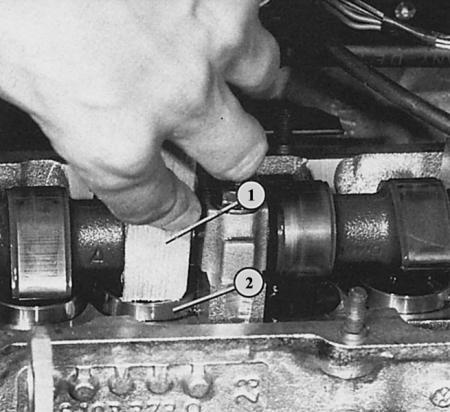
To check the hydraulic tappets, press a plastic or wooden wedge (1) onto the unloaded hydraulic tappet (2). Metal tools that can easily scratch the tappet surface must not be used.
[The original version is on the portal: audimanual]