
Repair Chevrolet Repair Toyota Repair Honda Repair AvtoVAZ Repair Mercedes-Benz Repair BMW Repair Opel
Home  |  Contacts  |  Sitemap  |    
English Русский
Български
Беларускі
Український
Српски
Hrvatski
Română
Polski
Slovenský
Magyar
AudiManual.ru


  • AUDI 80
  • AUDI 100
  • AUDI A3
  • AUDI A4
  • AUDI A6
  • AUDI A8
  • AUDI Q
  • OTHER
  • ARTICLES
D2 (1994-2002)

Checking hydraulic valve lifters (Audi A8 D2)

  • Home
  • Audi A8
  • D2 (1994-2002)
  • Power unit
  • Petrol engine 2.8L
  • Checking hydraulic valve lifters
            0
Correct valve clearances have a major impact on engine performance. If the valve clearances are too large, the engine will become noisy and less efficient because the valves will open too late and close too early. If the valve clearances are too small, the valves will not close completely when the engine is hot, which can cause serious engine damage.

The engines are equipped with hydraulic tappets, which automatically compensate for the gap between the camshaft cam and the corresponding valve stem under the action of pressure in the lubrication system. Therefore, regular checking and adjustment of valve clearances is not required. However, it is necessary to use motor oil good quality and recommended viscosity and replace it at the required intervals. When starting a cold engine, there is a slight delay due to equalization of engine oil pressure in all parts of the engine, especially in the hydraulic tappets. The valves may knock for about 10 seconds, after which they begin to operate silently.

If the engine has not been started for several days, the valves may knock for a longer period of time, as almost all the oil drains from the top of the engine and the bearing surfaces. During this time, care must be taken not to damage the engine: avoid sudden changes in engine speed until all tappets are filled with engine oil. When warming up the engine, the idle speed (maximum 2000 to 2500 min⁻¹) should not increase for 2 minutes or until the valves stop knocking. If the tappet noise does not stop, stop the engine and carry out the following actions (engine temperature should be at least 80°C).


Remove the cylinder head cover.

Rotate the crankshaft until the cam lobe above the tappet being tested is straight up.
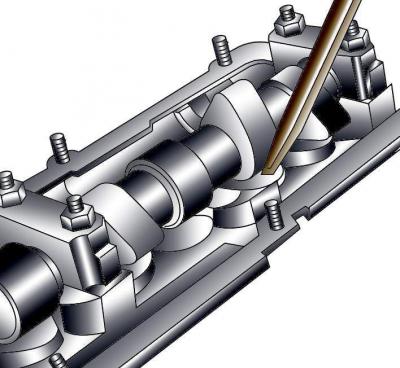
Rotate the crankshaft until the cam lobe above the tappet being tested is straight up.


Fig. 3.1–91. Checking the free play of the push rod


Press the plunger with a wooden or plastic wedge (Fig. 3.1–91). If the plunger free play is more than 0.2 mm, the plungers must be replaced.

Install the cylinder head cover.

Wait approximately 30 minutes before starting the engine. This is necessary to stabilize the hydraulic tappets, otherwise the pistons will hit the valves.

Valve seat machining


Valve seats with signs of wear or burning must be processed with the mandatory preservation of the angles and chamfer size.
Valve seats with signs of wear or burning must be processed with the mandatory preservation of the…


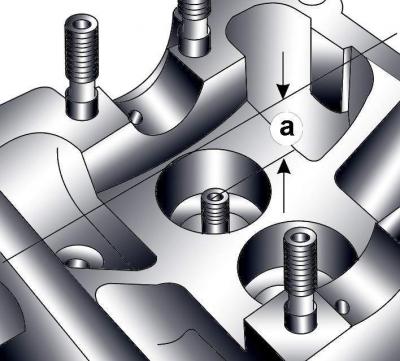
Fig. 3.1–92. Minimum permissible distance from the end of the valve to the upper surface of the cylinder head


If the valve seat must be machined, determine the maximum amount of metal that can be removed. If too much metal is removed, the hydraulic tappets will not operate properly. Insert the valve into the guide bushing and press it against the valve seat. Measure the distance from the end of the valve stem to the top surface of the cylinder head (Fig. 3.1–92). Minimum allowable distance a is 33.8 mm for intake valves and 34.1 mm for exhaust valves. If the valve seat is excessively worn, the cylinder head must be replaced.

After any treatment of the seats, it is necessary to grind the valves.
The article was checked by auto expert Nikita Rudakov
This article is available at russian, bulgarian, belarusian, ukrainian, serbian, croatian, romanian, polish, slovak, hungarian

Share information:
Previous articles
Audi A8 D2: Petrol engine 2.8L
Next articles

Camshaft
Cylinder head
Right cylinder head cover
Left cylinder head cover


Similar articles on other Audi car models:
Checking and adjusting clearances in the valve drive mechanism Audi 80 B2 (1979-1986)
Determination of the technical condition of hydraulic valve… Audi 100 C3 (1982-1990)
Checking the vehicle's readiness for operation Audi A3 Type 8L (1996-2003)
Checking the valve injectors Audi A4 B6 (2000-2006, petrol)
Checking hydraulic valve lifters Audi A6 C5 (1997-2004)
Timing chain covers, valve 1 of timing phase adjustment «N205» Audi Q5 Type 8R (2008-2017)
Checking the valve guides Audi A2 (1999-2005)
Link to this page in different formats


Visitor comments

No comments yet


How much will 10 + 38 =


A8(D2, 1994-2002) 
  • General information
  • User manual
  • Maintenance
  • Power unit
  • Petrol engine 2.8L
  • Petrol engine 3.7L and 4.2L
  • Diesel engine 2.5L
  • Diesel engine 3.3L
  • Ignition and injection (gasoline)
  • Fuel system (diesel)
  • Lubrication system
  • Cooling system
  • Transmission
  • Clutch
  • Car gearbox
  • Drive shafts
  • Cardan gear
  • Car suspension
  • Chassis
  • Wheels and tires
  • Steering
  • Brake system
  • Body
  • Exterior (external elements)
  • Interior (internal elements)
  • Heating and air conditioning
  • Electrical equipment
  • Fuses and relays
  • Lighting and lamps
  • Instruments and switches
 
AudiManual.ru © 2017-2026 · Mobile version · Feedback · Sitemap: EN BG BY UA RS HR RO PL SK HU · Site search · News and articles
80 B2 · 80 B3 petrol · 80 B3 · 80 B4 · 100 C3 diesel · 100 C3 petrol · 100 C3 · 100 C4 petrol · 100 C4 · A3 Type 8L · A4 B5 petrol · A4 B5 · A4 B6 petrol · A4 B6 · A4 B7 · A4 B8 · A6 C4 · A6 C5 · A6 C5 Allroad · A8 D2 · Q5 Type 8R · Q7 Typ 4L · Audi A2 ·
This site uses cookies 🍪. Click the button to accept this fact.