
Repair Chevrolet Repair Toyota Repair Honda Repair AvtoVAZ Repair Mercedes-Benz Repair BMW Repair Opel
Home  |  Contacts  |  Sitemap  |    
English Русский
Български
Беларускі
Український
Српски
Hrvatski
Română
Polski
Slovenský
Magyar
AudiManual.ru


  • AUDI 80
  • AUDI 100
  • AUDI A3
  • AUDI A4
  • AUDI A6
  • AUDI A8
  • AUDI Q
  • OTHER
  • ARTICLES
B8 (2007-2015) B7 (2004-2008) B6 (2000-2006) B6 (2000-2006, petrol) B5 (1994-2001) B5 (1994-2001, petrol)

Checking the oil level (Audi A4 B5)

  • Home
  • Audi A4
  • B5 (1994-2001, petrol)
  • General information
  • Maintenance
  • Checking the oil level
            0
Table of contents: Constant control ↓ Topping up oil ↓ Can oils be mixed? ↓
Checking the oil level


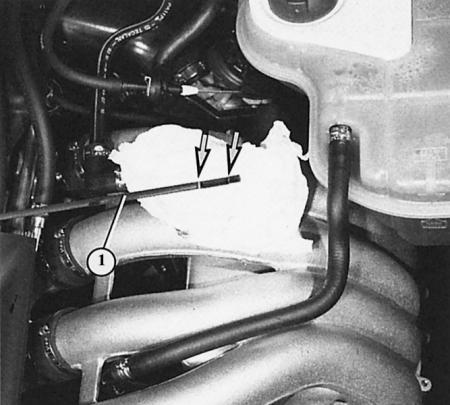
When checking the oil level, the dipstick (1) is removed from the guide tube. The oil level should be between the marks or in the area of the ribbed surface (arrow) on the tip of the dipstick. The amount of oil to be added between the marks is 1 l. The measurement can only be accurate if the car is on a horizontal surface.

Constant control


If you have just purchased your Audi A4 (new or used), then, for safety's sake, you should take hold of the dipstick every time you fill up the fuel tank to measure the oil level. Once you know that your engine is consuming very little oil, you can check it between the second and fourth fill-ups.

According to Audi instructions, the oil level should be checked at an engine temperature of 60°C, which corresponds to approximately 10 minutes after starting a cold engine.

Place the car on a horizontal surface.

After turning off the preheated engine, wait at least five minutes for all the oil to drain into the crankcase.

Be careful with a hot engine, you can burn your hand on the surrounding parts.


Remove the dipstick, wipe it with a clean, lint-free cloth or paper towel, reinsert it until it stops, wait a moment, and remove it again.

You can see the oil level on the rod.

If the lubricant level only reaches the lower mark, then engine oil needs to be added.

Tip: If you want to keep an accurate log of your Audi A4's oil consumption, you should always take measurements in the same place and at the same oil temperature.


The black color of the oil itself is not a signal to change the engine oil. The oil darkens again even soon after the change. The falling dirt and abrasion products are kept in suspension so that they do not get inside the engine.

Topping up oil


The difference between the lower and upper marks on the dipstick is 1 liter. The oil level should not fall below the lower mark. A lack of a quarter liter of oil is not yet dangerous, but if more oil is missing and the Audi A4 is driven in a sharp manner, then the oil pressure can drop to a dangerous level on turns.

Excess oil in the engine is also harmful. At high speeds, it can get through the ventilation hole in the crankcase into the combustion chambers. For the catalytic converter, excess oil is as dangerous as unburned gasoline. Consequence: it can melt. But with normal oil consumption, this is not dangerous.

Bottom line: It is recommended to add oil when the level is in the lower quarter between the two marks on the dipstick. Do not fill above the upper mark.

Tip: Oil in small quantities is more expensive than in 3-, 4- or 5-liter canisters. This type of packaging is often inconvenient for adding oil on the road. In addition, it takes up a lot of space in the trunk. A 1-liter can of motor oil with a screw cap is convenient, from which you can add oil in small portions as needed.


Can oils be mixed?


All types of oils from all manufacturers, including single-purpose and multi-purpose oils, can be mixed without fear. This miscibility without harmful consequences is a basic requirement of international oil standards. Although mixing with another engine oil may slightly affect the specific properties of a particular oil, since each brand of oil has its own combination of additives. But the lubricating effect is never compromised. Anyone who adheres to the oil standards recommended by Audi is not at risk of engine damage due to unsuitable oil.

(Text provided by the online resource: audimanual.ru)
The article was checked by auto expert Georgy Rodionov
This article is available at russian, bulgarian, belarusian, ukrainian, serbian, croatian, romanian, polish, slovak, hungarian

Share information:
Previous articles
Audi A4 B5: Maintenance
Next articles

Lubrication of all parts
Jacking up a car
Workplace safety practices
Vehicle identification
Oil consumption
Selecting the right oil specification
Oil viscosity
The right engine oil for Audi


Similar articles on other Audi car models:
Checking the oil level Audi 80 B3 (1986-1991)
Checking the oil level in the rear axle drive Audi 100 C4 (1990-1994, petrol)
Checking the transmission oil level of the manual transmission Audi A3 Type 8L (1996-2003)
Checking the oil level and filling Audi A6 C5 (1997-2004)
Checking the oil level in a manual transmission Audi A8 D2 (1994-2002)
Checking the fuel level sensor «G» Audi Q5 Type 8R (2008-2017)
Engine — Checking Oil Level Audi A2 (1999-2005)
Link to this page in different formats


Visitor comments

No comments yet


How much will 24 + 21 =


A4(B8, 2007-2015) 
  • General information
  • Operating instructions
  • Power unit
  • Petrol engines 1.8 l
  • Petrol engines 1.8/2.0 l
  • Petrol engines 3.0 l
  • Petrol engines 3.2 l
  • Fuel system (petrol)
  • Diesel engines 2.0 l (CA*)
  • Diesel engines 2.0 l (CJCB)
  • Diesel engines 2.7/3.0 l
  • Diesel engines 3.0 l
  • Fuel system (diesel)
  • Transmission
  • Manual gearbox 0B1
  • Manual gearbox 0B2
  • Manual gearbox 0B3
  • Manual gearbox 0B4
  • Automatic transmission 0B5
  • Automatic transmission 0B6
  • Automatic transmission 0AW
  • All-wheel drive system
  • Chassis
  • Front suspension
  • Rear suspension
  • Brake system
  • Steering system
  • Body
  • Exterior
  • Interior
  • Seats
  • Doors, locks and windows
  • Security system
  • Heating and air conditioning
  • Electrical equipment
  • Audio system
  • Power devices
  • Equipment and devices
  • Lighting and lamps
  • Electrical circuits
 
A4(B7, 2004-2008) 
  • General information
  • Introduction to manual
  • Troubleshooting
  • Operating instructions
  • Maintenance
  • Power unit
  • Petrol engines 2.0 (ALT)
  • Petrol engines 2.0 (TFSI)
  • Petrol engines 1.8 (MPI)
  • Diesel engines
  • Cooling system
  • Air conditioner
  • Fuel and exhaust system
  • Ignition system
  • Starting and charging
  • Transmission
  • Clutch
  • Manual gearbox
  • Automatic gearbox
  • Drive shafts
  • Chassis
  • Brake system
  • Front suspension
  • Rear suspension
  • Steering
  • Body
  • Exterior
  • Interior
  • Electrical equipment
  • Equipment and devices
  • Lighting and signaling
  • Windscreen wipers and washers
  • Electrical diagrams
  • Electrical diagrams (since 2007)
 
A4(B6, 2000-2006) 
  • General information
  • Vehicle Description
  • User manual
  • Maintenance
  • Power unit
  • Gasoline engine
  • Diesel engine
  • Lubrication system
  • Cooling system
  • Supply system
  • Injection system
  • Exhaust system
  • Ignition and control
  • Transmission
  • Gear box
  • Clutch and drive shafts
  • Chassis
  • Brake system
  • Car suspension
  • Steering
  • Body
  • Heating and ventilation
  • Exterior (external elements)
  • Interior (internal elements)
  • Electrical equipment
  • Power devices
  • Lighting and appliances
  • Electrical circuits
 
A4(B6, 2000-2006, petrol) 
  • General information
  • Introduction to the guide
  • Car care
  • Power unit
  • Engine repair
  • Lubrication system
  • Cooling system
  • Injection and control system
  • Ignition system
  • Power and exhaust system
  • Transmission
  • Clutch and drive shafts
  • Car gearbox
  • Chassis
  • Suspension and wheels
  • Steering
  • Brake system
  • Body
  • Interior
  • Exterior
  • Electrical equipment
  • Equipment and devices
  • Lighting and signaling
  • Power devices
  • Electrical circuits
 
A4(B5, 1994-2001) 
  • General information
  • Introduction to the guide
  • Car care
  • Maintenance (gasoline)
  • Maintenance (diesel)
  • Power unit
  • Gasoline engines
  • Diesel engines
  • Engine overhaul
  • Cooling system
  • Fuel injection (gasoline)
  • Fuel system (diesel)
  • Exhaust system
  • Ignition system
  • Transmission
  • Clutch
  • Mechanical gearbox
  • Automatic gearbox
  • Drive shafts
  • Chassis
  • Brake system
  • Car suspension
  • Steering
  • Body
  • Exterior
  • Interior
  • Doors, locks and windows
  • Heating and ventilation
  • Electrical equipment
  • Power devices
  • Equipment and devices
  • Electrical circuits
 
A4(B5, 1994-2001, petrol) 
  • General information
  • Vehicle description
  • Maintenance
  • Power unit
  • Engine repair
  • Turbocharging
  • Exhaust system
  • Cooling system
  • Ignition system
  • Fuel system
  • Motronic injection system
  • MPI and MPFI injection system
  • Transmission
  • Clutch
  • Gearbox and shafts
  • Chassis
  • Steering
  • Car suspension
  • Brake system
  • Wheels and tires
  • Body
  • Heating and ventilation
  • Body parts
  • Electrical equipment
  • Fuses and relays
  • Power devices
  • Lighting and lamps
  • Tools and devices
  • Electrical circuits
 
AudiManual.ru © 2017-2026 · Mobile version · Feedback · Sitemap: EN BG BY UA RS HR RO PL SK HU · Site search · News and articles
80 B2 · 80 B3 petrol · 80 B3 · 80 B4 · 100 C3 diesel · 100 C3 petrol · 100 C3 · 100 C4 petrol · 100 C4 · A3 Type 8L · A4 B5 petrol · A4 B5 · A4 B6 petrol · A4 B6 · A4 B7 · A4 B8 · A6 C4 · A6 C5 · A6 C5 Allroad · A8 D2 · Q5 Type 8R · Q7 Typ 4L · Audi A2 ·
This site uses cookies 🍪. Click the button to accept this fact.