



It should not be too viscous, since the starter must turn the cold engine so that after a cold start the oil immediately reaches all lubrication points.
It should not be too thin, because at high temperatures and speeds, the oil film may break.
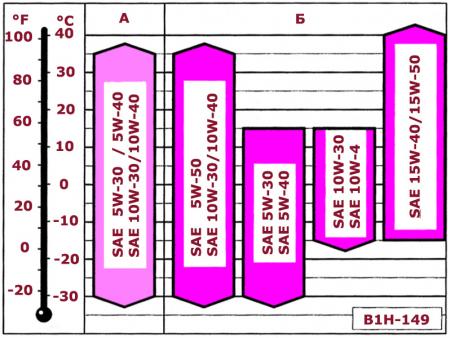
The graph shows the recommendations of Audi/Volkswagen regarding oil viscosity:
- A - all-season oils according to VW standard 500 00;
- B - all-season oils according to VW standard 500 01.
The parameters named are understood as long-term temperatures. Short-term fluctuations do not play a role.
Oil classes according to SAE
Society of Automotive Engineers (Society of Automotive Engineers, USA) divided all oils into classes according to their viscosity. The classification of motor oils begins with liquid winter oil (Winter) SAE 5 W, 10 W, 15 W, then the intermediate stage SAE 20 W/20 and ends with viscous summer oils (summer) SAE 30, 40 and 50.
Seasonal oil
The cheapest motor oil used to be seasonal oil. For optimal lubrication of the engine, thick or thin seasonal oil should be poured into it according to the season. Now seasonal oils are almost not sold (germany is meant), but they are still often used in car parks. The use of seasonal oil in the Audi A4 is not provided.
All-season oil
More labor-intensive to manufacture and therefore more expensive than seasonal oil, all-season oil has found the widest application today. To improve viscosity-temperature properties (VI), it contains long chains of molecules as an additive, which swell when heated and shrink again when cooled. In this regard, the oil can plastically adapt to temperature and cover several viscosity classes in its characteristics. SAE 15 W-50 oil at a temperature of -15°C corresponds to viscosity class 15 W and at 100°C - class 50.
All-season oils of classes SAE 10 W-30 and 10 W-40 are not recommended for use in Audi engines during the warm season.