



Table of contents: Does the starter turn the engine? ↓ Do the spark plugs produce a spark? ↓ Is fuel entering the injection… ↓ Visual inspection first ↓ The source of the fault is… ↓ The source of the fault is ignition ↓ The source of the fault is the fuel… ↓
In our troubleshooting, we assume that there is no mechanical damage to the engine. We assume that the power unit stops spontaneously or does not start again.
Does the starter turn the engine?
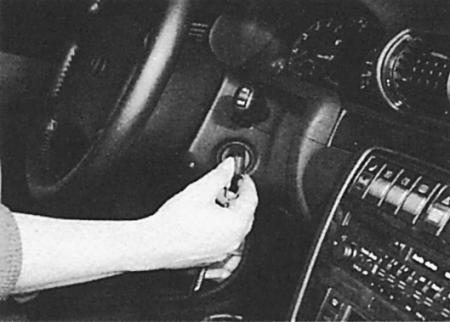
If it does not do this or does so slowly, please read the section below entitled "Fault Source - Electrical Equipment". On the other hand, if the engine starts quickly, you should answer the following questions one by one to narrow down the fault finding.
Do the spark plugs produce a spark?
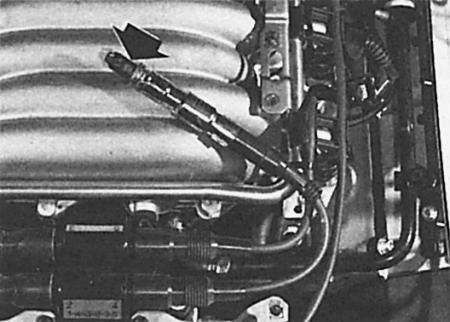
Remove the spark plug connector, unscrew the spark plug, insert it into the spark plug connector. Connect the spark plug with an auxiliary wire to the engine block so as to ensure conductivity (in the picture the auxiliary wire was omitted for clarity). Do not touch the spark plug or the spark plug wire - risk of accident! If yes, clarify the following question. If no, continue reading the section "Troubleshooting Source - Ignition".
Is fuel entering the injection system?
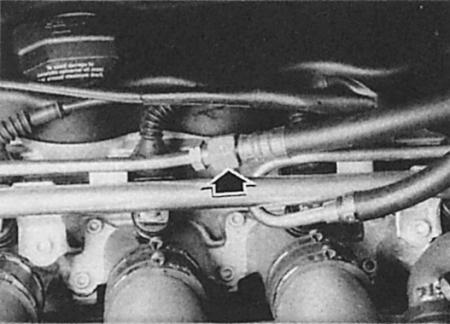
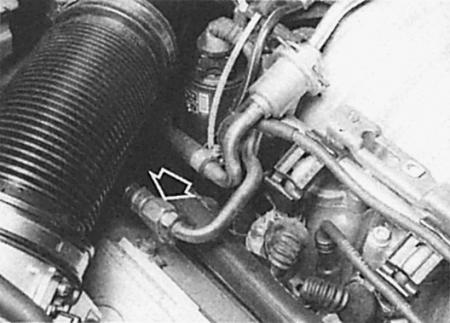
Disconnect the fuel hose where it screws into the engine compartment (photo above - 4-cylinder engine with a displacement of 1.8 liters, photo below - 6-cylinder engine). Be careful: fuel may squirt out. Therefore, when unscrewing the hose, place a thick rag under the screw connection. Extend the fuel supply line with a suitable hose and lower it into a container. Have an assistant turn the engine over with the starter.
If gasoline is supplied, the fuel pump is working properly. If not, read about this situation further in the section "Source of malfunction - fuel supply". Then the source of the malfunction remains fuel injection. Or the pump works, but creates insufficient pressure.
Visual inspection first
- Has the wire connector become disconnected on the ignition system units or in the injection system unit?
- Check the strength of the ignition wire fastening on the ignition coil, on the distributor (engine 1.6 l 74 kW) and on the spark plug connectors (do not turn on the ignition under any circumstances!).
- Are all low pressure hoses in the engine compartment connected to the appropriate fitting?
- Water condensation on and in the distributor cap (only with 1.6 l 74 kW engine)? All ignition system parts, including the ignition coil, must be clean and dry, otherwise there is a risk of creeping currents and voltage breakdowns.
- Is there a gasoline smell in the engine compartment? Is the fuel hose leaking or has it come loose?
The source of the fault is electrical equipment
- The control lights on the instrument panel do not light or do not flash when the ignition is on: the battery is completely discharged or the battery terminals are disconnected.
- The indicator lights go out when the starter is activated: the battery is very discharged, or old, or there is a short circuit in the starter.
- The indicator lights dim slightly when the key is turned, the starter does not turn: the electromagnetic switch is jammed, or it is faulty, or the starter is faulty.
- Indicator lights glow brightly or flash when key is turned; the starter does not turn: defective contact of terminal 50 in the ignition switch, disconnected wire of terminal 50 of the electromagnetic switch or faulty electromagnetic switch.
The source of the fault is ignition
- All connectors in the area of the ignition coil(s) and ignition distributor are connected correctly (engine 1.6 l 74 kW)?
- Cracks in the ignition coil housing or in the ignition coil housings, traces of burns from sparks during breakdowns?
- Only for the 1.6 l 74 kW engine: remove the distributor cap. Are there any traces of creeping currents on its inner side? Does the graphite brush in the middle of the cap spring perfectly? Is there verdigris on the contact pins?
- As a last resort, only a complete check of the ignition system will help.
The source of the fault is the fuel supply
- No petrol in the fuel tank is not as absurd as you might think. In our injection engines, lack of fuel first manifests itself as engine hesitation when cornering.
- The fuel pump is faulty.
- The fuel filter is clogged.
- If the fuel supply is normal - for example, if the engine has constant problems starting - the suspicion falls on the injection system.
(Read the original source on the website: «AUDIMANUAL.ru»)