



Table of contents: Checking the injectors ↓ Checking the cold start assist valve ↓ Checking the fuel dispenser ↓ Checking the air flow meter ↓
If you have any doubts about the serviceability of any part, you can check it.
Checking the injectors
Switch off the ignition as described in the relevant section.
To check whether fuel is being supplied to the injector, loosen the fuel line mounting bolt on the cold start valve.
Prepare a rag and ask an assistant to turn the starter.
If fuel is leaking, you need to check the injector itself.
Remove the injector (see further in this section).
To do this on some five-cylinder engines, it is necessary to remove the upper part of the intake manifold.
Keep a container or rag ready to collect any spilled fuel.
Remove the large air hose between the mixture regulator and the throttle body to gain access to the air flow meter pickup plate.
In the central distribution device, disconnect the fuel pump relay and short-circuit the contacts on the block with a piece of wire. The fuel pump should work.
The measuring plate in the dispenser should be slightly raised by hand. The injector should then create a conical jet. If this is not the case: raise the measuring plate as far as it will go. Repeat the test.
In a similar way, the difference in the amount of fuel injected between individual cylinders can be checked.
Each of the injectors should be lowered into its own measuring cup (there should be four or five of them), without kinking the high-pressure fuel lines.
Raise the measuring plate by approximately 2 cm.
The assistant should keep the above mentioned wire jumper inserted until 2 cm³ of fuel has been poured into the first cup.
Compare the amount of fuel in different cups. The difference should not exceed 3 cm³.
If the deviation is greater, swap the injectors with the minimum and maximum amount of fuel injected. Repeat the measurement.
If, with the replacement of injectors, the deviations in the amount of fuel also change places, then the injector with excessive deviation must be replaced.
If, upon re-checking, you get the same results, then it is possible that the fuel line leading to the injector is narrowed or the fuel dispenser is faulty.
Checking the tightness of the injectors: if you turn off the fuel pump after two minutes of operation (pull out the jumper), there should be no dripping from the injectors.
The procedure for installing injectors is described below.
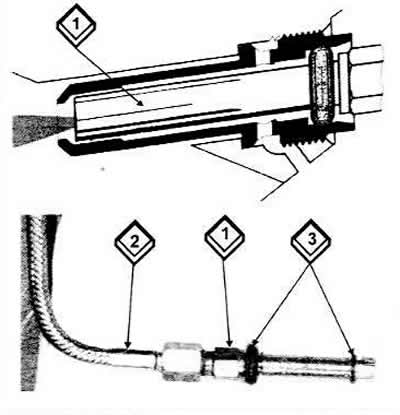
The injector (1) has been removed together with the sealing rings (3) and the connected high-pressure fuel line (2). The injector is shown here with two sealing rings. The picture on the right shows the operating principle of the air-flushed injector. By supplying additional air (indicated in a lighter color) better fuel atomization is achieved (darker color) in idle mode.
Checking the cold start assist valve
The check is carried out when the engine has cooled down.
Turn off the ignition.
Unscrew the cold start valve, leaving the plug and fuel line connected.
Lower the valve into the vessel and ask an assistant to turn the engine.
The valve should produce a conical shaped jet of fuel.
The injection duration depends on the engine temperature. At 0°C, the injection duration ranges from 3 to 7 ½ seconds, at 10°C — from 2 to 6 seconds, at 20°C — from 1 to 4 seconds. After injection, turn off the ignition.
Dry the valve by blotting it. No fuel should come out within a minute.
Checking the fuel dispenser
Let the engine run for about one minute.
Remove the air filter cover and filter element
From below, through the inlet shaft of the measuring plate, press the adjustment lever all the way up. The same resistance should be felt along the entire length of the stroke.
There should be no resistance when quickly pulling the measuring plate back. If there is, the air flow meter must be replaced.
If the measuring plate moves up with difficulty, but moves down easily, then the distribution piston is "stuck" in the dispenser. Replace the fuel dispenser.
Checking the air flow meter
Warm up the engine, or let the warmed up engine run for about 1 minute before checking.
Remove the air intake hose between the mixture regulator and the intake manifold by loosening the clamping straps.
Check the measuring plate: the measuring plate should be 1.9 mm below the top edge, in extreme cases 3 mm below.
If the measuring plate is not positioned correctly, it must be raised by bending the retaining wire clip at the bottom of the air flow meter shaft to correct its position. The flat spring must not be bent under any circumstances.
Check if the measuring plate touches the wall.
If so, you will need to loosen the center mounting bolt and re-center the plate.
(Material republished from the website: AudiManual.ru)