



A failure of the brake booster does not mean a loss of braking efficiency, it only means that the pedal force required to achieve the same braking efficiency increases.
The brake booster receives the vacuum required for its operation via the vacuum line from the intake manifold. The functionality of the brake booster can be checked as follows:
With the engine off, press the brake pedal several times until all vacuum is released from the system.
Press the pedal with medium force and start the engine.
If the brake booster is working properly, the brake pedal will noticeably drop. The brake booster cannot be removed by simple means, as it is necessary to use special tools used by Audi to separate the brake pedal from the push rod. Only if these tools are available can the following description be read.
Remove the trim from the driver's side.
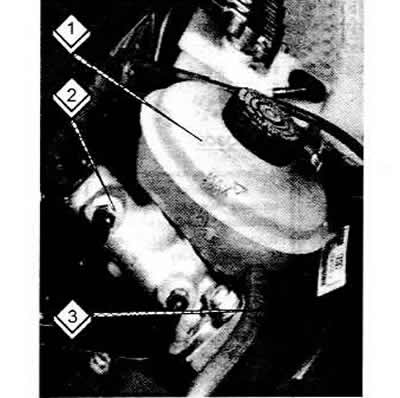
Remove the brake fluid reservoir as described above. To do this, remove the clutch hydraulic system hose (3), the plug connection (2) and the reservoir (1). The reservoir must be removed by rocking it back and forth.
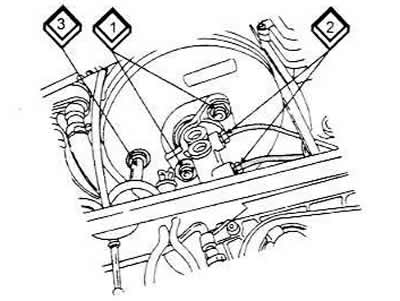
The following steps should be carried out using the figure below as a guide.
First, you need to disconnect both brake pipes (2), pull them out and carefully bend them to the side. Wipe off the leaking brake fluid with a rag. Disconnect the vacuum hose (3) from the brake booster on the side. Now unscrew the mounting bolts (1). For this, you need a Torx T45 head with an extension.
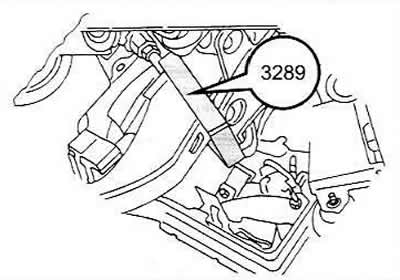
Next, the brake booster pushrod is disconnected from the pedal, which is associated with the difficulties already mentioned. First, remove the brake light switch. If a cruise control system is installed (cruise control), then you need to remove the air inlet valve nearby. The switch and valve must be installed in a certain way.
Now install special tool #3289 on the pedal. The brake booster push rod is removed from the pedal. Pull the brake pedal back to complete the removal.
Remove the brake booster together with the master cylinder from the housing.
Note: The master brake cylinder can also be removed in advance, as described above. In this case, unscrew the two flange nuts.
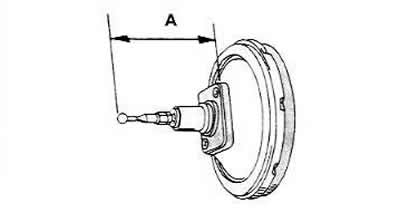
Installation is carried out in the reverse order of removal. If a new brake booster is to be installed, the length of the pushrod must be readjusted. In this case, the distance between the mounting surface of the brake booster and the end of the pushrod, marked as (A), is measured. Since the pushrod can move, care must be taken to ensure that it is perpendicular to the booster. In addition, there should be no gasket present when measuring. If it is stuck, its thickness must be taken into account when measuring.
To adjust, loosen the lock nut and move the push rod. After adjustment, tighten the lock nut.
Replace the gasket and re-tighten the brake booster. The bolts do not need to be replaced.
Lightly lubricate the pivot pin and reconnect the brake pedal/push rod connection.
If the brake cylinder has been removed, replace the flange nuts (50 Nm). Tighten the union nuts of the pipes to 15 Nm.
The check valve located in the brake booster may be the cause of the system malfunction. To check, you can carefully push out the valve with a screwdriver and blow it in the direction of the arrow on the valve. Air should come out on the other side. If you blow from the other side, the air should not come out. When replacing the valve, you must select the same one that was there before. The valve is pressed into the brake booster.