
Repair Chevrolet Repair Toyota Repair Honda Repair AvtoVAZ Repair Mercedes-Benz Repair BMW Repair Opel
Home  |  Contacts  |  Sitemap  |    
English Русский
Български
Беларускі
Український
Српски
Hrvatski
Română
Polski
Slovenský
Magyar
AudiManual.ru


  • AUDI 80
  • AUDI 100
  • AUDI A3
  • AUDI A4
  • AUDI A6
  • AUDI A8
  • AUDI Q
  • OTHER
  • ARTICLES
C4 (1990-1994) C4 (1990-1994, petrol) C3 (1982-1990) C3 (1982-1990, petrol) C3 (1982-1990, diesel)

Main brake cylinder (Audi 100 C4)

  • Home
  • Audi 100
  • C4 (1990-1994)
  • Chassis
  • Brake system
  • Main brake cylinder
            0
Table of contents: Removal and installation the master… ↓ Repair of the main brake cylinder ↓ Brake fluid level control device ↓
All the cars of the described models are equipped with a dual-cavity master brake cylinder, equipped with a dual reservoir for brake fluid. So both circuits of the dual-circuit brake system can be supplied with brake fluid.

The main brake cylinder cannot be repaired, i.e. if the cylinder fails, it must be replaced with a new one. The brake pipes are divided diagonally, i.e. two pistons work with two circuits as follows:

The piston closest to the push rod operates the left front brake and the right rear brake, while the intermediate piston operates the right front brake and the left rear brake.

Attention: If it is suddenly discovered that the force required for braking increases or the braking distance is lengthened, this means that one of the brake circuits has failed.


Removal and installation the master brake cylinder


The master cylinder is mounted on the front surface of the brake booster and can be removed from the engine compartment.

Before starting work, press the brake pedal several times to remove the vacuum from the brake booster. If there is no vacuum, then plug the vacuum line on the booster.

Suck the brake fluid out of the reservoir, then remove the mesh. To remove the fluid, use a bulb or syringe, but never by mouth.

Remove the check indicator plug from the tank.

Remove the hose going to the clutch cylinder.

Pull the reservoir out of the brake cylinder, rocking it back and forth.


Note: This will cause the remaining brake fluid to spill out and you will need to prepare a rag to collect it.


Unscrew the brake pipe connections and bend the pipes to the side. Mark the installation location of each pipe.

Unscrew the cylinder nuts (only two nuts, not bolts). The rubber seal is located at the end of the brake booster.
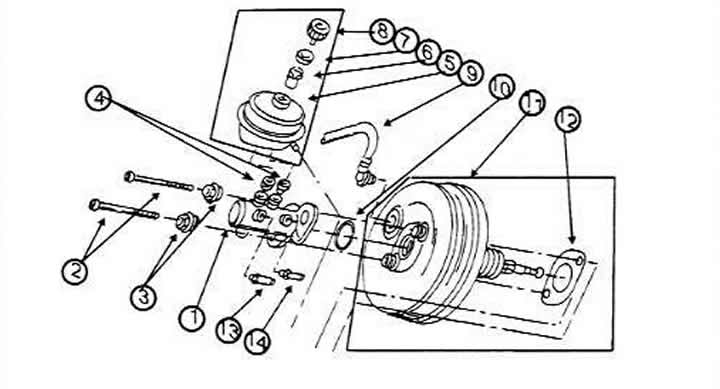
Mounting elements of the master brake cylinder and brake booster

Mounting elements of the master brake cylinder and brake booster
1 Master brake cylinder
2 Torx bolt, 25 Nm
3 Flange nut, 50 Nm (new)
4 Sealing sleeve
5 Brake fluid cans (the coupling connection is on the side shown)
6 Grid
7 Sealing ring.
8 Cork
9 Vacuum pipeline
10 Always replace the sealing ring after removing the cylinder
11 Brake booster
12 Gasket (glued)
13 Pipeline for the intermediate port circuit
14 Piston 1 circuit line. The dashed lines indicate the attachment points on the engine compartment bulkhead


The cylinder is installed in the reverse order of removal. Tighten both flange nuts (3) to 50 Nm, and the union nuts of the brake pipes to 15 Nm. There is no need to adjust the brake booster push rod (only when replacing the amplifier). In this case, it is necessary to adjust the length of the push rod to a certain length.


Lubricate the sealing bushings in the cylinder with brake fluid and press the brake fluid reservoir onto the bushings. The bushings must be in good condition. Finally, fill the system with brake fluid and bleed the clutch and brake hydraulic system as described in the relevant sections.

Repair of the main brake cylinder


The brake master cylinder of the models covered in this manual cannot be repaired. The brake master cylinder and brake booster may be supplied by different manufacturers, but it does not matter which product is installed when the cylinder needs to be replaced. The same applies to the brake booster.

The rubber bushings (4) for the reservoir can be replaced. if moisture is visible in this area. Press the reservoir carefully to the right and left, inserting a screwdriver, which will allow you to squeeze out the rubber bushings. Lubricate the new rubber bushings with brake fluid and press them into the master cylinder. Then carefully insert the reservoir. Remove air from the brake system.

Brake fluid level control device


The control lamp on the instrument panel lights up and the buzzer starts to sound when something is wrong with the brake fluid level. To check, remove the plug (8), turn on the ignition and press your finger on the grid (6). The control lamp should light up and the buzzer should sound. If this happens, the control device is working properly.

(This article was copied from the website: audimanual)
The article was checked by auto expert Georgy Rodionov
This article is available at russian, bulgarian, belarusian, ukrainian, serbian, croatian, romanian, polish, slovak, hungarian

Share information:
Previous articles
Audi 100 C4: Brake system
Next articles

Removal the brake drum
Measuring drum brake shoes
Rear drum brakes
Brake disc treatment
Brake booster
Removal air from the brake system («bleeding»)
Parking (hand) brake
Anti-lock braking system (ABS)


Similar articles on other Audi car models:
Master Brake Cylinder — Removal and Installation Audi 80 B4 (1991-1996)
Checking the brake system Audi A3 Type 8L (1996-2003)
Master brake cylinder Audi A4 B5 (1994-2001, petrol)
Rear brake wheel cylinder Audi A6 C4 (1994-1997)
Parking brake Audi A8 D2 (1994-2002)
Brake booster/master cylinder parts and assemblies Audi Q5 Type 8R (2008-2017)
Master brake cylinder, expansion tank Audi A2 (1999-2005)
Link to this page in different formats


Visitor comments

No comments yet


How much will 32 + 43 =


100(C4, 1990-1994) 
  • General information
  • User manual
  • Power unit
  • Engine repair
  • Ignition system
  • Fuel system (gasoline)
  • Fuel system (diesel)
  • Lubrication system
  • Cooling system
  • Exhaust system
  • Transmission
  • Clutch
  • Car gearbox
  • Drive shafts
  • Chassis
  • Car suspension
  • Steering
  • Wheels and tires
  • Brake system
  • Body
  • Ventilation and heating
  • Body repair
  • Electrical equipment
  • Power devices
  • Lighting and appliances
  • Electrical circuits
 
100(C4, 1990-1994, petrol) 
  • General information
  • Operation and maintenance
  • Power unit
  • Engine repair
  • Exhaust system
  • Cooling system
  • Supply system
  • Air filter
  • Mono-Motronic injection system
  • Digifant injection system
  • KE-III-Jetronic and KE-Motronic
  • MPI and MPFI injection system
  • Transmission
  • Clutch
  • Car gearbox
  • Chassis
  • Suspension and steering
  • Brake system
  • Wheels and tires
  • Body
  • Exterior
  • Interior
  • Electrical equipment
  • Fuses and relays
  • Power devices
  • Ignition system
  • Lighting and signaling
  • Equipment and devices
  • Electrical circuits
 
100(C3, 1982-1990) 
  • General information
  • User manual
  • Maintenance
  • Specifications
  • Power unit
  • Engines 4-cylinder
  • Engines 5-cylinder
  • Diesel engine
  • Cooling system
  • Power system (carburetor)
  • Power system (injector)
  • Fuel system (diesel)
  • Transistor ignition system
  • Electronic ignition system
  • Transmission
  • Clutch
  • 4 speed gearbox 014
  • 5 speed gearbox 013 and 093
  • 5 speed gearbox 016 and 012
  • Shift mechanism KP 016
  • Automatic transmission
  • Front wheel drive
  • Chassis
  • Front suspension
  • Rear suspension
  • Steering
  • Brake system
  • Body
  • Body elements
  • Electrical equipment
  • Lighting and appliances
  • Power devices
  • Electrical circuits
 
100(C3, 1982-1990, petrol) 
  • General information
  • Maintenance and operation
  • 4 cylinder engine
  • Engine repair
  • Cooling and lubrication system
  • Supply system
  • Ignition system
  • 5 cylinder engine
  • Engine repair
  • Cooling and lubrication system
  • Supply system
  • Ignition system
  • Transmission
  • Clutch and drive shafts
  • 4 speed gearbox 014
  • 5 speed gearbox 013 and 093
  • 5 speed gearbox 016 and 012
  • Automatic gearbox
  • Chassis
  • Steering
  • Front suspension
  • Rear suspension
  • Brake system
  • Body
  • Body elements
  • Doors, locks and windows
  • Body repair
  • Electrical equipment
  • Equipment and devices
  • Power devices
  • Electrical circuits
 
100(C3, 1982-1990, diesel) 
  • General information
  • User manual
  • Maintenance
  • Troubleshooting
  • Power unit
  • Engine in a car
  • Engine removed
  • Cooling system
  • Fuel system
  • Exhaust system
  • Starting and charging
  • Preheating
  • Transmission
  • Clutch
  • Mechanical gearbox
  • Automatic gearbox
  • Drive shafts
  • Chassis
  • Brake system
  • Suspension
  • Steering
  • Body
  • Exterior
  • Interior
  • Electrical equipment
  • Equipment and devices
  • Electrical circuits
 
AudiManual.ru © 2017-2026 · Mobile version · Feedback · Sitemap: EN BG BY UA RS HR RO PL SK HU · Site search · News and articles
80 B2 · 80 B3 petrol · 80 B3 · 80 B4 · 100 C3 diesel · 100 C3 petrol · 100 C3 · 100 C4 petrol · 100 C4 · A3 Type 8L · A4 B5 petrol · A4 B5 · A4 B6 petrol · A4 B6 · A4 B7 · A4 B8 · A6 C4 · A6 C5 · A6 C5 Allroad · A8 D2 · Q5 Type 8R · Q7 Typ 4L · Audi A2 ·
This site uses cookies 🍪. Click the button to accept this fact.