
Repair Chevrolet Repair Toyota Repair Honda Repair AvtoVAZ Repair Mercedes-Benz Repair BMW Repair Opel
Home  |  Contacts  |  Sitemap  |    
English Русский
Български
Беларускі
Український
Српски
Hrvatski
Română
Polski
Slovenský
Magyar
AudiManual.ru


  • AUDI 80
  • AUDI 100
  • AUDI A3
  • AUDI A4
  • AUDI A6
  • AUDI A8
  • AUDI Q
  • OTHER
  • ARTICLES
C4 (1990-1994) C4 (1990-1994, petrol) C3 (1982-1990) C3 (1982-1990, petrol) C3 (1982-1990, diesel)

Clutch master cylinder (Audi 100 C3)

  • Home
  • Audi 100
  • C3 (1982-1990)
  • Transmission
  • Clutch
  • Clutch master cylinder
            0
Table of contents: Removal ↓ Disassembly ↓ Inspection and defect detection of… ↓ Assembly ↓ Installation ↓ Adjusting the clutch pedal free… ↓

Hydraulically operated clutch
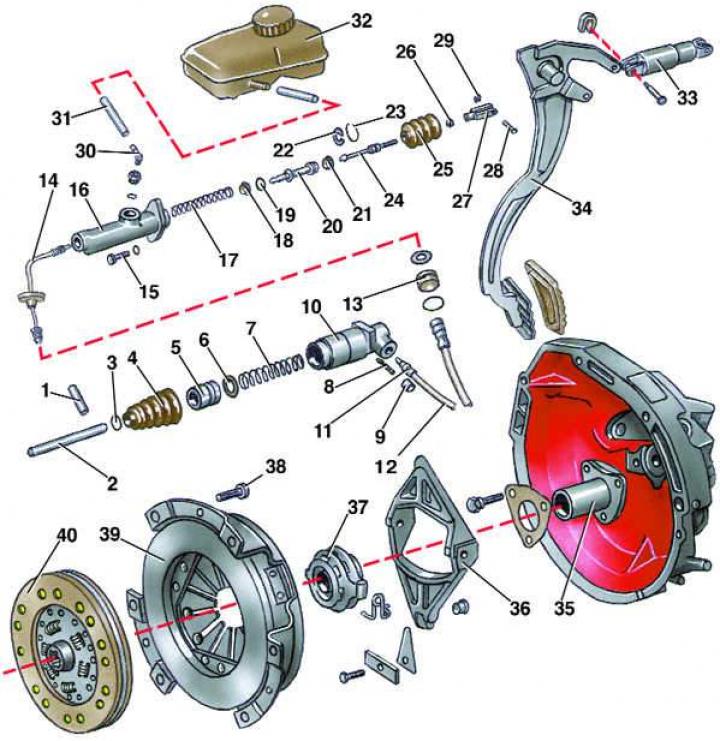


Hydraulically operated clutch

  • 1 - locking pin;
  • 2 - pusher;
  • 3 - retaining ring;
  • 4 - mudguard;
  • 5 - piston;
  • 6 - working cylinder cuff;
  • 7 - spring;
  • 8 - bleed valve;
  • 9 - protective cap;
  • 10 - working cylinder body;
  • 11 - nipple;
  • 12 - hose;
  • 13 - coupling sleeve;
  • 14 - tube;
  • 15 - bolt;
  • 16 - cylinder body;
  • 17 - return spring;
  • 18, 21 - cuffs;
  • 19 - bypass ring;
  • 20 - piston;
  • 22 - locking bracket;
  • 23 - retaining ring;
  • 24 - pusher;
  • 25 - mudguard;
  • 26 - lock nut;
  • 27 - Pusher fork;
  • 28 - finger;
  • 29 - retaining ring;
  • 30 - nipple;
  • 31 - working fluid supply pipe;
  • 32 - tank;
  • 33 - return spring;
  • 34 - clutch pedal;
  • 35 - guide bushing;
  • 36 - clutch release fork;
  • 37 - clutch release bearing;
  • 38 - bolt;
  • 39 - pressure plate assembly;
  • 40 - driven disk

Removal


1. Disconnect the wire from the negative terminal of the battery.

2. Disconnect the working fluid supply pipe from the master cylinder and plug the opening in the pipe.

3. Remove the lower left instrument panel trim to gain access to the master cylinder mount.


4. Disconnect the tube from the end of the master cylinder by unscrewing the fastening nut and plug the tube hole.

5. Disconnect the push rod fork from the clutch pedal by removing the retaining ring and removing the pin.

6. Loosen the two mounting bolts and remove the master cylinder from the vehicle.

Disassembly


1. Clean the master cylinder from dirt.

2. Remove the mudguard from the master cylinder body.

3. Remove the retaining ring and remove the pusher from the housing.

4. Push the piston out of the cylinder body through the end hole using a suitable rod until it appears from the cylinder. Finally remove the piston from the cylinder body together with the return spring.

5. Remove the spring from the piston and cuff.

Inspection and defect detection of master cylinder parts


1. Wash the master cylinder parts with clean brake fluid and dry.

2. The mirror of the main cylinder should not have any scratches, cavities or corrosion spots. If these defects are present, the cylinder must be replaced. There should be no mechanical damage on the threaded parts of the cylinder.

3. The master cylinder seals must be elastic and flexible. Torn, swollen and hardened seals, as well as those with scratches on the working surfaces, must be replaced.

4. The end of the pusher and the mating surface of the piston should not have any obvious signs of one-sided wear. The surfaces of the piston that contact the cylinder mirror should also not have any signs of one-sided wear. Otherwise, it is recommended to replace the pusher and piston. The piston valve should not have any visible signs of deformation and should fit tightly to the end of the piston.


5. The master cylinder mudguard must not have any cracks or through holes. It must be installed on the pushrod and the master cylinder body with a slight tension. Otherwise, replace the mudguard.

6. The spring must have elastic properties. Breakage of the spring is not allowed.

7. The threads of the tube and hose tips must not have any mechanical damage. The nozzles of the tips must not have any cracks or traces of visible deformation.

Assembly


1. Lubricate the cuff with clean brake fluid and install it on the spring, orienting the working edge towards the spring.

2. Carefully insert the spring into the cylinder body.

3. Lubricate the cuff with clean brake fluid and install it on the piston, orienting the working edge towards the spring.

4. Insert the piston with the bypass ring placed on it into the cylinder body.

5. Install the locking bracket onto the pushrod if it was removed.

6. Insert the push rod into the cylinder body and install the retaining ring.

7. Install the mudguard onto the cylinder body.

Installation


Install the clutch master cylinder in the reverse order. Tighten the master cylinder mounting bolts to 20 N·m (2.0 kgf·m). After installation, bleed the clutch hydraulic drive (see subsection 7.3.4).

Adjusting the clutch pedal free travel


1. Loosen the pushrod fork lock nut.

2. By unscrewing or screwing the pusher by hand or with pliers, achieve a position of the clutch pedal relative to the brake pedal of 10 mm.

3. Tighten the lock nut.

The original article is located on the online resource Audimanual.ru
The article was checked by auto expert Daniil Ushakov
This article is available at russian, bulgarian, belarusian, ukrainian, serbian, croatian, romanian, polish, slovak, hungarian

Share information:
Previous articles
Audi 100 C3: Clutch
Next articles

Adjusting the clutch pedal free travel
Replacing the clutch release bearing
Clutch installation
Inspection and defect detection of clutch parts
Clutch slave cylinder
Clutch Release Bearing (1988+ Models)
Bleeding the clutch release drive system


Similar articles on other Audi car models:
Clutch Master Cylinder — Removal, Overhaul and Installation Audi 80 B3 (1986-1991, petrol)
Lubrication of door latches and lock cylinder Audi A3 Type 8L (1996-2003)
Clutch Master Cylinder — Removal, Repair and Installation Audi A4 B5 (1994-2001)
Clutch release master cylinder Audi A6 C4 (1994-1997)
Clutch master cylinder Audi A8 D2 (1994-2002)
Instructions for removing and installing the clutch master and… Audi Q5 Type 8R (2008-2017)
Removal and installation the clutch master cylinder Audi A2 (1999-2005)
Link to this page in different formats


Visitor comments

No comments yet


How much will 31 + 15 =


100(C4, 1990-1994) 
  • General information
  • User manual
  • Power unit
  • Engine repair
  • Ignition system
  • Fuel system (gasoline)
  • Fuel system (diesel)
  • Lubrication system
  • Cooling system
  • Exhaust system
  • Transmission
  • Clutch
  • Car gearbox
  • Drive shafts
  • Chassis
  • Car suspension
  • Steering
  • Wheels and tires
  • Brake system
  • Body
  • Ventilation and heating
  • Body repair
  • Electrical equipment
  • Power devices
  • Lighting and appliances
  • Electrical circuits
 
100(C4, 1990-1994, petrol) 
  • General information
  • Operation and maintenance
  • Power unit
  • Engine repair
  • Exhaust system
  • Cooling system
  • Supply system
  • Air filter
  • Mono-Motronic injection system
  • Digifant injection system
  • KE-III-Jetronic and KE-Motronic
  • MPI and MPFI injection system
  • Transmission
  • Clutch
  • Car gearbox
  • Chassis
  • Suspension and steering
  • Brake system
  • Wheels and tires
  • Body
  • Exterior
  • Interior
  • Electrical equipment
  • Fuses and relays
  • Power devices
  • Ignition system
  • Lighting and signaling
  • Equipment and devices
  • Electrical circuits
 
100(C3, 1982-1990) 
  • General information
  • User manual
  • Maintenance
  • Specifications
  • Power unit
  • Engines 4-cylinder
  • Engines 5-cylinder
  • Diesel engine
  • Cooling system
  • Power system (carburetor)
  • Power system (injector)
  • Fuel system (diesel)
  • Transistor ignition system
  • Electronic ignition system
  • Transmission
  • Clutch
  • 4 speed gearbox 014
  • 5 speed gearbox 013 and 093
  • 5 speed gearbox 016 and 012
  • Shift mechanism KP 016
  • Automatic transmission
  • Front wheel drive
  • Chassis
  • Front suspension
  • Rear suspension
  • Steering
  • Brake system
  • Body
  • Body elements
  • Electrical equipment
  • Lighting and appliances
  • Power devices
  • Electrical circuits
 
100(C3, 1982-1990, petrol) 
  • General information
  • Maintenance and operation
  • 4 cylinder engine
  • Engine repair
  • Cooling and lubrication system
  • Supply system
  • Ignition system
  • 5 cylinder engine
  • Engine repair
  • Cooling and lubrication system
  • Supply system
  • Ignition system
  • Transmission
  • Clutch and drive shafts
  • 4 speed gearbox 014
  • 5 speed gearbox 013 and 093
  • 5 speed gearbox 016 and 012
  • Automatic gearbox
  • Chassis
  • Steering
  • Front suspension
  • Rear suspension
  • Brake system
  • Body
  • Body elements
  • Doors, locks and windows
  • Body repair
  • Electrical equipment
  • Equipment and devices
  • Power devices
  • Electrical circuits
 
100(C3, 1982-1990, diesel) 
  • General information
  • User manual
  • Maintenance
  • Troubleshooting
  • Power unit
  • Engine in a car
  • Engine removed
  • Cooling system
  • Fuel system
  • Exhaust system
  • Starting and charging
  • Preheating
  • Transmission
  • Clutch
  • Mechanical gearbox
  • Automatic gearbox
  • Drive shafts
  • Chassis
  • Brake system
  • Suspension
  • Steering
  • Body
  • Exterior
  • Interior
  • Electrical equipment
  • Equipment and devices
  • Electrical circuits
 
AudiManual.ru © 2017-2026 · Mobile version · Feedback · Sitemap: EN BG BY UA RS HR RO PL SK HU · Site search · News and articles
80 B2 · 80 B3 petrol · 80 B3 · 80 B4 · 100 C3 diesel · 100 C3 petrol · 100 C3 · 100 C4 petrol · 100 C4 · A3 Type 8L · A4 B5 petrol · A4 B5 · A4 B6 petrol · A4 B6 · A4 B7 · A4 B8 · A6 C4 · A6 C5 · A6 C5 Allroad · A8 D2 · Q5 Type 8R · Q7 Typ 4L · Audi A2 ·
This site uses cookies 🍪. Click the button to accept this fact.