
Repair Chevrolet Repair Toyota Repair Honda Repair AvtoVAZ Repair Mercedes-Benz Repair BMW Repair Opel
Home  |  Contacts  |  Sitemap  |    
English Русский
Български
Беларускі
Український
Српски
Hrvatski
Română
Polski
Slovenský
Magyar
AudiManual.ru


  • AUDI 80
  • AUDI 100
  • AUDI A3
  • AUDI A4
  • AUDI A6
  • AUDI A8
  • AUDI Q
  • OTHER
  • ARTICLES
C4 (1990-1994) C4 (1990-1994, petrol) C3 (1982-1990) C3 (1982-1990, petrol) C3 (1982-1990, diesel)

Operating principle of turbocharger of MPI and MPFI injection system (Audi 100 C4)

  • Home
  • Audi 100
  • C4 (1990-1994)
  • Power unit
  • Fuel system (gasoline)
  • Operating principle of turbocharger of MPI and MPFI injection system
            0
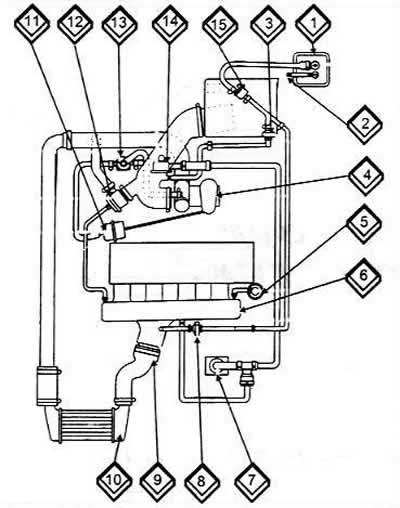
1 Activated carbon filter

1 Activated carbon filter
2 Ventilation line from the fuel tank
3 Check valve for activated carbon tank
4 Exhaust-driven turbocharger
5 Fuel pressure regulator
6 Intake manifold (fuel line)
7 Engine crankcase ventilation
8 Check valve for activated carbon tank
9 Connection on the throttle body
10 Charge air cooler
11 Charge air cooler pressure tank
12 Coasting cut-off valve
13 Magnetic valve for limiting discharge pressure
14 Crankcase ventilation pressure limiting valve
15 Electrically controlled valve for activated carbon filter.


A turbocharger provides better cylinder filling when the fuel-air mixture is forced into the cylinders under pressure. The turbocharger is driven using the energy of the exhaust gases.
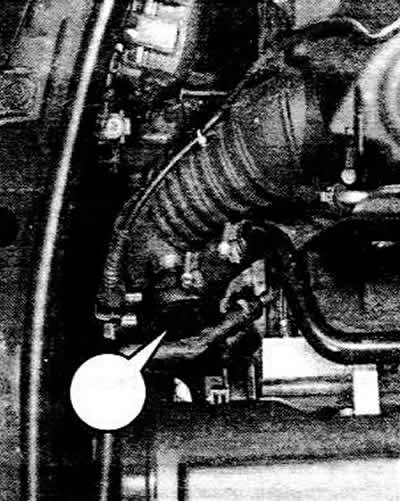
The arrow shows the crankcase ventilation system pressure limiting valve.

The arrow shows the crankcase ventilation system pressure limiting valve.


To keep the pressure generated within certain limits, a boost pressure regulator must be installed in the system. Its task is to open the magnetic valve when the pressure is too high, so that only part of the flow can pass through the turbine wheel of the turbocharger.
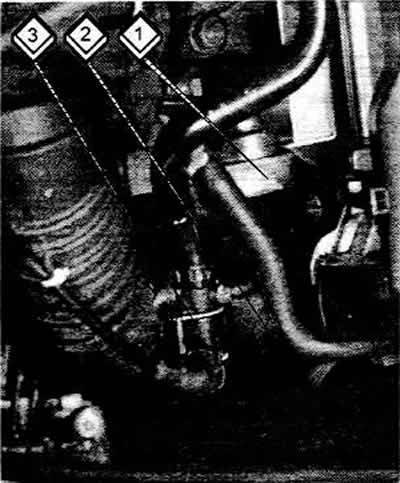


1 Capacity of charge air cooler

1 Capacity of charge air cooler
2 Coasting cut-off valve
3 Magnetic valve for limiting the supercharger pressure


In order to keep the regulation under control under all operating conditions, the injection/ignition control unit is activated. An electropneumatic valve controls the turbocharger bypass via a booster tank. When the valve is open, the boost pressure drops. The control unit also ensures that the required boost pressure is always provided. In addition, the height controller is connected to the control unit (installed in the electronic unit in the engine compartment), which ensures that when operating the vehicle at high altitude, the reduced air density does not interfere with the normal operation of the turbocharger. In this case, the boost pressure is increased so that, while the amount of fuel injected remains the same, more air enters the cylinders, i.e. the fuel-air mixture remains unchanged.

The turbocharging system also includes a coasting cutoff valve. The purpose of this valve is as follows:
  • Turbocharger pressure with throttle closed (foot off the gas pedal) has no outlet, i.e. the back pressure acts against the turbocharger and its speed decreases. To prevent this, the valve opens the outlet. The air can then be diverted back to the inlet side and the turbocharger restores its speed.
  • As soon as the driver presses the gas pedal, the valve closes. Since the turbocharger then operates at high speeds, it can immediately supply air under pressure again, i.e. there is no "dip" during acceleration, as was previously the case with previous models of engines with a turbocharger.
  • The system also includes a charge air cooler (intercooler). What is its job? The outside air entering through the air filter is accelerated and compressed in the turbocharger. Since the turbocharger, driven by hot exhaust gases, also gives off heat to the air, i.e. heats it, this leads to overheating of the incoming air, due to which the oxygen contained in it loses its activity before it gets into the engine.
  • Charge air cooler installed between the turbocharger and the intake manifold (also called an intercooler) cools the air sufficiently before it enters the engine. Due to this, the air becomes denser and brings in more oxygen, which is important for the formation of the fuel-air mixture. The filling of the cylinders is improved and the engine power increases.
The article was checked by auto expert Georgy Rodionov
This article is available at russian, bulgarian, belarusian, ukrainian, serbian, croatian, romanian, polish, slovak, hungarian

Share information:
Previous articles
Audi 100 C4: Fuel system (gasoline)
Next articles

Technical characteristics of MPI and MPFI injection systems
Checking the injectors of the MPI and MPFI injection system
Fuel injector of MPI and MPFI injection system — removal and…
Measuring the pressure in the fuel line of the MPI and MPFI…
Malfunctions of the turbocharger of the MPI and MPFI injection…
Removal and installation of turbocharger of MPI and MPFI…


Similar articles on other Audi car models:
Fuel system of diesel engines TD Distribution fuel injection… Audi 80 B4 (1991-1996)
Fuel injection system device (petrol) Audi A3 Type 8L (1996-2003)
MPI and MPFI injection system Audi A4 B5 (1994-2001, petrol)
Checking the ignition and fuel injection system Audi A6 C5 (1997-2004)
General information about the ignition and fuel injection system Audi A8 D2 (1994-2002)
Injection system Audi Q5 Type 8R (2008-2017)
Design and operating principle of the steering system Audi A2 (1999-2005)
Link to this page in different formats


Visitor comments

No comments yet


How much will 39 + 50 =


100(C4, 1990-1994) 
  • General information
  • User manual
  • Power unit
  • Engine repair
  • Ignition system
  • Fuel system (gasoline)
  • Fuel system (diesel)
  • Lubrication system
  • Cooling system
  • Exhaust system
  • Transmission
  • Clutch
  • Car gearbox
  • Drive shafts
  • Chassis
  • Car suspension
  • Steering
  • Wheels and tires
  • Brake system
  • Body
  • Ventilation and heating
  • Body repair
  • Electrical equipment
  • Power devices
  • Lighting and appliances
  • Electrical circuits
 
100(C4, 1990-1994, petrol) 
  • General information
  • Operation and maintenance
  • Power unit
  • Engine repair
  • Exhaust system
  • Cooling system
  • Supply system
  • Air filter
  • Mono-Motronic injection system
  • Digifant injection system
  • KE-III-Jetronic and KE-Motronic
  • MPI and MPFI injection system
  • Transmission
  • Clutch
  • Car gearbox
  • Chassis
  • Suspension and steering
  • Brake system
  • Wheels and tires
  • Body
  • Exterior
  • Interior
  • Electrical equipment
  • Fuses and relays
  • Power devices
  • Ignition system
  • Lighting and signaling
  • Equipment and devices
  • Electrical circuits
 
100(C3, 1982-1990) 
  • General information
  • User manual
  • Maintenance
  • Specifications
  • Power unit
  • Engines 4-cylinder
  • Engines 5-cylinder
  • Diesel engine
  • Cooling system
  • Power system (carburetor)
  • Power system (injector)
  • Fuel system (diesel)
  • Transistor ignition system
  • Electronic ignition system
  • Transmission
  • Clutch
  • 4 speed gearbox 014
  • 5 speed gearbox 013 and 093
  • 5 speed gearbox 016 and 012
  • Shift mechanism KP 016
  • Automatic transmission
  • Front wheel drive
  • Chassis
  • Front suspension
  • Rear suspension
  • Steering
  • Brake system
  • Body
  • Body elements
  • Electrical equipment
  • Lighting and appliances
  • Power devices
  • Electrical circuits
 
100(C3, 1982-1990, petrol) 
  • General information
  • Maintenance and operation
  • 4 cylinder engine
  • Engine repair
  • Cooling and lubrication system
  • Supply system
  • Ignition system
  • 5 cylinder engine
  • Engine repair
  • Cooling and lubrication system
  • Supply system
  • Ignition system
  • Transmission
  • Clutch and drive shafts
  • 4 speed gearbox 014
  • 5 speed gearbox 013 and 093
  • 5 speed gearbox 016 and 012
  • Automatic gearbox
  • Chassis
  • Steering
  • Front suspension
  • Rear suspension
  • Brake system
  • Body
  • Body elements
  • Doors, locks and windows
  • Body repair
  • Electrical equipment
  • Equipment and devices
  • Power devices
  • Electrical circuits
 
100(C3, 1982-1990, diesel) 
  • General information
  • User manual
  • Maintenance
  • Troubleshooting
  • Power unit
  • Engine in a car
  • Engine removed
  • Cooling system
  • Fuel system
  • Exhaust system
  • Starting and charging
  • Preheating
  • Transmission
  • Clutch
  • Mechanical gearbox
  • Automatic gearbox
  • Drive shafts
  • Chassis
  • Brake system
  • Suspension
  • Steering
  • Body
  • Exterior
  • Interior
  • Electrical equipment
  • Equipment and devices
  • Electrical circuits
 
AudiManual.ru © 2017-2026 · Mobile version · Feedback · Sitemap: EN BG BY UA RS HR RO PL SK HU · Site search · News and articles
80 B2 · 80 B3 petrol · 80 B3 · 80 B4 · 100 C3 diesel · 100 C3 petrol · 100 C3 · 100 C4 petrol · 100 C4 · A3 Type 8L · A4 B5 petrol · A4 B5 · A4 B6 petrol · A4 B6 · A4 B7 · A4 B8 · A6 C4 · A6 C5 · A6 C5 Allroad · A8 D2 · Q5 Type 8R · Q7 Typ 4L · Audi A2 ·
This site uses cookies 🍪. Click the button to accept this fact.