



Table of contents: Checking the generator charging… ↓ Checking the brushes ↓ Driving with a non-working generator ↓
The generator can be considered as maintenance-free. Only after a very long mileage may it happen that it will be necessary to replace the brushes. Before carrying out other work on the generator, it is recommended to check the charging current, the number of revolutions, etc. on a test bench before installing it. Before replacing the generator, the following operations can be performed.
Checking the generator charging voltage
A voltmeter is required for this operation. The voltage can be used to determine whether the battery is being recharged sufficiently.
Connect a voltmeter between ground and the thick red wire on the generator.
Start the engine and increase its speed slightly.
Check the voltmeter readings. If the voltage is between 13.3 and 14.6 V, it is correct.
If the measured voltage is much lower than the specified values, you need to check the brushes. Another reason could be a faulty voltage regulator. If the brushes look good, then the generator itself is faulty.
Checking the brushes
Although the work can be done with the generator installed, it is still better to remove it.
Remove the cover from the back of the generator. It is secured with three bolts in the middle.
On the top of the generator, remove the voltage regulator by unscrewing one bolt on the left and one on the right.
Take the regulator and carefully pull it out.
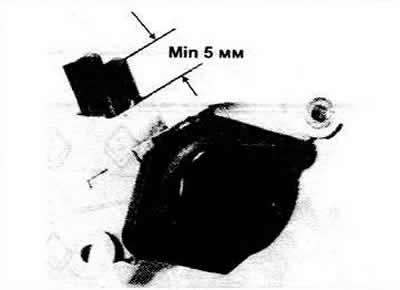
Measure the length of the carbon brushes protruding from the brush mount. New brushes are 13 mm long, which must be taken into account when measuring. Brushes less than 5 mm long mean they need to be replaced, i.e. the entire regulator with the brushes must be replaced. However, it is possible to replace only the brushes, but this is more difficult and requires soldering them to the mount.
Driving with a non-working generator
If it is determined that the generator no longer charges the battery (the control lamp is on), then this is not a reason for despair. During the day, with such a malfunction, you can move for several more hours (assuming the AB is in good condition). In this case, you need to proceed as follows:
Try not to turn off the engine, because the starter consumes a lot of current when starting. If you still need to do this, you need to stop on a slope so that you don't have to use the starter when starting the engine.
Turn off the rear window defroster, receiver and heating.
In light rain, use the windshield wiper pause mode.
When driving at night, use only low beam. Do not turn on additional headlights.
If it is determined that the generator is faulty, then you can disconnect the wire from it and insulate it to prevent current leakage from the battery through the generator.
(This article was copied from the website AUDIMANUAL.RU)