



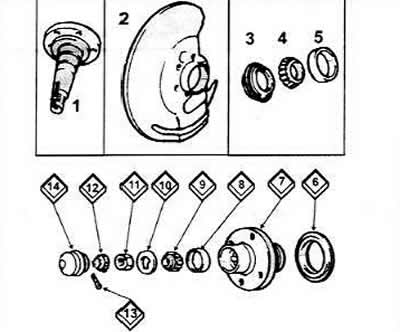
1 Rear axle axle
2 Shield (with rear disc brakes)
3 Seal
4 Inner wheel bearing
5 Inner bearing ring
6 Rotor (only for vehicles with ABS)
7 Wheel hub (disc brake)
8 Outer bearing ring
9 Outer wheel bearing
10 Pressure washer
11 Nut
12 Crown retainer
13 Split pin
14 Grease cap
Each side requires a new 4x30 cotter pin, inner and outer bearing and seal.
Remove the brake drum.
For vehicles with rear disc brakes, the brake discs are removed together with the wheel hub. The rest of the removal is carried out as with drum brakes.
Pry up the seal at the rear in the middle of the wheel hub, remove the bearing and remove the old grease from the hub.
Pull the rings of both bearings out of the center of the wheel hub. To do this, place a brass rod in different places of the ring and knock the ring out with light blows of a hammer. Be careful not to skew the ring.
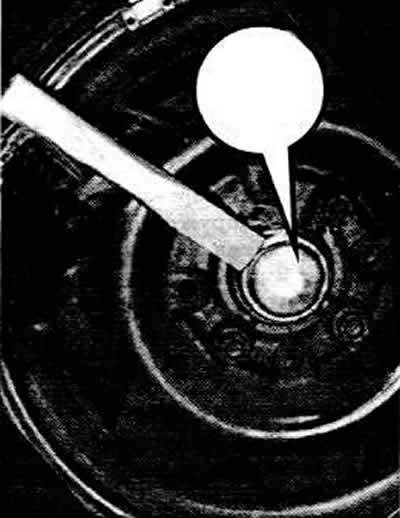
Insert a new bearing ring into the wheel hub. Put the old ring on it for protection (thick side down), so as not to damage the surface of the new ring when driving it in carefully.
Drive the bearing rings in until they stop.
Remove the old bearing ring that was inserted earlier for protection.
Fill the space between both bearing rings with grease, and also lubricate the rings and bearings themselves.
Insert the inner ring.
Tap the seal evenly on the inside using a rubber hammer.
Slide on the brake drum or disc.
Insert the outer wheel bearing and thrust washer.
Tighten the hex nut onto the axle by hand, rotating the wheel at the same time to avoid distorting the bearing.
Adjust the wheel bearing.
For vehicles with rear disc brakes, install a rear caliper (see next section). Press the brake pedal several times
Adjusting the rear wheel bearing.
Raise and support the car from behind.
Remove the hub cap, cotter pin and crown retainer.
Tighten the hex nut (2) lightly and carefully, turning the wheel at the same time so as not to jam the bearing.
Loosen the nut a little.
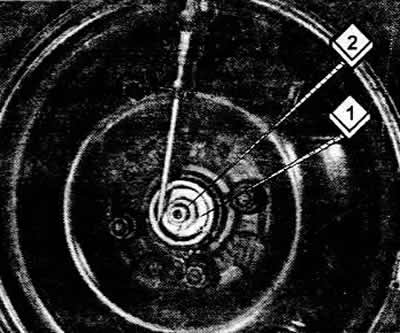
The clearance is adjusted correctly when the pressure washer (1) behind the nut can be moved by applying moderate pressure with a screwdriver. Do not rest the blade of the screwdriver on the edge of the wheel hub.
If the locking pin cannot be pushed into the crown lock at this time, the nut must be turned slightly in the tightening direction.
Hammer the hub cap with a rubber mallet, placing a rag underneath.
Content source: the specified website: audimanual.ru