



Table of contents: Removal ↓ Installation ↓
Removal
1. The bearings are installed in the rear hub/brake disc. Removal details are described in paragraph 7 chapter 9.
2. Wipe the inner bearing and seal. Remembering the way the seal is installed, remove it from the hub with a screwdriver, being careful not to damage the ABS adjusting disk. Remove the inner bearing from the hub.
3. The outer bearing races can be pressed out using a soft drift, try not to damage the ABB timing disk (Fig. 9.3).
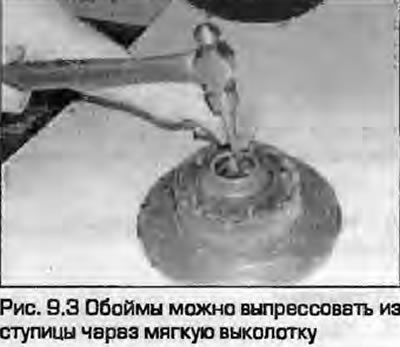
4. Clean the hub thoroughly, removing all traces of grease and dirt. Remove any burrs that may interfere with pressing in the new bearing. Check for cracks or other damage to the hub; replace it if necessary. The outer races are pressed in with a mandrel of a suitable diameter on both sides of the hub, completely and evenly. If you are installing the old bearing, install the old races as well. Never install new bearings with old races and vice versa.
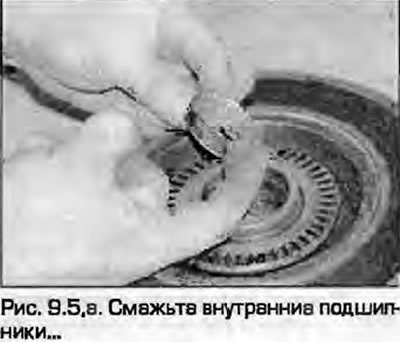
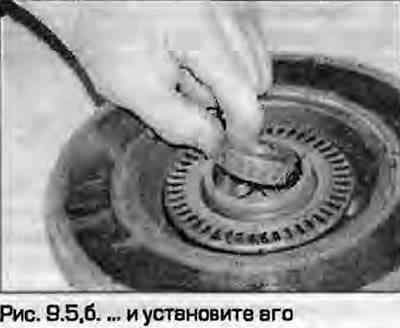
5. Lubricate the inner bearing and install it in place (fig. 9.5, a, b).
 |
 |
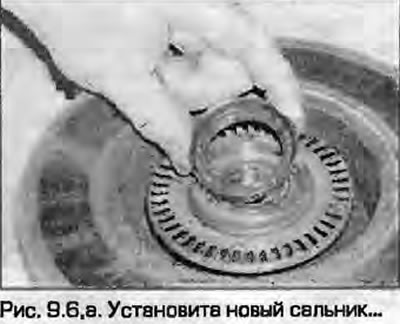
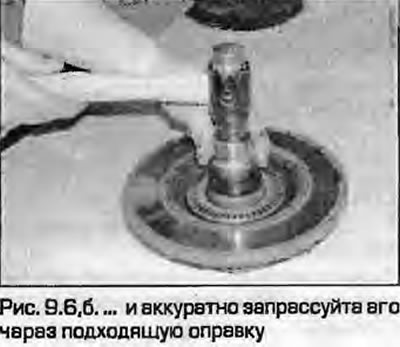
6. Install the hub with the outer surface down and press in the new seal, being careful not to damage the ABS timing disc (if provided). Before installing the hub on the axle, lubricate the working lips of the seal (fig. 9.6, a, b).
 |
 |
7. As described in paragraph 7 of chapter 9, pack the hub with grease and install it on the axle. Install the outer bearing, thrust washer and hub nut. Adjust the bearing as described in paragraph 8, install the retaining ring, cotter pin and cap.
Installation
7. Check during assembly (if possible) presence of grease in the bearing. Lightly lubricate the inner and outer surfaces of the bearing with transmission oil to facilitate pressing.
8. Securely support the hub. Evenly press the bearing, resting on the outer race with a cylindrical mandrel.
9. Make sure that the bearing is pressed all the way into the shoulders and secure it with a retaining ring. Make sure that the retaining ring is fully seated in the groove.
10. Install the brake disc or drum as described in chapter 9.