



If the filter has not been replaced in time and the filter paper is clogged with dirt, the safety valve opens, bypassing the oil filter and the oil supply is ensured.
From the filter, the lubricant passes through the holes in the cylinder block to the lubrication points of the crankshaft and intermediate shaft (4 cylinder engine only) and the cylinder head with the camshaft. Through the holes, the oil flows back into the oil pan, from where the oil pump can take it again for the next cycle.
Oil pump
At full load, 30 liters of oil pass through the engine per minute:
- In a 4-cylinder engine, the already mentioned intermediate shaft is the drive element for the distributor shaft, which transmits rotation to the oil pump.
- In 5- and 6-cylinder engines, the oil pump is located in the direction of travel at the front directly on the crankshaft.
The way oil pumps operate also varies between Audi engines.
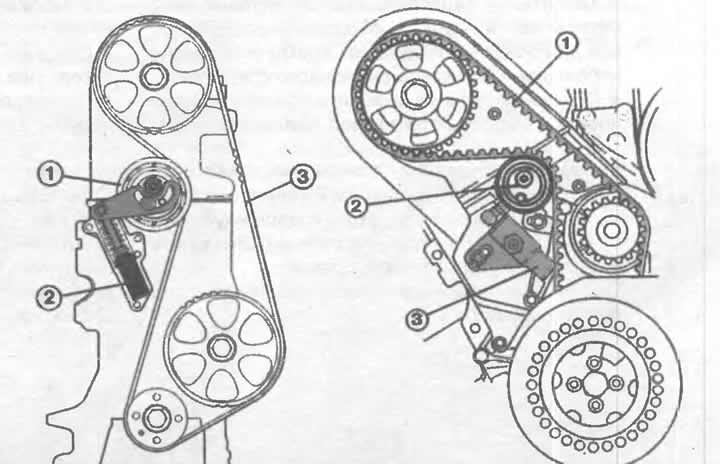
The toothed belts of the 4- and 5-cylinder engines are equipped with so-called temperature-sensitive tension rollers.
Left: Timing belt drive of a 4-cylinder engine.
1 - tension roller;
2 - thermoelement;
3 - toothed belt.
Right: Timing belt drive of a 5-cylinder engine.
1 - toothed belt;
2 - tension roller;
3 — thermoelement.
- The 4-cylinder engine is equipped with a gear oil pump. Two identically sized gears that fit into each other simply pump oil from the intake side to the discharge side.
- The 5- and 6-cylinder engines are lubricated by a rotary oil pump of the Eaton system. The rotating gears pump the oil to the outlet side of the pump and from there to the lubrication channels.
Oil temperature
The oil temperature is very important for reliable engine operation. This information is only available to the Audi driver via the built-in additional instruments. For comparison purposes, the engine oil temperature at the oil filter flange or in the oil pump is interesting; the oil is coldest there. On the piston rings, on the contrary, temperatures of up to 300°C can prevail. If your car is equipped with an oil thermometer, then you should remember: Audi shows a temperature of 145°C in the oil pan as the maximum permissible.
However, too low an oil temperature is also harmful to the engine. In this case, the oil has not yet reached its full lubricating capacity. Therefore, after a cold start, you should, if possible, not accelerate the engine above 3500 rpm until the oil temperature has risen to approximately 60°C. It is believed that engine oil, compared to coolant, requires approximately twice as much time before it reaches its operating temperature.
Oil pressure
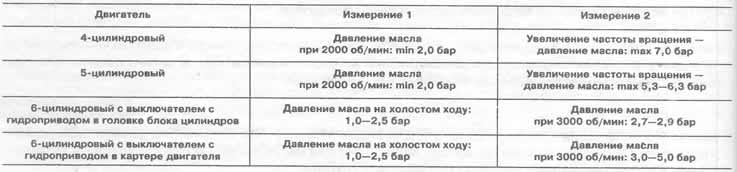
If your car has a built-in oil pressure gauge, you can check the oil pressure yourself within the accuracy of the measuring instruments. Test conditions: seasonal oil of class SAE 20 W/20, oil temperature 80°C. You should get the following readings:
However, the oil pressure in the Audi is monitored perfectly well even without instruments. This is ensured by two hydraulically operated switches. You will learn more about this monitoring system in the chapter "Instruments and auxiliary devices".