



| Engine marking and production date | AAE since 11/90 | AAD up to 6/92 | AVK since 7/92 | AAR from 12/90 | ABC since 5/92 | AAN S 12/90 |
| Number of cylinders | 4 | 4 | 4 | 5 | 6 | 6 |
| Power, kW (hp) | 74 (101) | 85 (115) | 85 (115) | 98 (133) | 110 (150) | 128 (174) |
| At rpm | 5500 | 5400 | 5400 | 5500 | 5750 | 5500 |
| Volume, cm³ | 1984 | 1984 | 1984 | 2309 | 2598 | 2771 |
| Preparation of combustible mixture | Mono-Motronic | KE-Motronic | Digifant | KE-III-Jetronic | MPFI | MPI |
4-cylinder engine
Originally designed for the Audi 80, this engine is also used for the Audi 100 and Volkswagen models Golf and Passat. Its most important design features: 4-cylinder engine with overhead camshaft. Valve drive is carried out by means of hydraulic plate tappets. The intermediate shaft drives the oil pump and ignition distributor. The drive of the camshaft and intermediate shaft is carried out by means of a toothed belt.
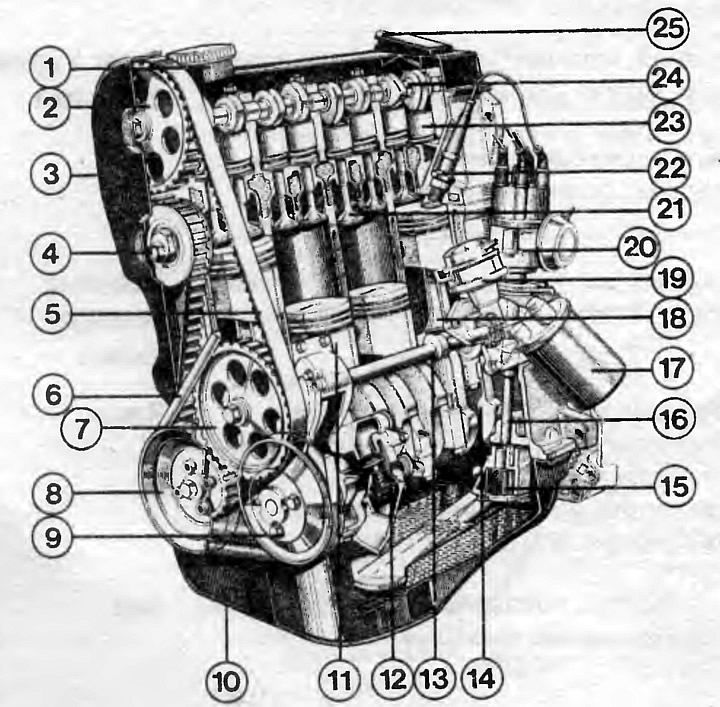
4-cylinder engine in section:
1 - oil filler neck;
2 - camshaft gear wheel;
3 - toothed drive belt cover;
4 - tensioner for toothed drive belt;
5 - toothed drive belt;
6 - V-belts;
7 — intermediate shaft gear (ignition distributor and oil pump drive);
8 — crankshaft V-belt pulley;
9 — pulley of V-belt drive of water pump;
10 - oil pan;
11 — piston;
12 — thermostat;
13 — intermediate shaft;
14 - crankshaft with counterweights;
15 - oil pump;
16 - drive shaft for oil pump and ignition distributor;
17 - oil filter;
18 — connecting rod;
19 — fuel pump;
20 — ignition distributor;
21 — intake valve 3 cylinder;
22 — spark plug;
23 - hydraulic tappet with valve springs;
24 — camshaft;
25 — crankcase ventilation.
5-cylinder engine
The basic design features of the 4 - cylinder engine are the same as those of the 5 - cylinder engine, which was first introduced in 1976 on the Audi 100. It is enough to name just two common features: this engine also has a toothed belt to drive the camshaft and coolant pump, and this engine uses hydraulic plate tappets to actuate the valves.
The design of the crankshaft of the 5-cylinder engine is especially interesting: the crankpins of the crankshaft are at an angle of 72 to each other, for each cylinder there are two counterweights on the shaft. Further: a specially organized flywheel imbalance and also a damper on the front end of the crankshaft serve to absorb torsional vibrations.
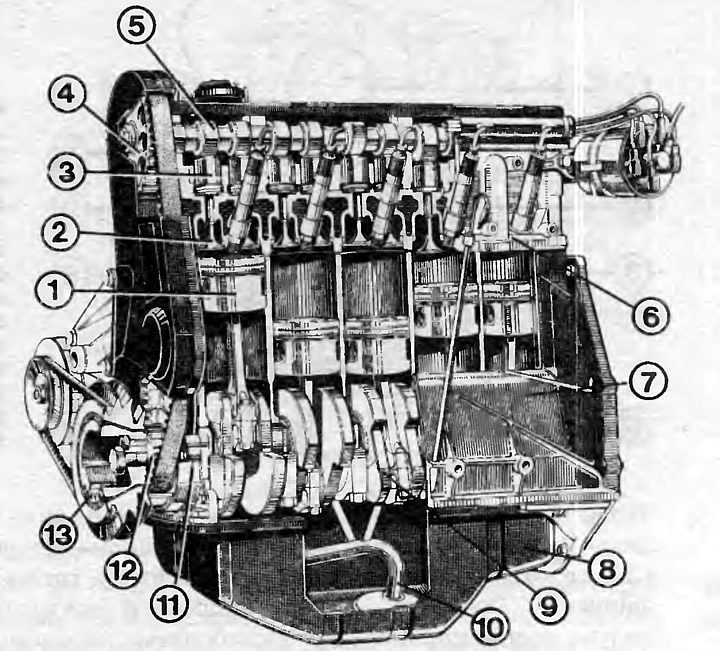
5-cylinder engine in section:
1 — piston;
2 — valve;
3 - hydraulic tappets;
4 - toothed pulley of the camshaft belt;
5 — camshaft;
6 — cylinder head;
7 — engine cylinder block;
8 - oil pan;
9 — crankshaft;
10 — oil pump inlet pipe;
11 - oil pump;
12 — toothed pulley of the crankshaft belt;
13 — V-belt drive pulley with damper on the crankshaft.
6-cylinder engine
The newly developed V6 engine for the fourth generation of the Audi 100 in 1991 is a very compact unit, specially designed for longitudinal installation. Two overhead camshafts driven by toothed belts control the valves via plate tappets. The space between the cylinder heads houses the exhaust manifold. The 2.8-liter version has a variable-length intake manifold, which changes the active length of the intake ports depending on the speed range. This ensures optimum engine torque in all speed ranges. Also worth mentioning is the distributorless ignition system, which is described in more detail in Chapter "Ignition system".
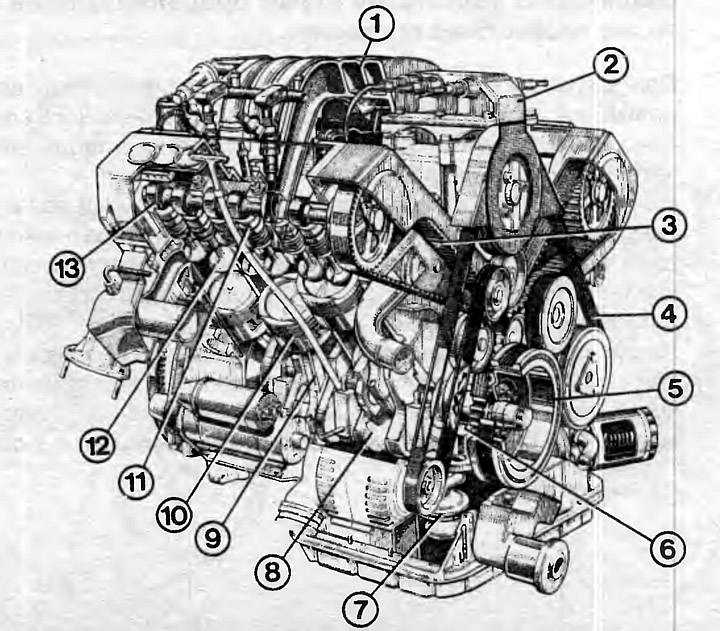
6-cylinder engine in section:
1 - intake gas line;
2 - ignition coil pack;
3 - toothed belt;
4 - poly V-belt;
5 - pulley with damper on the crankshaft;
6 - oil pump;
7 - oil pump inlet pipe;
8 — crankshaft;
9 — connecting rod;
10 — piston;
11 - hydraulic tappets;
12 — valve;
13 — camshaft.
The article is a reprint of material from: Audimanual.ru