



Table of contents: Oil viscosity ↓ Choosing the Right Motor Oil ↓ How often should I change my oil? ↓
Since there is a risk of sludge formation in the oil sump with relatively long, 15,000 km, oil change intervals, Audi/VW has issued strict oil specifications.
- Conventional mineral oil must comply with VW-Norm 50101. In this case, it has sufficient cleaning properties to prevent sediment formation.
- Oils with good antifriction properties reduce internal friction in the engine. They must comply with VW-Norm 500 00.
- Only if one of the oils listed above is not available, can all-season or seasonal oils of the API SF and API SG categories be used for topping up.
Note: factors such as the price of the oil or its origin do not say anything about its quality!
Oil viscosity
The fluidity of the oil, i.e. its viscosity, must meet the requirements for use in a given engine. In this case, two criteria should be kept in mind:
- The oil should not be too viscous, since the starter must be able to turn over a cold engine, and the places where oil gets into the engine must be lubricated immediately after starting a cold engine.
- The oil should not be too thin, because at high temperatures and engine speeds the lubricating film may break.

To check the oil level, pull the dipstick out of the guide tube on the left side of the engine. The oil level should be between the max and min marks, i.e. in the area of the ribbed surface (by the arrows) on the tip of the dipstick. The amount to be added between both marks is 1 l. The measurement will only be accurate when the car is on a horizontal surface.
Classes no SAE
The American Society of Automotive Engineers has classified oils into classes according to their viscosity. These classes start with thin winter oils SAE 5W, 10W, 15W through the intermediate stage SAE 20W/20 to viscous summer oils SAE 30, 40 and 50.
Seasonal oil
The cheapest motor oil used to be seasonal oil. For perfect lubrication of the engine, it must be filled with viscous or liquid seasonal oil according to the season. Seasonal oil is almost impossible to find at gas stations or supermarkets today, but it is still often used in car parks. It is suitable for use in the Audi-100 (and this is the opinion of the manufacturer himself) only as a temporary solution in a hopeless situation.
All-season oil
The production of the multigrade oil used today is more complex, and therefore multigrade oil is correspondingly more expensive than seasonal oil. As an additive that improves the viscosity index (the viscosity index of multigrade oil is "VI"), it contains long chains of molecules that "swell" when heated and lose volume again when cooled. In this case, the oil can "elastically" adapt to temperatures and cover many viscosity classes. SAE 15W-50 oil corresponds to viscosity class 15W at a temperature of -15°C, and to class 50 at 100°C.
The problem with all-season oils based on mineral oils is that the chains of molecules that improve viscosity decompose over time, and in this case the oil becomes less resistant to temperature effects. For this reason, Audi does not allow the use of all-season oils of the SAE 10W-30 and 10W-40 classes in its cars during the warm season.
Choosing the Right Motor Oil
Two criteria are decisive when buying motor oil. The oil must have:
- Correct oil specification. Deceptive labels on canisters are extremely rare, because manufacturers mutually control each other.
- Correct viscosity (viscous flow). It depends on the prevailing external temperature and can be traced on the upper graph.
Motor oil additives
"The use of additives - of any kind - in lubricating oils is contrary to our operating instructions. Damage resulting from the use of such additives is excluded from the warranty." This is Audi's opinion on additives to oils. The advisability of spending money on oil additives to extend the service life of an engine remains highly questionable, especially when considering the use of oils with high performance properties.
How often should I change my oil?
According to Audi's specifications, the oil should be changed every 15,000 km or at least once a year. We believe that a driver who drives exclusively long distances should also stick to the upper limit of 15,000 km. On the other hand, someone who uses an Audi mainly for short distances should change the oil much earlier. In the cold season, the latest after six months, regardless of the possibly low mileage. If used exclusively in the city, you should think about changing the oil after four months.
Note: Anyone who uses seasonal oil should consider changing it according to the seasons - spring and autumn - so that the oil is suitable for the outside temperatures.
Oil change - where and how?
- Engine oil should be changed on a warm engine so that when the oil drains, it washes away all the dirt.
- In our experience, oil changes are the most expensive at workshops because they only use very expensive grades of oil. In addition, the engine often cools down again before the used oil has time to drain. And the bill also includes at least the work of changing the oil filter.
- At gas stations, the car usually immediately goes to work. You can choose a cheaper oil from those sold at the gas station, and the price of the oil immediately includes work.
- There is nothing to object to changing the oil yourself by sucking out the old oil at the gas station, but only if the oil filter is also changed every 15,000 km. This can be done yourself.
What do you need for an oil change?
- Motor oil of the named grades (in most cases it can be purchased in a bargain priced five litre canister).
- New gasket for the oil drain plug thread.
- Oil filter, for example Audi - No.056 115 561 G for 4-cylinder engines, 035 115 561 for 5-cylinder engines, and also 034 115 561 A for 6-cylinder engines or under various manufacturer designations in auto shops.
- A container for used oil. An old oil canister with the side wall cut out or a large used saucepan will do.
- The waste oil canister is used to transport waste oil.
- Using an oil can makes it easier to pour in fresh motor oil.
- A clamp wrench will help you unscrew the oil filter.
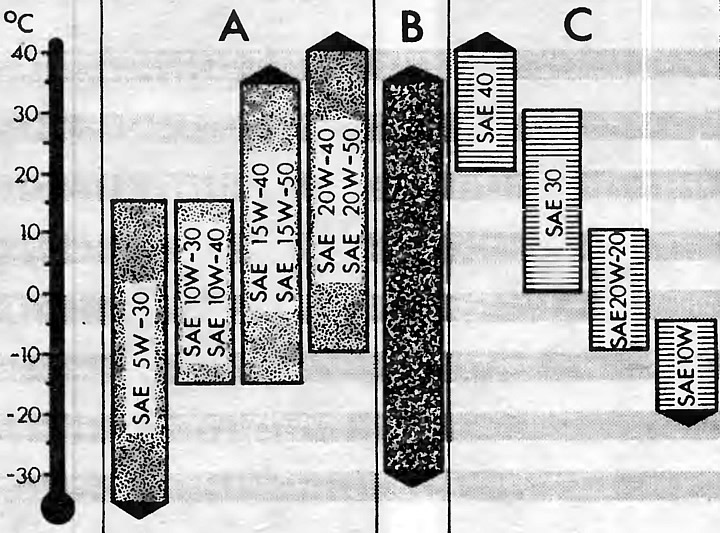
The graph shows Audi/Volkswagen's recommendations for oil viscosity:
A - all-season oils that meet the requirements of VW-Norm 50101;
B - oils with good antifriction properties, meeting the requirements of VW-Norm 500 00;
C — seasonal oils that meet the requirements of API-Norm SF or SG.
The temperature values given should be understood as long-term. Short-term fluctuations do not play any role.
(Text provided by the online resource: AUDIMANUAL)