
Repair Chevrolet Repair Toyota Repair Honda Repair AvtoVAZ Repair Mercedes-Benz Repair BMW Repair Opel
Home  |  Contacts  |  Sitemap  |    
English Русский
Български
Беларускі
Український
Српски
Hrvatski
Română
Polski
Slovenský
Magyar
AudiManual.ru


  • AUDI 80
  • AUDI 100
  • AUDI A3
  • AUDI A4
  • AUDI A6
  • AUDI A8
  • AUDI Q
  • OTHER
  • ARTICLES
C4 (1990-1994) C4 (1990-1994, petrol) C3 (1982-1990) C3 (1982-1990, petrol) C3 (1982-1990, diesel)

Checking the tightness of pipeline and instrument connections (Audi 100 C4)

  • Home
  • Audi 100
  • C4 (1990-1994)
  • Power unit
  • Fuel system (diesel)
  • Checking the tightness of pipeline and instrument connections
            0
Air leak in the internal part of the system (from tank to fuel pump) leads to a disruption in the operation of the fuel supply equipment, and a leak in the part of the system that is under pressure (from the fuel pump to the injectors), causes leakage and excessive fuel consumption. The inlet part of the fuel line is checked for leaks using a special device - a tank.

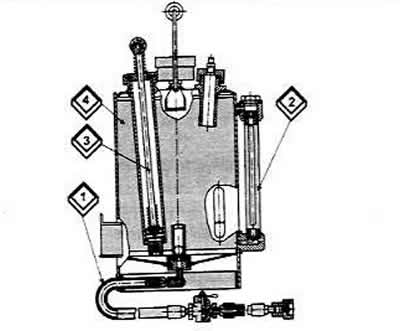
Tank for checking the tightness of the diesel fuel system

Tank for checking the tightness of the diesel fuel system


To do this, connect the fuel line from the fuel tank that drains excess fuel, seal it with a plug, then disconnect the fuel supply line from the tank and connect the hose (1) of the tank (4) to it. Fuel from the tank, filled to 4/5 of its volume, controlled by the fuel gauge tube (2), is supplied to the system under a pressure of 0.3 MPa, which is created by the air pump (3) located in the tank. The appearance of air and fuel bubbles at the joints indicates that they are not tight.

Checking the tightness of the engine air intake tract


Loss of tightness of seals and air ducts leads to abrasive (dust) getting into the engine cylinders, which causes increased wear of the cylinder-piston group and premature engine failure. Air leaks when the engine is running at maximum speed are detected by an indicator.


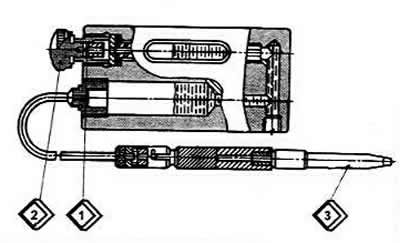
Indicator for checking the tightness of the air intake tract


To do this, unscrew the screw (2) to the lower edge of the hole (1), then take the indicator with the eye towards you with your left hand, and with your right hand, taking the rubber tube with a fork and tip (3), apply the tip to the places of possible leakage of the air tract. If the liquid level begins to drop, then a gap has been detected. It is necessary to check all possible places of leakage, mark and eliminate them.

After finishing the work, tighten the screw (2) until it stops and put the indicator in the case. Antifreeze, diesel fuel or kerosene are used as liquid.
After finishing the work, tighten the screw (2) until it stops and put the indicator in the case.…
The article was checked by auto expert Georgy Rodionov
This article is available at russian, bulgarian, belarusian, ukrainian, serbian, croatian, romanian, polish, slovak, hungarian

Share information:
Previous articles
Audi 100 C4: Fuel system (diesel)
Next articles

Checking the start of fuel supply
Removal and installation injectors
Checking glow plugs
Gas drive installation


Similar articles on other Audi car models:
Checking the tightness of the pressure regulator Audi 80 B2 (1979-1986)
Checking the vehicle's readiness for operation Audi A3 Type 8L (1996-2003)
Checking the tightness of the cooling system Audi A4 B6 (2000-2006, petrol)
Checking the tightness of the cooling system Audi A6 C5 (1997-2004)
Checking the tightness of the hoses Audi A8 D2 (1994-2002)
Checking the tightness of the steering system Audi Q5 Type 8R (2008-2017)
Checking the keyed and riveted connections of the clutch Audi A2 (1999-2005)
Link to this page in different formats


Visitor comments

No comments yet


How much will 17 + 37 =


100(C4, 1990-1994) 
  • General information
  • User manual
  • Power unit
  • Engine repair
  • Ignition system
  • Fuel system (gasoline)
  • Fuel system (diesel)
  • Lubrication system
  • Cooling system
  • Exhaust system
  • Transmission
  • Clutch
  • Car gearbox
  • Drive shafts
  • Chassis
  • Car suspension
  • Steering
  • Wheels and tires
  • Brake system
  • Body
  • Ventilation and heating
  • Body repair
  • Electrical equipment
  • Power devices
  • Lighting and appliances
  • Electrical circuits
 
100(C4, 1990-1994, petrol) 
  • General information
  • Operation and maintenance
  • Power unit
  • Engine repair
  • Exhaust system
  • Cooling system
  • Supply system
  • Air filter
  • Mono-Motronic injection system
  • Digifant injection system
  • KE-III-Jetronic and KE-Motronic
  • MPI and MPFI injection system
  • Transmission
  • Clutch
  • Car gearbox
  • Chassis
  • Suspension and steering
  • Brake system
  • Wheels and tires
  • Body
  • Exterior
  • Interior
  • Electrical equipment
  • Fuses and relays
  • Power devices
  • Ignition system
  • Lighting and signaling
  • Equipment and devices
  • Electrical circuits
 
100(C3, 1982-1990) 
  • General information
  • User manual
  • Maintenance
  • Specifications
  • Power unit
  • Engines 4-cylinder
  • Engines 5-cylinder
  • Diesel engine
  • Cooling system
  • Power system (carburetor)
  • Power system (injector)
  • Fuel system (diesel)
  • Transistor ignition system
  • Electronic ignition system
  • Transmission
  • Clutch
  • 4 speed gearbox 014
  • 5 speed gearbox 013 and 093
  • 5 speed gearbox 016 and 012
  • Shift mechanism KP 016
  • Automatic transmission
  • Front wheel drive
  • Chassis
  • Front suspension
  • Rear suspension
  • Steering
  • Brake system
  • Body
  • Body elements
  • Electrical equipment
  • Lighting and appliances
  • Power devices
  • Electrical circuits
 
100(C3, 1982-1990, petrol) 
  • General information
  • Maintenance and operation
  • 4 cylinder engine
  • Engine repair
  • Cooling and lubrication system
  • Supply system
  • Ignition system
  • 5 cylinder engine
  • Engine repair
  • Cooling and lubrication system
  • Supply system
  • Ignition system
  • Transmission
  • Clutch and drive shafts
  • 4 speed gearbox 014
  • 5 speed gearbox 013 and 093
  • 5 speed gearbox 016 and 012
  • Automatic gearbox
  • Chassis
  • Steering
  • Front suspension
  • Rear suspension
  • Brake system
  • Body
  • Body elements
  • Doors, locks and windows
  • Body repair
  • Electrical equipment
  • Equipment and devices
  • Power devices
  • Electrical circuits
 
100(C3, 1982-1990, diesel) 
  • General information
  • User manual
  • Maintenance
  • Troubleshooting
  • Power unit
  • Engine in a car
  • Engine removed
  • Cooling system
  • Fuel system
  • Exhaust system
  • Starting and charging
  • Preheating
  • Transmission
  • Clutch
  • Mechanical gearbox
  • Automatic gearbox
  • Drive shafts
  • Chassis
  • Brake system
  • Suspension
  • Steering
  • Body
  • Exterior
  • Interior
  • Electrical equipment
  • Equipment and devices
  • Electrical circuits
 
AudiManual.ru © 2017-2026 · Mobile version · Feedback · Sitemap: EN BG BY UA RS HR RO PL SK HU · Site search · News and articles
80 B2 · 80 B3 petrol · 80 B3 · 80 B4 · 100 C3 diesel · 100 C3 petrol · 100 C3 · 100 C4 petrol · 100 C4 · A3 Type 8L · A4 B5 petrol · A4 B5 · A4 B6 petrol · A4 B6 · A4 B7 · A4 B8 · A6 C4 · A6 C5 · A6 C5 Allroad · A8 D2 · Q5 Type 8R · Q7 Typ 4L · Audi A2 ·
This site uses cookies 🍪. Click the button to accept this fact.