



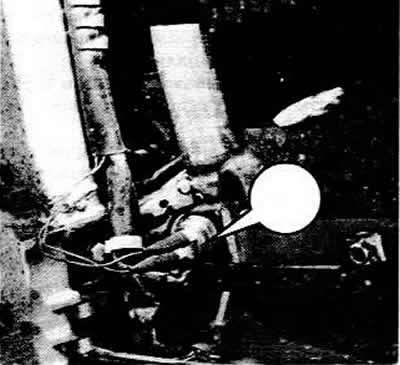
When it "feels" that the liquid flowing around it has become too hot, it switches on the fan. In the same way, it switches off the electric fan when the temperature at the bottom of the radiator drops to a certain value. The switching temperatures are given in the table.
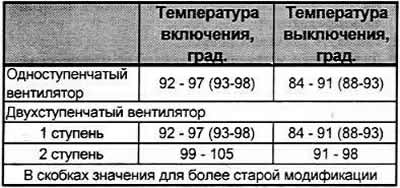
Two-stage radiator fan
Some modifications use a two-stage radiator fan. When the engine is heavily loaded and the coolant temperature is high, the thermal switch turns on a higher fan speed. A two-stage thermal switch may be present, which turns on an additional current circuit of the fan via an additional relay.
Electrical switching
Electrical switching is carried out as follows:
- The thermal switch controls the fan motor not directly, but via a relay. It is located in the relay control circuit and ensures that current flows from terminal 30 when the contacts are closed (continuously conducting current) to the fan. The control circuit itself receives current only when the ignition is on through terminal X. Thus, the relay contacts can only be closed when the ignition is on.
- If there is a two-stage fan, a corresponding double switch is installed. This switch controls the two-stage motor via a relay.
Caution. Since the electrical switching circuit is supplied with current via terminal X, the radiator fan, either single-stage or dual-stage, cannot be switched on when the ignition is off. However, the vehicle may be equipped with an additional fan switching system. In this case, the fan may suddenly switch on when the engine is not running. Be careful when working inside the engine compartment!
Additional fan activation
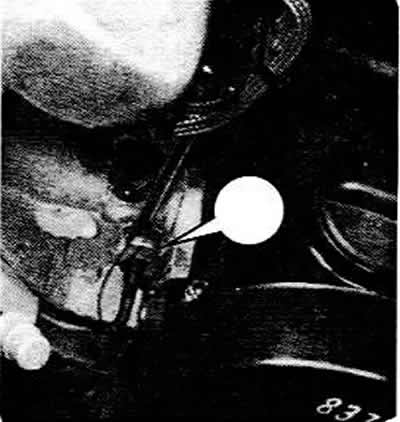
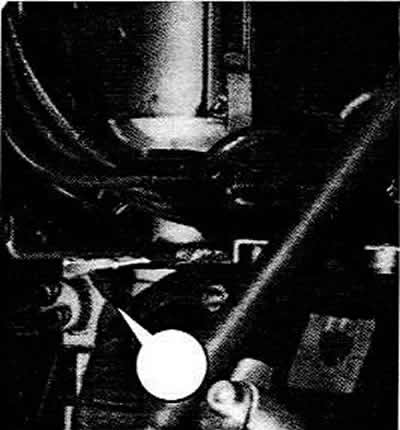
Some engines have an additional fan switch. After the engine is turned off, condensation begins to form in the engine compartment, which can penetrate the high-pressure fuel lines, which will lead to difficulties when starting. In such modifications, the thermal switch on the cylinder head "feels" the temperature and, via the "additional fan switch control unit", activates the fan.
The thermal switch, if there is an additional fan activation system (arrow), is located on the right front of the cylinder head on a four-cylinder engine, and on the left rear of a five-cylinder engine.
[The original article is posted on the resource AUDImanual]