



The cross-section of the starting wire for a spark-ignition engine with a displacement of up to 2.5 l must be at least 16 mm² (diameter about 5 mm). For diesel engines, the cross-section of this wire must be at least 25 mm. The determining factor in this case is always a car with a discharged battery. The cross-section of the wire is usually indicated on its packaging. When buying a new starting cable, you should choose a wire with insulated terminals, a cross-section of 25 mm², since it is also suitable for engines with a smaller working volume.
Both batteries must have a voltage of 12 V.
A discharged battery can freeze at temperatures as low as -10°C. Before connecting the jumper cable, it is essential to defrost such a battery.
The discharged battery must be properly installed in the vehicle.
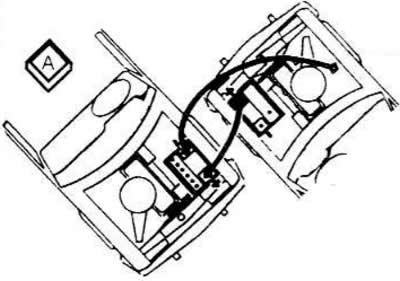
Place both vehicles so far apart that there is no contact between them with metal parts. Otherwise, voltage could arise already when connecting the positive terminals.
Apply the handbrake on both vehicles. Set the gearshift levers to neutral and the automatic transmission to the "P" parking position.
Turn off all power consumers.
Turn on the engine of the car that supplies the voltage at idle speed.
The jumper cables must be connected in the following sequence:
- Clamp the red cable to the positive terminal of the discharged battery.
- Clamp the other end of the red cable to the positive terminal of the battery that supplies voltage.
- Clamp the black cable to the negative terminal of the battery that supplies voltage.
- Connect the other end of the black cable to a well-lubricated place, such as the engine body of the car being started. This will help avoid ground losses. In the unfortunate event of connecting the cable to the negative terminal of an empty battery, an explosion may occur.
Check the fastening of the terminals on the battery terminals again. Make sure that the cables do not touch rotating parts, such as the fan.
CAUTION: The cable terminals must not touch each other or come into contact with ground (body or chassis).
Start the engine of the car with a discharged battery and leave it on. When starting, do not turn on the starter for more than 15 seconds, because with a high current, the cable and terminals heat up. For this reason, you should take pauses for cooling, lasting at least 1 minute.
The engine of the car providing the starting is usually set to idle speed. As a result, it will be possible to avoid possible damage to the generator during starting by peak voltages. If the number of idle speeds decreases, you can add gas slightly.
Avoid open flames near the battery when starting, as it may emit flammable gases.
After starting, disconnect the cables in reverse order.
CAUTION: If the above connection recommendations are not followed, there is a risk of electrolyte burns. In addition, injuries may occur if the battery explodes, and damage to the electrical systems of both vehicles may occur.
The original version of the article is posted on the website: Audimanual.ru