
Repair Chevrolet Repair Toyota Repair Honda Repair AvtoVAZ Repair Mercedes-Benz Repair BMW Repair Opel
Home  |  Contacts  |  Sitemap  |    
English Русский
Български
Беларускі
Український
Српски
Hrvatski
Română
Polski
Slovenský
Magyar
AudiManual.ru


  • AUDI 80
  • AUDI 100
  • AUDI A3
  • AUDI A4
  • AUDI A6
  • AUDI A8
  • AUDI Q
  • OTHER
  • ARTICLES
C4 (1990-1994) C4 (1990-1994, petrol) C3 (1982-1990) C3 (1982-1990, petrol) C3 (1982-1990, diesel)

Cooling system fan malfunctions (Audi 100 C4)

  • Home
  • Audi 100
  • C4 (1990-1994, petrol)
  • Power unit
  • Cooling system
  • Cooling system fan malfunctions
            0
Table of contents: Troubleshooting ↓ Removal the cooling system fan ↓
Besides the jammed thermostat and broken V-belt (only on models with 4-cylinder engine) a faulty cooling fan can cause the coolant temperature to be too high, but only if the engine is running at idle for a long time. But a faulty fan doesn't have to mean the end of the ride:
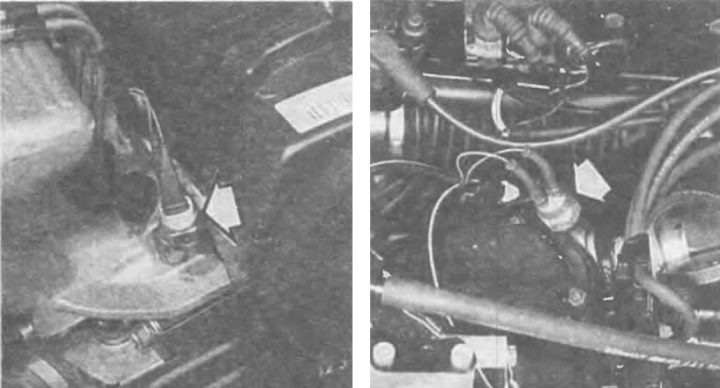
The illustrations show the thermal switch for the cooling system fan function after the engine has…

The illustrations show the thermal switch for the cooling system fan function after the engine has stopped, on the left for a 4-cylinder engine, on the right for a 5-cylinder engine.
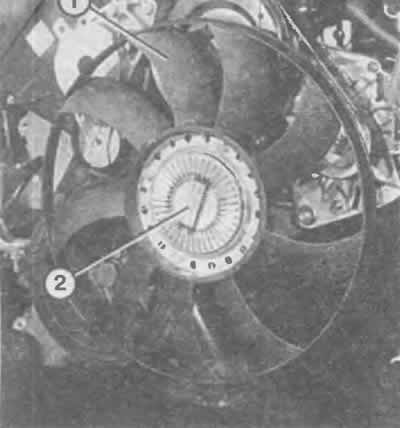

Cars with a 5-cylinder engine are equipped with a fan with a hydraulic clutch. The number «2»…

Cars with a 5-cylinder engine are equipped with a fan with a hydraulic clutch. The number "2" indicates the liquid clutch, to which the fan itself is bolted (1).
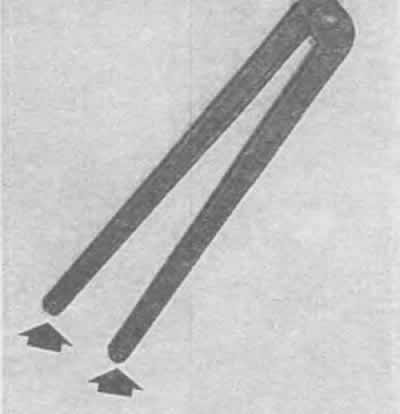

With the help of such a special key and a 32 mm spanner, you can unscrew the liquid clutch. In this…

With the help of such a special key and a 32 mm spanner, you can unscrew the liquid clutch. In this case, the special key is installed in the holes on the surface of the fan pulley (behind the hydraulic fan). Now, using a 32 mm wrench, you can unscrew the fan from the pulley.


Once the engine has cooled down, you can drive to the nearest workshop at medium speed and at a relatively fast pace. In this case, you need to watch the temperature indicator and the coolant temperature control light.


Idling and driving slowly can be fatal for the engine. At the same time, almost no cooling air passes through the radiator. If you absolutely must continue driving at low speed, it is better to immediately start looking for the causes of malfunctions and, if necessary, "bypass" the thermal switch (see next section).

Troubleshooting


First, you need to check the corresponding fuse in the additional relay block on the left under the dashboard.

If it is OK, disconnect the thermal switch plug.

Connect both contacts at the end of the wire with a piece of wire. For a two-speed fan, you must connect all three connector tabs.

If the fan starts working when the ignition is on, this means that the thermal switch is faulty and has been removed from the electrical circuit (for testing).

To proceed further, you need to secure the wire well in the plugs and insulate it with adhesive tape or a bandage to avoid short circuits.

If disconnecting the thermal switch does not lead to success, check the fan relay in the central switch: if both jumpers of the thermal switch are "bypassed", then when the ignition is on, the contacts in relays 1 and 2 should close clearly and audibly.

If you can't hear anything, you need to "bypass" the relay with auxiliary means. To do this, connect the tabs of the relay plug terminals 30 and 87 with a piece of wire (with a paper clip) and insert the relay.

The cooling system fan should now start working even with the ignition off. If this happens, the relay is faulty.

The jumper wire may, in an emergency, remain installed while driving. After driving, it must be removed.


If there is still no reaction, check the fan motor: Disconnect the wire tip at the fan motor and instead run an auxiliary wire from the contact of the red-black wire to the positive terminal of the battery. Connect the plug connection of the brown wire directly to the negative terminal.

If the impeller still does not rotate, then the fan motor is faulty - replace it.

If the fan starts working, you need to check the relay (see chapter "Body electrical system"), wire ends, as well as all cable connections from the thermal switch and fan.

You can safely continue driving even with the fan powered directly from the battery. The auxiliary wiring should be routed so that a short circuit does not occur.

If the additional fan is working properly, the fault in the first stage may be in the additional resistor.

Removal the cooling system fan


The cooling system fan must be removed from the radiator together with the rear protective cover of the radiator - the so-called fan frame:

Unscrew the mounting bolts at the top of the fan frame.

Disconnect the plug from the fan motor and disconnect the wiring harness.

Pull the frame out of the brackets on the bottom edge.

Loosen the four mounting bolts on the column. Disconnect the plugs on the fan motor.

Remove the column together with the fan motor

To separate the engine and the frame, loosen the three mounting nuts.
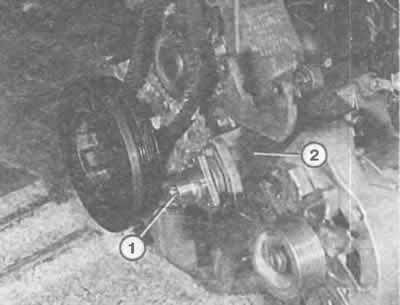
The illustration shows a 5-cylinder engine with the hydraulic fan removed. The numbers indicate:

The illustration shows a 5-cylinder engine with the hydraulic fan removed. The numbers indicate:
1 - Fan support with thread for screwing on liquid clutch;
2 - support bracket fixed to the engine.
The article was checked by auto expert Nikita Rudakov
This article is available at russian, bulgarian, belarusian, ukrainian, serbian, croatian, romanian, polish, slovak, hungarian

Share information:
Previous articles
Audi 100 C4: Cooling system
Next articles

Cooling system fan
Water pump
List of faults
Thermostat
Hydraulic fan
List of faults in the cooling system


Similar articles on other Audi car models:
Possible malfunctions of the engine cooling system Audi 80 B3 (1986-1991)
Cooling system specifications Audi A3 Type 8L (1996-2003)
Checking the cooling system for leaks Audi A4 B5 (1994-2001, petrol)
Checking the tightness of the cooling system Audi A6 C5 (1997-2004)
Central section of the cooling system pipe of a 2.5L diesel… Audi A8 D2 (1994-2002)
Cooling system Audi Q5 Type 8R (2008-2017)
Cooling system — checking and refilling fluid Audi A2 (1999-2005)
Link to this page in different formats


Visitor comments

No comments yet


How much will 43 + 12 =


100(C4, 1990-1994) 
  • General information
  • User manual
  • Power unit
  • Engine repair
  • Ignition system
  • Fuel system (gasoline)
  • Fuel system (diesel)
  • Lubrication system
  • Cooling system
  • Exhaust system
  • Transmission
  • Clutch
  • Car gearbox
  • Drive shafts
  • Chassis
  • Car suspension
  • Steering
  • Wheels and tires
  • Brake system
  • Body
  • Ventilation and heating
  • Body repair
  • Electrical equipment
  • Power devices
  • Lighting and appliances
  • Electrical circuits
 
100(C4, 1990-1994, petrol) 
  • General information
  • Operation and maintenance
  • Power unit
  • Engine repair
  • Exhaust system
  • Cooling system
  • Supply system
  • Air filter
  • Mono-Motronic injection system
  • Digifant injection system
  • KE-III-Jetronic and KE-Motronic
  • MPI and MPFI injection system
  • Transmission
  • Clutch
  • Car gearbox
  • Chassis
  • Suspension and steering
  • Brake system
  • Wheels and tires
  • Body
  • Exterior
  • Interior
  • Electrical equipment
  • Fuses and relays
  • Power devices
  • Ignition system
  • Lighting and signaling
  • Equipment and devices
  • Electrical circuits
 
100(C3, 1982-1990) 
  • General information
  • User manual
  • Maintenance
  • Specifications
  • Power unit
  • Engines 4-cylinder
  • Engines 5-cylinder
  • Diesel engine
  • Cooling system
  • Power system (carburetor)
  • Power system (injector)
  • Fuel system (diesel)
  • Transistor ignition system
  • Electronic ignition system
  • Transmission
  • Clutch
  • 4 speed gearbox 014
  • 5 speed gearbox 013 and 093
  • 5 speed gearbox 016 and 012
  • Shift mechanism KP 016
  • Automatic transmission
  • Front wheel drive
  • Chassis
  • Front suspension
  • Rear suspension
  • Steering
  • Brake system
  • Body
  • Body elements
  • Electrical equipment
  • Lighting and appliances
  • Power devices
  • Electrical circuits
 
100(C3, 1982-1990, petrol) 
  • General information
  • Maintenance and operation
  • 4 cylinder engine
  • Engine repair
  • Cooling and lubrication system
  • Supply system
  • Ignition system
  • 5 cylinder engine
  • Engine repair
  • Cooling and lubrication system
  • Supply system
  • Ignition system
  • Transmission
  • Clutch and drive shafts
  • 4 speed gearbox 014
  • 5 speed gearbox 013 and 093
  • 5 speed gearbox 016 and 012
  • Automatic gearbox
  • Chassis
  • Steering
  • Front suspension
  • Rear suspension
  • Brake system
  • Body
  • Body elements
  • Doors, locks and windows
  • Body repair
  • Electrical equipment
  • Equipment and devices
  • Power devices
  • Electrical circuits
 
100(C3, 1982-1990, diesel) 
  • General information
  • User manual
  • Maintenance
  • Troubleshooting
  • Power unit
  • Engine in a car
  • Engine removed
  • Cooling system
  • Fuel system
  • Exhaust system
  • Starting and charging
  • Preheating
  • Transmission
  • Clutch
  • Mechanical gearbox
  • Automatic gearbox
  • Drive shafts
  • Chassis
  • Brake system
  • Suspension
  • Steering
  • Body
  • Exterior
  • Interior
  • Electrical equipment
  • Equipment and devices
  • Electrical circuits
 
AudiManual.ru © 2017-2026 · Mobile version · Feedback · Sitemap: EN BG BY UA RS HR RO PL SK HU · Site search · News and articles
80 B2 · 80 B3 petrol · 80 B3 · 80 B4 · 100 C3 diesel · 100 C3 petrol · 100 C3 · 100 C4 petrol · 100 C4 · A3 Type 8L · A4 B5 petrol · A4 B5 · A4 B6 petrol · A4 B6 · A4 B7 · A4 B8 · A6 C4 · A6 C5 · A6 C5 Allroad · A8 D2 · Q5 Type 8R · Q7 Typ 4L · Audi A2 ·
This site uses cookies 🍪. Click the button to accept this fact.