



Thermostat
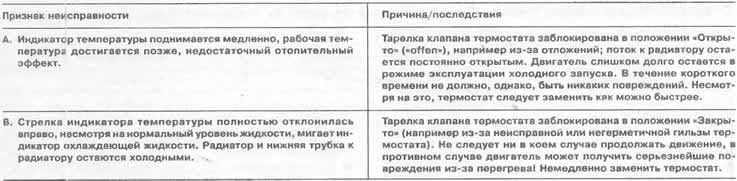
Note: If the engine boils on the road due to a faulty thermostat, either a tow truck or removing the thermostat on the spot can help. If you decide to remove the thermostat, you must wait until the coolant temperature drops. At this time, you can get containers to drain the coolant.
Removal the thermostat
Removing a jammed thermostat on the road is quite a problematic task. It is located quite deep down, so you will have to drain almost all the coolant. In addition, with a hot engine, you will have to wait a long time before you can start working without fear of scalding your hands. When installing a new thermostat, it is necessary on the thermostat housing or water pump.
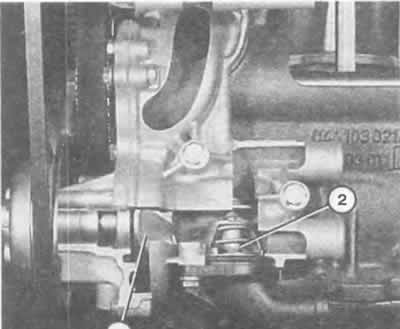
4-cylinder engine: The illustration shows the water pump and thermostat housing in section so you can look inside. The impeller (1) of the water pump is clearly visible. The thermostat (2) is located nearby.
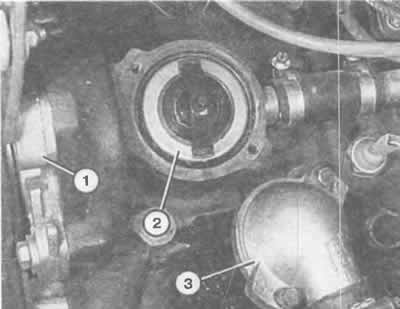
After removing the housing cover (3) on the left side of the engine, the thermostat (2) becomes accessible on a 5-cylinder engine. Position (1) shows the water pump.
Drain the coolant completely.
Models with 4-cylinder engines: Remove the lower engine compartment protection (Chapter "Body elements").
Remove the hose at the bottom of the water pump housing (already done to drain the coolant).
Unscrew the two bolts on the cover at the bottom of the thermostat housing.
Remove the cover and thermostat.
Models with 5-cylinder engines: Unscrew the two bolts on the thermostat housing cover.
Press the cover to the side and remove the thermostat.
Models with 6-cylinder engines: remove the V-belt, take out the tensioner (chapter "Generator").
Remove the timing belt guard (chapter "Engines"). The timing belt itself remains installed.
Remove the coolant hose leading to the radiator and located at the bottom of the thermostat housing pipe.
Unscrew the two bolts on the thermostat housing cover.
Carefully lift the timing belt through the partition on the thermostat housing, remove the thermostat housing.
Remove the thermostat.
All models: When installing a new thermostat, the smaller sealing plate should point towards the engine.
6-cylinder models only: The air vent on the outer thermostat ring should point up.
Replace the gasket.
Tighten the bolts on the thermostat housing or water pump to 10 Nm.
Checking the Thermostat
With a jam thermometer, you can determine for yourself whether the coolant regulator opens at the prescribed temperature.

Remove the thermostat.
Hang the thermostat in a pot of water and heat the water.
Check whether the valve disc rises from the seat at 87°C.
It is impossible to achieve complete opening in this experiment (in an open pan, water boils, as we know, at 100°C), but at least you can see whether the thermostat opens further.
The full lifting height is thus almost reached. What can be seen is sufficient to draw a conclusion about the serviceability or malfunction of the thermostat.
[This article was copied from an online resource «audimanual.ru»]