
Repair Chevrolet Repair Toyota Repair Honda Repair AvtoVAZ Repair Mercedes-Benz Repair BMW Repair Opel
Home  |  Contacts  |  Sitemap  |    
English Русский
Български
Беларускі
Український
Српски
Hrvatski
Română
Polski
Slovenský
Magyar
AudiManual.ru


  • AUDI 80
  • AUDI 100
  • AUDI A3
  • AUDI A4
  • AUDI A6
  • AUDI A8
  • AUDI Q
  • OTHER
  • ARTICLES
C4 (1990-1994) C4 (1990-1994, petrol) C3 (1982-1990) C3 (1982-1990, petrol) C3 (1982-1990, diesel)

Replacing the V-belt (not poly-V-belt) of the generator (Audi 100 C4)

  • Home
  • Audi 100
  • C4 (1990-1994, petrol)
  • Electrical equipment
  • Power devices
  • Replacing the V-belt (not poly-V-belt) of the generator
            0
Table of contents: TO No.40 ↓ Replacing the poly V-belt in a… ↓ Replacing the poly V-belt on models… ↓ Replacing the Poly V-Belt on Models… ↓

TO No.40


It has already been mentioned that the alternator V-belt must be replaced on a 4-cylinder engine built before August 91. However, the following also applies to replacing other V-belts.

Replacing the poly V-belt in a 4-cylinder engine


A new V-belt should never be "pulled" onto the pulleys using a screwdriver, because the resulting cuts, so to speak, predetermine the next belt break.

Loosen the old belt for replacement.

Now you can easily remove it from the pulleys, and the new belt can be conveniently put on them.
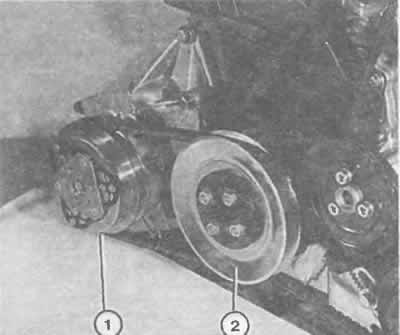
Left: Illustration shows the installation position of the air conditioning compressor (1) of a…

Left: Illustration shows the installation position of the air conditioning compressor (1) of a 4-cylinder engine. The 4-cylinder engine has an additional pulley (2) mounted at the front, which is where the belt tension is adjusted.
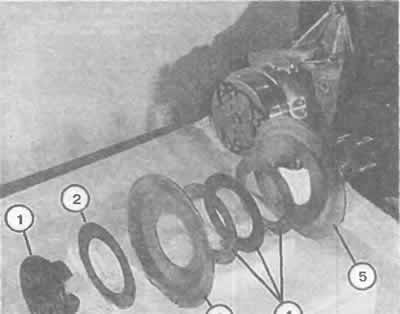

Right: Crankshaft pulley components for 4-cylinder models with air conditioning. Numbers represent:

Right: Crankshaft pulley components for 4-cylinder models with air conditioning. Numbers represent:
1 - pulley hub;
2 - extra adjusting washers;
3 - front half of the pulley;
4 - adjusting washers;
5 - rear half of the pulley.
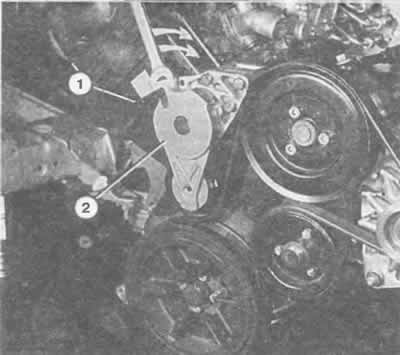

To remove the poly V-belt on a 5-cylinder engine, use a spanner as shown in the figure, installed…

To remove the poly V-belt on a 5-cylinder engine, use a spanner as shown in the figure, installed in the tensioner (2) and turned in the direction of the arrows. To secure the tensioner when the belt is loose, insert the punch (1) into the hole provided for it, as well as into the hole in the panel below.
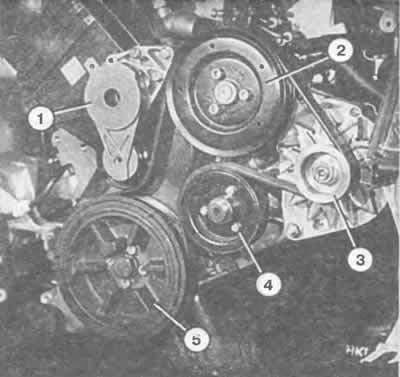

This shows the position of the poly V-belt in a car with a five-cylinder engine (without air…

This shows the position of the poly V-belt in a car with a five-cylinder engine (without air conditioning). Parts and pulleys:
1 - tensioning device;
2 — power steering pump pulley;
3 - generator;
4 - fan pulley;
5 — crankshaft pulley.


Please note: if necessary, you will have to remove other V-belts or you will have to disconnect the front engine mount.


Finally, tighten the belts, drive about a hundred kilometers and then tighten them further (v-belt tension, see earlier in this chapter).

The same section describes how to tension the poly V-belt for the generator (since 9/91).

You can find out which V-belt should be installed where in the Audi-100 from the table on the previous page.

Replacing the poly V-belt on models with a 5-cylinder engine


Remove the protective cover.

Disconnect the air duct from the air filter.

Remove the fan with a viscous coupling, for which you will need a special tool (see chapter "Cooling system").

Place the fan in the rings (frame) near the radiator.

Unscrew the radiator frame and remove it upwards together with the fan.

Place the wrench on the tensioner and move it to the right.

Insert the pin (for example, a suitable bolt, etc.) into the hole provided for this purpose and thereby secure the tensioning device.

Mark the direction of rotation of the belt with chalk or a felt-tip pen.

Remove the poly V-belt.

When installing with the poly V-belt applied, lift the tensioner with a key and remove the pin.

Observe the prescribed fan tightening torque (see chapter "Cooling system").
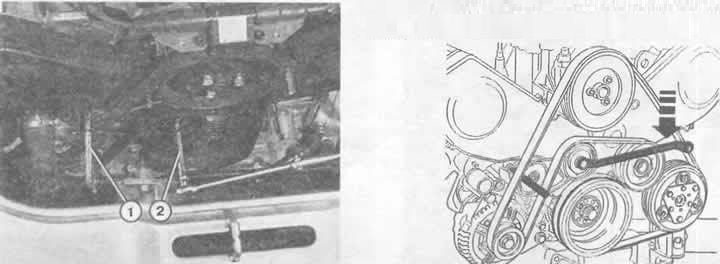
Left: The tension roller for the poly V-belt in a 6-cylinder engine is secured with a star bolt,…

Left: The tension roller for the poly V-belt in a 6-cylinder engine is secured with a star bolt, onto which a star head (2) with a suitable open-end wrench is placed for turning. Pin (1; in the illustration this role is performed by a punch) is inserted into the hole provided for this purpose on the tensioner, due to which the tensioner is fixed in this position.

Right: In the picture, the tension roller is fixed with a hex punch, which allows it to be turned with a spanner.
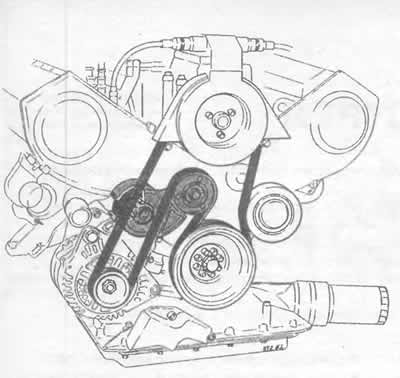

So the poly V-belt is put on different pulleys in models with a 6-cylinder engine without air…

So the poly V-belt is put on different pulleys in models with a 6-cylinder engine without air conditioning.
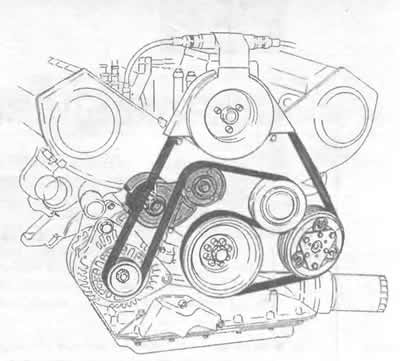

The figure shows the routing of the poly-pin belt on a model with a 6-cylinder engine equipped with…

The figure shows the routing of the poly-pin belt on a model with a 6-cylinder engine equipped with air conditioning.


Replacing the Poly V-Belt on Models with a 6-Cylinder Engine


Remove the poly V-belt cover.

In the older version: Place a 15mm open-end wrench on the tensioner hex.

In newer versions: Remove the tension roller cover and install a TORX key or a 10 mm Allen key on the central screw inside the roller.

For all: Move the tensioner to the right.

Secure the tensioner by inserting the pin into the holes provided for this purpose.

Mark the direction of rotation of the belt with chalk or a felt-tip pen.

Remove the poly V-belt.

When installing, place the poly V-belt first on the drive and guide rollers; lastly, on the tension roller.

Raise the tensioner again with the key and remove the pin.

Install the casing.
The article was checked by auto expert Nikita Rudakov
This article is available at russian, bulgarian, belarusian, ukrainian, serbian, croatian, romanian, polish, slovak, hungarian

Share information:
Previous articles
Audi 100 C4: Power devices
Next articles

Overview of V-belts and poly V-belts
Engine overheating due to damage to the V-belt
Broken V-belt
Tensioning a V-belt or poly V-belt
List of faults of the battery and generator
Starter — general information
List of starter faults


Similar articles on other Audi car models:
Generator drive belt — removal, installation and adjustment Audi 80 B3 (1986-1991, petrol)
Checking the timing belt for damage, measuring wear Audi A3 Type 8L (1996-2003)
V-belt and poly-V-belt Audi A4 B5 (1994-2001, petrol)
Checking the condition of the poly V-belt Audi A6 C5 (1997-2004)
Checking the condition of the poly V-belt Audi A8 D2 (1994-2002)
Removal the poly V-belt Audi Q5 Type 8R (2008-2017)
Poly V-belt — checking condition (petrol engines) Audi A2 (1999-2005)
Link to this page in different formats


Visitor comments

No comments yet


How much will 48 + 17 =


100(C4, 1990-1994) 
  • General information
  • User manual
  • Power unit
  • Engine repair
  • Ignition system
  • Fuel system (gasoline)
  • Fuel system (diesel)
  • Lubrication system
  • Cooling system
  • Exhaust system
  • Transmission
  • Clutch
  • Car gearbox
  • Drive shafts
  • Chassis
  • Car suspension
  • Steering
  • Wheels and tires
  • Brake system
  • Body
  • Ventilation and heating
  • Body repair
  • Electrical equipment
  • Power devices
  • Lighting and appliances
  • Electrical circuits
 
100(C4, 1990-1994, petrol) 
  • General information
  • Operation and maintenance
  • Power unit
  • Engine repair
  • Exhaust system
  • Cooling system
  • Supply system
  • Air filter
  • Mono-Motronic injection system
  • Digifant injection system
  • KE-III-Jetronic and KE-Motronic
  • MPI and MPFI injection system
  • Transmission
  • Clutch
  • Car gearbox
  • Chassis
  • Suspension and steering
  • Brake system
  • Wheels and tires
  • Body
  • Exterior
  • Interior
  • Electrical equipment
  • Fuses and relays
  • Power devices
  • Ignition system
  • Lighting and signaling
  • Equipment and devices
  • Electrical circuits
 
100(C3, 1982-1990) 
  • General information
  • User manual
  • Maintenance
  • Specifications
  • Power unit
  • Engines 4-cylinder
  • Engines 5-cylinder
  • Diesel engine
  • Cooling system
  • Power system (carburetor)
  • Power system (injector)
  • Fuel system (diesel)
  • Transistor ignition system
  • Electronic ignition system
  • Transmission
  • Clutch
  • 4 speed gearbox 014
  • 5 speed gearbox 013 and 093
  • 5 speed gearbox 016 and 012
  • Shift mechanism KP 016
  • Automatic transmission
  • Front wheel drive
  • Chassis
  • Front suspension
  • Rear suspension
  • Steering
  • Brake system
  • Body
  • Body elements
  • Electrical equipment
  • Lighting and appliances
  • Power devices
  • Electrical circuits
 
100(C3, 1982-1990, petrol) 
  • General information
  • Maintenance and operation
  • 4 cylinder engine
  • Engine repair
  • Cooling and lubrication system
  • Supply system
  • Ignition system
  • 5 cylinder engine
  • Engine repair
  • Cooling and lubrication system
  • Supply system
  • Ignition system
  • Transmission
  • Clutch and drive shafts
  • 4 speed gearbox 014
  • 5 speed gearbox 013 and 093
  • 5 speed gearbox 016 and 012
  • Automatic gearbox
  • Chassis
  • Steering
  • Front suspension
  • Rear suspension
  • Brake system
  • Body
  • Body elements
  • Doors, locks and windows
  • Body repair
  • Electrical equipment
  • Equipment and devices
  • Power devices
  • Electrical circuits
 
100(C3, 1982-1990, diesel) 
  • General information
  • User manual
  • Maintenance
  • Troubleshooting
  • Power unit
  • Engine in a car
  • Engine removed
  • Cooling system
  • Fuel system
  • Exhaust system
  • Starting and charging
  • Preheating
  • Transmission
  • Clutch
  • Mechanical gearbox
  • Automatic gearbox
  • Drive shafts
  • Chassis
  • Brake system
  • Suspension
  • Steering
  • Body
  • Exterior
  • Interior
  • Electrical equipment
  • Equipment and devices
  • Electrical circuits
 
AudiManual.ru © 2017-2026 · Mobile version · Feedback · Sitemap: EN BG BY UA RS HR RO PL SK HU · Site search · News and articles
80 B2 · 80 B3 petrol · 80 B3 · 80 B4 · 100 C3 diesel · 100 C3 petrol · 100 C3 · 100 C4 petrol · 100 C4 · A3 Type 8L · A4 B5 petrol · A4 B5 · A4 B6 petrol · A4 B6 · A4 B7 · A4 B8 · A6 C4 · A6 C5 · A6 C5 Allroad · A8 D2 · Q5 Type 8R · Q7 Typ 4L · Audi A2 ·
This site uses cookies 🍪. Click the button to accept this fact.