



Table of contents: Constantly checking ↓ Faulty horn? ↓
Constantly checking
When you press the horn located in the steering wheel, with the ignition on, a regular or two-tone sound signal should sound. The horn button closes the electrical circuit of the horn relay to ground (body) (chapter "Body electrical system"). Power is supplied to the relay from terminal X, which receives voltage only when the ignition is on.
When the electrical circuit is closed (that is, with the horn pressed) the relay contacts close and power is supplied to the horn via the wire with the black and yellow sheath. The wiring to the "ground" for the horn goes via the brown wire.
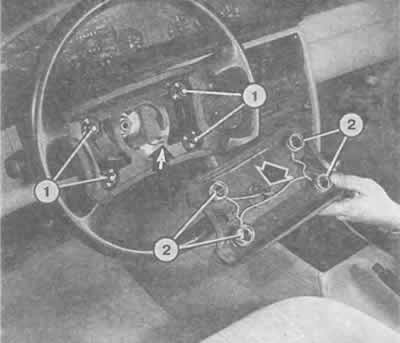
When the horn is pressed, contact with the "ground" (housing) is provided by contacts in the steering wheel (1) and in the horn board (2). The path then goes through the plug connection (arrows).
Faulty horn?
Remove the lower engine compartment protection (chapter "Body elements").
Disconnect the wire ends.
Remove the corresponding horn.
Connect an auxiliary wire to each plug connector and connect it to the positive and negative terminals of the battery.
If you don't hear anything, then the horn is faulty.
A wheezing or completely "silent" horn can sometimes be adjusted or brought back to life by turning the adjustment screw located on its back side.
Clean the screw from the sealing compound.
After adjustment, reseal the screw with body sealant.
The same testing method should be used for a two-tone sound signal.