



Table of contents: Checks performed from the driver's… ↓ Checks performed on a vehicle on the… ↓ Checks carried out on a vehicle… ↓
The Section lists all units and systems subject to inspection and suggests methods for independently checking their condition and operation. Based on the analysis of the results of such checks, it is possible to assess the readiness of the car for operation and technical inspection. Naturally, independent checks cannot be compared in terms of measurement accuracy with professional ones, due to the lack of appropriate operator qualifications and the inaccessibility of special diagnostic equipment. If, during the course of independent checks, it is revealed that any of the components need to be repaired or replaced, refer to the relevant Sections of the relevant Chapters of the Manual for more complete information.
In most cases, the upcoming checks require the participation of an assistant.
Checks performed from the driver's seat
Parking (hand) brake
The operation of the parking brake is checked by fully cocking its control lever. In doing so, make sure that the lever travel is (number of ratchet clicks), required to create a feeling of full resistance caused by the braking mechanism is not excessive. If this requirement is not met, the serviceability of the brake mechanisms of the rear wheels of the car and/or the correct adjustment of the parking brake cables should be checked.
With the parking brake fully engaged, rock the control lever from side to side (tap it on the sides) – the brake should not be released, otherwise the ratchet or pawl of the lever is worn. Release the parking brake and swing the lever from side to side to detect signs of wear of the axle bearing. Check the reliability of the lever fastening and make sure that there are no traces of corrosion of the supporting element of the body within a radius of 30 cm around the lever support. If the condition of the lever fastening cannot be checked from the car interior, assess it later during checks carried out under the car.
Brakes
Make sure that the brake pedal does not make any sounds when pressed and released, does not show obvious signs of excessive wear of the axle bushings, and also check the condition of the pedal pad. Make sure that there are no signs of brake fluid leaks on the pedal, floor or surface of the mat around the pedal, indicating a violation of the sealing cuffs of the master brake cylinder.
Press the pedal slowly at first, then quickly, achieving the ability to maintain a steady pressure. Create pressure and make sure that the pedal does not then slowly fall to the floor, which would again indicate problems with the master brake cylinder. Release the pedal, wait a few seconds, then press it again until a solid resistance appears. Make sure that resistance begins to appear already at the top of the pedal stroke. If the pedal needs to be pressed almost to the floor to create resistance, this indicates a violation of the brake adjustment. If a solid resistance to pressing the pedal does not occur at all, i.e. there is a soft pedal stroke, this indicates air has entered the hydraulic system and the system needs to be completely bled.
Check the proper functioning of the brake booster by pressing the brake pedal several times to release the vacuum. Then, keeping the pedal depressed, start the engine. When the engine starts, the resistance to pressing the pedal should change (decrease). If this is not the case, there is a possibility of "leaks" in the brake booster unit vacuum hoses or its actual malfunction.
Steering wheel and column
Check the steering wheel for cracks or looseness in the hub, spokes, or rim. Rock the wheel from side to side, then up and down in relation to the column. Check for any play in the wheel on the column, which would indicate a loose wheel nut or worn shaft splines. Continue rocking the wheel as described above, but add a slight left-right rotation. Check for excessive play in the wheel, which would indicate excessive wear in the upper shaft support bearing, universal joint, or flexible coupling.
Windshield and rear view mirrors
The windshield should not have any cracks or other damage that could significantly limit the driver's field of view or interfere with the operation of the windshield wipers. The presence of small chips left by stone impacts is acceptable. Any kind of stickers and hanging souvenirs should also not limit the driver's view.
Rear view mirrors must be securely fastened, undamaged and adjustable. The door mirror on the passenger side of the vehicle is not subject to inspection, provided that the rear view mirror attached to the inside of the windshield is in good working order and can be used.
Seats and seat belts
Warning: The following checks apply to both front and rear seat belts.
Carefully inspect the structure of the seat belt material for cuts, signs of severe wear or aging of the material. If inertia-type belts equipped with return devices are installed, pull them out of the drum cover completely when inspecting.
Fasten and unfasten each of the belts, checking that the locking mechanisms are functioning properly (both for latching and for opening) and their reliability. If inertia-type belts are installed, check the correct functioning of the return devices.
Check the reliability of the fastening of the belts to the body elements and the condition of their support units, which can be accessed without removing the trim panels. The presence of signs of severe corrosion or deformation of the supporting elements of the body within the radius of the belt support is also unacceptable. Some of the seat belt fastening units are inaccessible and cannot even be visually inspected from the car interior; in this case, their condition should be checked later during the inspection of the underbody. If any of the belt mechanism parts are fastened directly to the front seat, the seat supports must be securely screwed to the floor and their condition subjected to the same check as described above for the belt supports.
The front seats themselves must also be securely fixed and must not allow spontaneous changes in their position. The backrests must be securely fixed in the vertical position.
Doors
The front doors must be able to be opened and closed from inside the vehicle and must be securely locked in the closed position.
Electrical equipment
Turn on the ignition and sound the horn. The horn must produce a clear sound that is clearly audible to other road users. The use of gongs, sirens or 2-tone horns installed as additional accessories by yourself is unacceptable.
Check the operation of the windshield washers and wipers. The washers should spray fluid with adequate pressure and flow, and their nozzles should be adjusted so that the streams hit the upper edge of the windshield.
Use the windscreen wipers simultaneously with the washers and make sure that the brushes wipe the windscreen well throughout their entire range of travel. There should be no streaks or stripes of smeared road film on the glass that limit the driver's view in both the straight-line and peripheral sectors of the field of vision. Otherwise, replace the brushes.
Press the foot brake pedal with the ignition on and have an assistant check the operation of the brake lights.
When you press the pedal, the brake lights should light up, and when you release them, they should go out. If only one of the brake lights does not light up, then the cause of the failure is most likely a burnt-out bulb or poor electrical contact on the bulb socket (or near it). If both brake lights fail, you should check their fuse and switch. You should not completely rule out the possibility that both lamps burn out at the same time. If the brake lights fail to turn off when you release the brake pedal, this indicates a faulty switch.
Checks performed on a vehicle on the ground
License plates and vehicle identification numbers
Front and rear number plates must be in satisfactory condition, securely attached and easily legible.
The vehicle identification number (VIN), located on the plate under the hood, must be legible.
Electrical equipment
Switch on the parking lights and make sure that both the front and rear parking lights and the number plate lights are on. The lenses and reflectors must be clean, undamaged and securely fastened. The integrity of the lenses is especially important in rear lights, where the white light of a damaged light can be confused with the reversing signal by other road users. Dirty lenses cause a noticeable reduction in the intensity of the light emitted by the lamp.
Turn on the headlights and make sure that both the low and high beam units are functioning properly and with the same intensity for both headlights. A decrease in the intensity of the glow of any of the headlights is usually associated with a violation of the quality of the electrical contacts or severe corrosion of the internal reflector. Check the lenses of the headlights for cracks and chips left by stone impacts. Such defects are unacceptable, but usually the qualification of the degree of their severity is a subjective factor. Remember that all lighting devices must work reliably when the switches are first toggled. Tapping on the lighting unit in order to turn it on is an unacceptable action.
Headlights should not only be adjusted so as not to blind other road users in low beam mode, but also provide adequate illumination of the roadway in front of the car. Checking the adjustment of the headlights is carried out using special optical equipment, therefore, if you are not sure of its correctness, you should contact specialists in advance to check and adjust the position of the headlights.
With the ignition on, check the operation of the direction indicators. Make sure that both the front and rear ones emit a yellow light and flash at a frequency of about one or two times per second. In addition, it is a mandatory requirement that the direction indicator indicators on the instrument panel are in good working order. Turning on the side lights and brake lights should not affect the operation of the direction indicators - if this is not the case, the cause is usually poor grounding in the rear combination lamp units. Similarly, make sure that the hazard warning lights are working properly, which should operate both with the ignition on and off. Check the condition of the lenses.
Check the operation of the fog lights. The mandatory check usually concerns only the externally mounted fog light, which is included in the standard equipment and is located on one side of the car. The light should be securely fastened and should produce a bright, sharp beam of red light. Indicator lamp on the instrument panel (or inside the switch) should also function.
Brakes
From the engine compartment, inspect the brake lines for signs of leaks, corrosion, poor mounting, fraying, and other damage. Inspect the master cylinder and brake booster unit for signs of leaks, poor mounting, and signs of excessive corrosion of both the component mounts and the surrounding bodywork. The master cylinder reservoir should be securely fastened; if it is made of a translucent material, the liquid level in it should be between the upper and lower marks on the walls.
Turn the steering wheel so that the right front brake hose can be seen. Check the hose carefully for cracks and signs of rubber deterioration. Defects are most easily detected by bending the hose in half and are almost inevitable where the hose connects to the fittings. Turn the steering wheel fully to the left, then to the right, and make sure that the hose does not contact the wheel rim, tire, or any moving components of the suspension or steering system. With an assistant firmly depressing the brake pedal, check the hose for bulges and signs of fluid leakage under pressure. Repeat the checks for the left brake hose. If defects are found, make the necessary replacements.
Check the brake line tubes and hoses for signs of damage and material aging.
Steering and suspension
Ask your assistant to turn the steering wheel slightly to the right and left in the range up to the moment of the beginning of the transfer of rotation to the steered wheels. Try to estimate the amount of free play of the steering wheel before the moment of the beginning of the steering mechanism operation. The amount of this play provides information on the degree of wear of the steering column joints, wear and reliability of the fastening of the coupling connecting the column to the steering mechanism or unreliability of the fastening, wear or violation of the adjustment of the steering mechanism itself. In general, the free play of the steering wheel should not exceed 1.3 cm.
Ask an assistant to turn the steering wheel vigorously in both directions in the range before the steering wheels begin to turn. At the same time, carefully monitor the behavior of the joints, rods and other elements of the steering drive and their fastening units. Components that show signs of wear, damage, deformation or unreliability of fastening must be repaired or replaced.
If the vehicle is equipped with a power steering system, also check that the power steering pump is securely mounted and that its drive belt is in good condition and properly tensioned. The system should function properly and show no signs of hydraulic fluid leaks or damaged hoses. Additional checks can be made later, once the vehicle is raised off the ground and access underneath is much easier.
Make sure the vehicle is level and ride height is correct. Make sure there is sufficient clearance between the suspension components and the compression buffers to allow full suspension travel.
Shock absorbers
Press down on each corner of the car in turn, then release it sharply. If the shock absorber is OK, the corner should rise and then return to its normal position. If the corner of the car continues to swing up and down after releasing, the shock absorber has lost its damping properties.
Exhaust system
Start the engine and, having an assistant press a rag against the end of the exhaust pipe, check the entire system for signs of leaks, which are manifested in the form of rhythmically pulsating streams of smoke or a hissing sound emanating directly from the source of the leak. Check the efficiency of the muffler, making sure that the noise level emitted by the engine corresponds to what is expected for this type of vehicle. If the system is generally in satisfactory condition, minor local leaks can be eliminated using a patented special repair kit.
Checks carried out on a vehicle raised above the ground with wheels rotating freely
Jack up the vehicle, securely supporting it on supports placed under the load-bearing points of the vehicle frame.
Install the supports so that they do not come into contact with suspension components (including when turning the front wheels). Make sure all wheels are off the ground and the steerable wheels can turn from lock to lock.
Steering gear
Check the condition of the rubber steering rack boots. Make sure that there are no cuts, signs of leaks, or unreliable fastening of the bandages. If the steering is equipped with a power steering system, check its rubber hydraulic hoses, tubes, and their joints for signs of material aging, leaks, abrasions, and other damage. Carefully inspect all steering components for signs of jamming or excessively tight movement, loss of cotter pins and other locking devices, as well as traces of excessive corrosion of body elements within a radius of 30 cm around the fastening points of any of the components.
Have an assistant turn the steering wheel all the way to the left, then to the right. Make sure that the steering components are in proper alignment (columns, mechanism and drive) move smoothly and freely and that none of them (including wheels and tires) does not come into contact with hoses or pipes of the brake system or any elements of the vehicle body.
Front and rear suspension and wheel bearings
Starting with the right front, check the condition of the wheel bearings, suspension ball joints, pivot points and suspension component fasteners one by one. To do this, grab the wheel at the 3 and 9 o'clock positions and tug it vigorously. Any play in these components is unacceptable. Check the housings of the rubber and metal bushings of the suspension components for signs of aging or damage to the material, and the components themselves for bends, deformations and signs of excessive corrosion. Check for the presence of all cotter pins, lock washers or other locking hardware for suspension component fasteners. Make sure that there are no signs of severe corrosion of body components within a 30 cm radius around the component fastening points.
The presence of any excessive play can be determined by inserting a pry bar or large screwdriver between the component support and its body and using it as a lever. This will determine whether the slack is due to wear of the axle bushing, the mounting bolt, or the pores themselves (bolt holes are often developed to an oval shape).
Now grab the wheel at 12 and 6 o'clock and repeat the above check. Rotate the wheel, checking for any binding points in the bearing.
Repeat the check for the second front wheel, then for both rear wheels.
Springs and shock absorbers
Inspect the strut assemblies for signs of fluid leaks, corrosion, deep piston rod cavities, or housing damage. Also, make sure the strut mountings are secure.
Make sure that the ends of the coil springs are properly seated in their seats and that the spring body rod is not damaged by corrosion, broken, cracked or otherwise defective.
Check the reliability of the fastening of the support units, the presence of signs of excessive wear, corrosion, cracks, deformations, and other damage to the components and their bushings.
Check your shock absorbers for signs of serious leaks (a small amount of fluid leakage is normal for some types of shock absorbers). Check the fasteners and bushings of the support units for wear and damage to the block housings.
Drive shafts
Turn the steering wheel all the way, turn each of the front wheels in turn and inspect the constant velocity joint (CV) protective boots for cracks and other damage. Also check the reliability of the boots' fastening to the corresponding housings with your bandages.
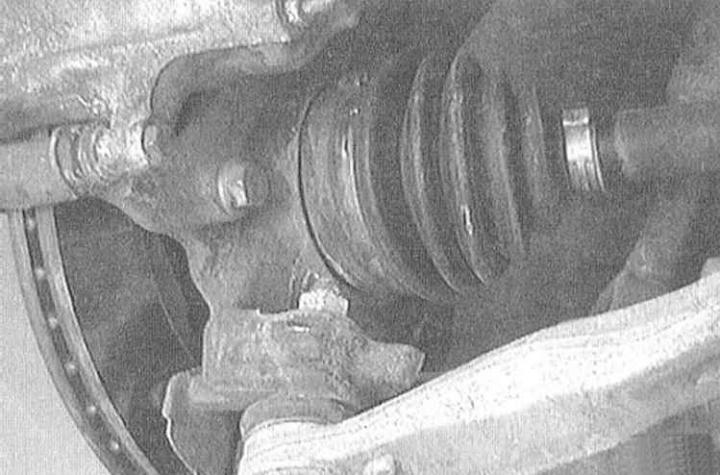
Check the CV joint boots for cracks and other damage
While continuing to rotate the wheel, make sure the drive shaft is not bent or otherwise damaged.
Brake system
If possible, without disassembling the mechanisms, check the condition of the brake pads and discs. Make sure that the friction lining material is not excessively worn and that there are no cracks, cavities, grooves or other signs of excessive wear on the disc surfaces.
Carefully check the condition of the rigid brake pipes under the car's bottom and the flexible hoses of the rear brake mechanisms. The presence of traces of excessive corrosion, abrasions, unreliability of the fastening of the nipple connections of the pipes, as well as cracks, signs of aging of the material, leaks and swelling under the pressure of the flexible hoses is unacceptable.
Check the brake calipers and shields for signs of brake fluid leaks, which indicate a deterioration in the quality of the hydraulic seals of the corresponding components.
While slowly rotating each wheel in turn, have an assistant apply the foot brake and then release it. Make sure that each brake mechanism is functioning properly and that the wheel rotates freely when the brake pedal is released. It is not possible to check the effectiveness of the brake mechanisms without using special equipment, but road tests (subject to appropriate road and weather conditions) are able to detect the effect of a vehicle being pulled to the side when driving in a straight line.
Check the parking brake drive mechanism for frayed or broken cables, excessive wear, and unreliable fastening of the rods. Ask an assistant to apply and then release the parking brake, and make sure that the brake mechanisms of each of the rear wheels of the car operate and release reliably.
Fuel and exhaust systems
Check the condition of the fuel tank, pipes, hoses and fittings (including connections on the pump, filter and fuel injection system). All components must be securely fastened and show no signs of leakage. The fuel cap must close securely and meet the vehicle manufacturer's requirements.
Check the exhaust system along its entire length for damage to supports and suspensions, the reliability of the clamps of the section butt joints, and traces of corrosion.
Wheels and tires
Carefully inspect the tires of all wheels one by one, both from the outside and from the inside, as well as over the entire surface of the tread. The presence of cuts, cracks, swellings, seals, tread delamination, as well as exposure of the cord and tire frame due to wear or damage are unacceptable. Make sure that the tire bead fits tightly on the rim of the wheel disk. Check the fit and condition of the tire inflation valve (nipple). Rotate the wheels, checking the disks for signs of deformation, especially along the rim.
Make sure that the correct size tires are installed, corresponding in size to the vehicle brand. It is not allowed to install tires of different types or sizes on the same axle. It is not allowed to use special spare tires during normal operation of the vehicle (compact) type. In addition, the tires must be inflated to the required pressure.
Using a special device, measure the depth of the tyre tread pattern. According to currently accepted road safety regulations, the pattern must be clearly visible over the entire tread area and have a depth of at least 1.6 mm over at least three-quarters of the tread width. A certain amount of tread wear on the outer and inner edges is acceptable, but it must be in the form of an even, continuous ring and the tread pattern in the worn area must also be visible. Any of the above excessive wear may be a sign of a front wheel alignment problem, which should be checked before the tyres fail completely. More detailed information on typical tread wear and front wheel alignment is provided in the relevant Chapters of the Manual.
Body corrosion
Check all load-bearing elements of the car body and frame in areas subject to loads for signs of corrosion. All profile elements of the frame, thresholds, cross beams, body pillars, supports and fasteners of suspension and steering elements, brake system components and seat belts are considered loaded and load-bearing. Corrosion that significantly reduces the thickness of the metal of load-bearing sections of the car body and causes them to weaken is unacceptable. In this case, the car must undergo body repair.
Exhaust gas toxicity test
Warm up the engine to normal operating temperature and ensure that the prerequisites for checking the idle speed and mixture quality are met (i.e., that the ignition system is functioning normally and the air filter element is in satisfactory condition).
Before starting the measurements, raise the engine speed to approximately 2500 rpm and hold it there for about 20 seconds. Reduce the speed again to idle and look closely at the smoke coming out of the vehicle's exhaust pipe. If the idle speed is clearly exceeded, or if clearly visible dark blue or black smoke is emitted from the exhaust system for more than 5 seconds, the vehicle should be repaired. Blue smoke is a sign of engine oil burning (wear of valve stem oil seals, valve guides, piston rings or cylinder bores), while black can be considered evidence of incomplete combustion of fuel (contamination of the air filter element, excessive enrichment of the mixture or other problems in the operation of the fuel injection system).
If the idle speed and the external condition of the exhaust are normal, it is necessary to measure the content of carbon monoxide (CO) and hydrocarbon compounds in the exhaust using an exhaust gas analyzer. It is further assumed that such an analyzer can be rented or borrowed - it is not rational to purchase one for an amateur mechanic. Alternatively, you should contact a service station to conduct this check.
CO emission (quality of the mixture)
When carrying out this check, it is necessary to be guided by the requirements of the traffic regulations regarding the CO content in exhaust gases.
If it is not possible to reduce the CO level to within acceptable limits (it is assumed that from other points of view the fuel and ignition systems are functioning properly), it should be assumed that there is some defect in the fuel injection system.
It is possible that the CO level meets the traffic regulations but exceeds the norm set by the manufacturer.
Emission of hydrocarbon compounds
Having made sure that the level of CO in the exhaust gases is normal (or achieve this), proceed to measure the hydrocarbon content in the exhaust. It should not exceed 1200 parts per million. If the car does not pass this test at idle, repeat it at 2000 rpm; if the hydrocarbon content now falls within the norm, the test can be considered successfully passed.
Excessive hydrocarbon content in exhaust gases may be a sign of oil burnout, but it is equally likely to be caused by incomplete combustion of fuel. Possible causes include:
- a) Poor condition of spark plugs or incorrect spark plug gap.
- b) Violation of the ignition timing angle setting.
- c) Incorrect valve clearance.
- d) Low compression pressure in the cylinders.
Also remember that excessive hydrocarbon content in the exhaust gases may be a consequence of a malfunction of the catalytic converter (if such is included in the vehicle's equipment).