



Table of contents: Cleaners ↓ Lubricating fluids ↓ Petrol engines ↓ Qualities of motor oils ↓ Additives for motor oils ↓ Mixing oils ↓ Sealants ↓ Chemicals ↓ Others ↓
There are many chemicals, oils and lubricants available for sale that are essential for routine maintenance and repair of a vehicle. These include a wide range of chemical and petroleum products, from cleaning compounds and solvents to oils, lubricants and aerosols for protecting rubber and plastic components of a vehicle.
Cleaners
Carburetor and choke cleaner is a powerful solvent for resins, carbon deposits and carbon deposits. Most carburetor cleaners leave behind a dry type of lubricating film that does not harden or become resinous over time. It is because of the formation of such a film that these cleaners are not recommended for use in cleaning electrical components.
Brake system cleaner is used to remove traces of grease and brake fluid from the surfaces of brake system components, where absolute cleanliness is a primary condition for efficient operation. The cleaner leaves no traces and in many cases eliminates the squeal of brake mechanisms caused by contamination of their components.
The electrical component cleaner helps remove oxide films, traces of corrosion and carbon deposits from contact surfaces without disrupting electrical conductivity. It can also be used to clean spark plugs, carburetor jets, voltage regulators and other components where complete removal of oil and grease is desired.
Desiccants are used to remove water and moisture from the surfaces of electrical components such as generators, voltage regulators, fuse boxes, electrical connectors, etc. Desiccants are typically non-conductive, non-corrosive, and non-flammable.
Degreasers are super-strong solvents and are used to remove traces of grease from the outer surfaces of the engine and chassis components. They are available as aerosols or applied with a brush or brush and, depending on the type, are washed off with either water or solvent.
Lubricating fluids
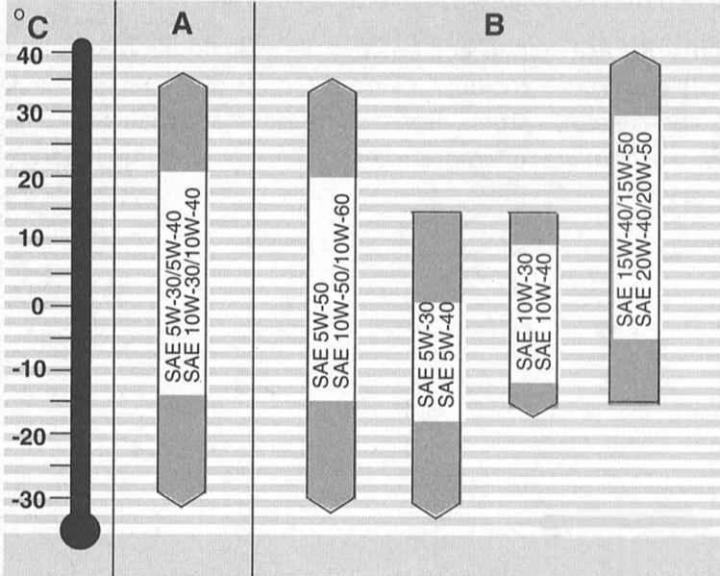
Viscosity map of motor oils
Petrol engines
- And all-season oils with increased antifriction properties, specification VW 500 00
- In all-season oils, specification VW 501 01
- Multigrade oils, API-SF or SG specification
- Turbodiesel all-season oils specification VW 505 00
Engine (motor) oils are specially developed compounds for lubricating internal engine components. They usually contain a wide range of various additives that prevent foaming and corrosion. Engine oils are available in various viscosity grades – from 5 to 80. The need to use a particular grade of oil is usually determined by climatic conditions and the requirements of a specific engine. Liquid (light) oils are usually used in cold climates and with minor engine loads. Heavy (viscous) oils are used in hot conditions and with increased engine loads. All-season oils have the characteristics of both light and heavy oils and are usually designated from 5W–20 to 20W–50.
Qualities of motor oils
All-season oils according to VW standards 501 01 and 505 00 are relatively inexpensive oils with the following qualities:
- year-round use in temperate climate zones;
- excellent cleaning properties;
- good lubricating ability at all temperatures and engine loads;
- high stability of initial properties over a long period of time.
All-season oils with improved anti-friction properties according to the VW 500 00 standard also have additional advantages:
- year-round use at almost all possible outdoor temperatures;
- low engine power losses due to friction;
- facilitating cold engine starting even at very low temperatures.
Warning: Due to their specific viscosity-temperature properties, monograde oils cannot usually be used all year round. Therefore, these oils should only be used in extreme climate zones.
Warning: When using SAE 5W–30 grade all-season oils, prolonged high-speed engine operation and constant high engine loads should be avoided. These restrictions do not apply to all-season oils with improved antifriction properties.
Additives for motor oils
No friction reducing additives should be added to engine oils.
Mixing oils
This and similar questions interest many car enthusiasts. The answer to the first one is, unfortunately, no, even if these are oils from companies with a "world-famous" name (Shell, Mobil, British Petroleum). Each company produces commercial oils, adding a whole range of additives to the oil base, the chemical composition of which is kept secret. Therefore, many high-quality oils of the same purpose, manufactured according to the requirements regarding operational and technical properties of the international API classification and the European CCMS-ACEA specification, but according to the technologies of different companies, when mixed are capable of creating low-quality mixtures due to the interaction and mutual destruction of additives, that is, the "incompatibility" of additives. Oils of different companies are interchangeable, the possibility of using such oils is often indicated by engine developers. But this does not mean that they can be mixed. The API classification and the ACEA specification imply mandatory identical testing methods (laboratory, bench, motor, etc.) oils from different companies. If desired (or necessity) developers may introduce additional tests (or more stringent conditions) to these classifications.
The same applies to mixing mineral or synthetic oils (sometimes even from the same company). Synthetic oils can have a hydrocarbon composition (in such cases, oils from the same company can be mixed, which is what the oil manufacturer recommends and for which it is responsible), different chemical composition. Unfortunately, it is not uncommon for oils to deteriorate in quality when mixed. As a result, the engine may "knock" because the mixture of incompatible oils turns into "jelly".
An even more negative answer to the question about the possibility of mixing imported and domestic oils, especially those made with the addition of "domestic" additives. Neither the seller nor the consumer knows the composition of the additives that are in the oils. Some oils of "domestic origin" are produced by "companies" that do not have even basic knowledge of petroleum products. Sometimes such "specialists" use waste oils (even without proper regeneration) to the production of "commercial". At the same time, the corresponding quality. Therefore, advice on the possibility of mixing oils should be given very carefully!
No "cleaners" are capable of increasing the octane number of gasoline. For this purpose, special additives are used - antiknock agents, which are added during the production of gasoline at oil refineries. The cause of detonation (metallic knocking sound during engine operation) and glow plug ignition (continuing engine operation with ignition off) there may be excessive carbon deposits in the combustion chamber.
The increase in compression in the system "with the introduction of certain additives" occurs not due to viscosity additives, since they do not have them in their composition, but for other reasons.
It is not advisable to reduce oil burn in an old engine and increase compression in the cylinders by using high-viscosity oils, since this will only lead to a temporary improvement. In the future, engine repairs will cost more.
The reason for engine knocking is its wear. Therefore, it will be cheaper to repair with subsequent use of high-quality oil. It is possible to "reduce" the gaps with additives, but the expediency of this should be understood in order not to harm the engine.
A few words about "marine oils" and the possibility of their use in automobile diesel engines.
Special marine oils for diesel engines belong to group E, for example, M-16E30, M16E60, intended for low-speed diesel engines operating on high-sulfur viscous fuel – fuel oil. These oils have technical and operational properties (quality indicators), different from the quality indicators of oils for automobile diesel engines, so their use in automobile diesel engines is impossible. There are marine oils of group D, for example, M-10 DCL20, M-14DCL20, M-14DCL30, which are used in diesel engines running on high-sulfur fuel. The oils are water-resistant and have an increased alkaline number and high ash content. For automobile diesel engines, this leads to increased wear, which over time may not pay off with free oil. Oil M-16DR for marine diesel engines that run on distillate fuel with increased viscosity compared to the viscosity of automobile fuel and a sulfur content of up to 0.5%, can be used in automobile diesel engines in the summer (for heavy trucks, not passenger cars).
It is necessary to make it a rule: to use high-quality oil of the same brand corresponding to the engine (by classification) and don't risk mixing it with the same synthetic (or semi-synthetic) oil. The engine will thank you for this with reliable operation. Do not buy oil from hands, as the packaging is easy to counterfeit.
Transmission oil designed for use in differentials, gearboxes and other applications where high temperature resistance is required.
Lubricant for chassis components and wheel bearings is a thick lubricant used in components subject to increased loads and friction, such as wheel bearings, suspension ball joints, steering rod ends and cardan joints.
High Temperature Wheel Bearing Grease capable of withstanding the high temperatures that occur in wheel bearings of vehicles equipped with disc brakes. Typically contains molybdenum disulphide, which is a dry type lubricant.
White grease (tsiatim) is a thick lubricant applied to metal surfaces in contact with each other in places where there are problems with increased moisture. It remains soft at both low and high temperatures, is not washed out or diluted by water.
Assembly grease is a special grease for use under high pressure conditions, usually contains molybdenum and is used to lubricate components subject to increased loads (such as main connecting rod bearings and cam lobes) before the first engine start after completion of a major overhaul.
Silicone lubricants used to protect rubber, plastic, vinyl and nylon components.
Graphite lubricants are used where oil cannot be used due to contamination problems (for example, in castles). Dry graphite perfectly lubricates metal parts, preventing the impact of moisture, acids and other aggressive contaminants on them. The lubricant is electrically conductive and does not disrupt contact in such units as, for example, the ignition switch.
Molybdenum-containing penetrating compounds are used to facilitate the release of "stuck" fasteners, as well as to lubricate fasteners to prevent corrosion in the future.
Thermal conductive grease is non-conductive and is used for installing electronic ignition modules, which require intensive heat dissipation.
Sealants
RTV sealant is the most widely used gasket sealant. It is made on the basis of silicon, hardens in air, provides sealing, adhesion, is waterproof, fills surface defects, remains elastic, does not shrink or shrink, is relatively easy to remove and is used in addition to almost all gaskets on units where temperatures do not exceed average values.
Anaerobic sealant unlike RTV sealant, it can be used not only in addition to gaskets, but also to form them. It remains elastic, is resistant to solvents and fills surface irregularities well. The main difference from RTV sealant is in the curing conditions. If RTV sealant begins to harden after exposure to air, then anaerobic sealant only hardens in the absence of air. This means that such a sealant hardens only after assembling the components and pressing them tightly against each other.
Pipe Sealant and threaded connections is used to seal nipple connections of hydraulic, pneumatic and vacuum lines. It is usually made on the basis of Teflon compound and is supplied in the form of aerosols applied like paint, liquids or in the form of tape (FUM).
Chemicals
Anti-seize compound serves to prevent "sticking", corrosion, jamming and cold welding of fasteners. High-temperature anti-seizing sealants are usually made on the basis of copper-containing or graphite lubricants and are used in fasteners of the exhaust system and exhaust manifold.
Anaerobic gripping compounds serve to prevent spontaneous loosening of fasteners under the influence of vibrations and harden only after installation in the absence of contact with air. Medium-power gripping compounds are used to fix small fasteners (nuts, bolts, screws), which are subject to regular release in the future. High-power compounds are usually used to lock large fasteners that are not released on a regular basis.
Oil additives are used to change the chemical properties of the oil without changing its viscosity in order to reduce internal friction in the engine. It should be noted that most manufacturers of motor oils warn against using any additives to them.
Fuel additives perform several functions at once, depending on their chemical composition. They usually contain solvents that help remove sludge and carbon deposits from the internal surfaces of the carburetor and components of the fuel injection system and intake tract. In addition, the use of such additives helps remove carbon deposits that form on the walls of combustion chambers. Some additives contain substances that serve to lubricate the components of the upper part of the cylinder head (valve mechanism, piston rings), others help remove condensation from the walls of the fuel tank.
Others
Brake fluid – is a specially developed compound that can withstand the effects of high temperatures and pressures that occur in the brake system. Avoid contact of brake fluid with painted surfaces of the car and exposed areas of the body. Keep brake fluid in a hermetically sealed container to prevent moisture from getting into it (the liquid is very hygroscopic) and dirt.
During vehicle operation, brake fluid absorbs a certain amount of water from the surrounding air. Too much water in the brake fluid can eventually cause corrosion of the working brake system components. In addition, the boiling point of the brake fluid is significantly reduced.
Therefore, you should change the brake fluid every two years!
Warning: If the brake fluid is very old, it is possible that, under high load on the service brake system, steam bubbles may form in the system. This has a negative effect on the efficiency of the service brake system and, therefore, on driving safety.
Warning: Use only recommended brake fluid (uS FMVSS 116 DOT 4 specification).
Adhesive for fixing sealing strips of body openings, as its name suggests, is used to secure sealing strips for door openings, windows and luggage compartment lids. It can be used to secure interior trim elements.
Anti-corrosion coating for the underbody of a car is a tar-like composition made on an oil base and serves as a protective coating for metal surfaces, preventing their corrosion. In addition, it performs the function of soundproofing the interior.
Waxes and polishes are used to protect painted surfaces from environmental influences. Different types of paint may require the use of different types of waxes and polishes. Some polishes contain abrasive or chemical additives that serve to remove the outer layer of oxides (tarnishings) from the painted surfaces of old cars. Recently, various types of wax-free polishes have become widely available on the market, which contain many chemical additives such as polymers or silicon-based substances. Such polishes are usually easier to apply and last longer than regular (wax) polishes.