



Table of contents: Seat belts ↓ Why wear seat belts? ↓ Automatic seat belts with… ↓ Pyrotechnic seat belt tensioner ↓ Fastening with three-point belts ↓ Belt height adjustment ↓ Removal the three-point harness ↓ Waist belt* ↓ Airbags ↓ Airbag modules ↓ Under what conditions do airbags… ↓ Front airbags ↓ Side airbags ↓ Head airbags (SIDEQUARD)* ↓ It is also important to remember: ↓ Disabling airbags ↓ Disabling the front passenger airbag… ↓ Front Passenger Airbag Switch* ↓ Rules for the safe transportation of… ↓ Group 0 / 0+ ↓ Group 1 ↓ Group 2 ↓ Group 3 ↓ Child seat lock ↓ Installing child seats on the front… ↓ Child safety and side airbag ↓ Child seat mounting (ISOFIX system)* ↓
Seat belts
Warning: Fasten your seat belts before every trip, including in the city! This also applies to rear seat passengers. Pregnant women should also always fasten their seat belts.
Warning: The protective effect of the belts depends to a large extent on the position of the straps after fastening. Recommendations for proper fastening of the belts are given below.
Why wear seat belts?
It is known that seat belts are an effective means of protection in road accidents.
In a frontal collision, unbelted passengers are thrown forward and hit (as shown in the illustration) about various parts of the car interior, such as, for example, the steering wheel, dashboard, windshield.
The common belief that in case of a light collision you should protect your body with your hands is wrong. Even a low-speed collision creates forces that are insurmountable for your hands.
Rear seat passengers also need to wear seat belts, as they are thrown around uncontrollably in a collision. An unfastened rear seat passenger is dangerous not only to themselves, but also to the front passengers.
Warning: Please remember the following:
Warning: Do not allow the belt webbing to become caught, twisted or rub against sharp edges.
Warning: Never use one belt to secure two people at the same time (also children).
Warning: The maximum protective effect of the belts is only achieved if the seat is correctly positioned - refer to subsection Seats.
Warning: The belt strap must not press against hard or brittle objects (glasses, ballpoint pens, etc.), as this may cause injury.
Warning: Layered, loose clothing (for example, a coat over a jacket) restricts the fit and interferes with the operation of the seat belts.
Warning: The belt buckle must be inserted into the buckle slot of your seat.
Warning: Keep the belt tape clean, as heavy contamination may cause the automatic operation of the belts to be disrupted.
Warning: Do not fill the lock slot with paper or other debris, as this will prevent the lock clasp from snapping into place.
Warning: It is not permitted to dismantle or make any changes to the seat belts, or to repair them on your own.
Warning: Damaged seat belts or those that have been stretched as a result of an emergency deployment must be replaced at an Audi service station.
Also check the belt attachment points.
Automatic seat belts with three-point fastening
Automatic seat belts provide full freedom of movement when tensioned smoothly. However, they lock when braking sharply.
The automatic system also locks the belts when the car accelerates, when driving on mountain roads and when turning corners.
In addition, it is possible to permanently lock the front passenger seat belts, as well as the rear side seat belts for securing child seats.
Warning: The front seat backs can only be reclined if the diagonal strap is against the chest. Otherwise, the protective effect of the belts may be lost.
Warning: The split rear seat back* must be securely fastened to ensure the protective effect of the centre seat belt – refer to subsection Seats.
Pyrotechnic seat belt tensioner
In the event of a serious frontal or side collision, the three-point seat belts are automatically tightened. In even more severe collisions, the airbags are additionally deployed.
Pyrotechnic seat belt tensioners do not deploy in rear impact or rollover situations.
Warning: All work on the system, as well as dismantling and installing its components for other repair operations, should only be performed at an Audi service station.
Warning: The system is a single-action device. Once activated, it must be replaced.
Warning: When pyrotechnic tension devices are activated, smoke is released. Smoke does not indicate a vehicle fire.
Fastening with three-point belts
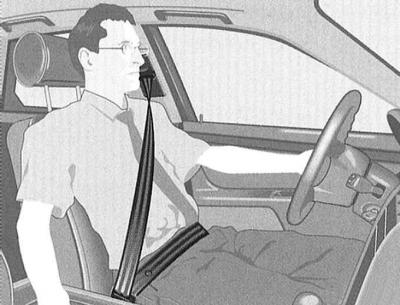
Take hold of the belt buckle, smoothly pull the strap, place it over your chest and waist and insert the buckle into the slot of your lock until you hear a click (pull the belt and make sure the lock is locked!).
The diagonal portion of the belt should pass through the middle of the shoulder (refer to illustration) and in no case should it cover your neck. It should fit tightly to your chest.
The waistband should always fit snugly around your hips. If necessary, slide it down and tighten it.

Pregnant women should also always wear seat belts.
In this case, the waist belt should be positioned as low as possible to avoid pressure on the stomach.
Belt height adjustment
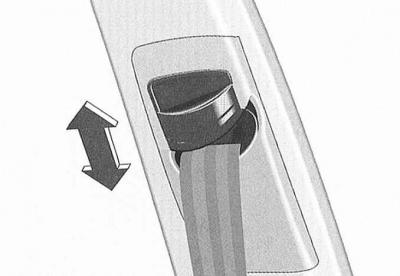
The front seats have the ability to adjust the position of the diagonal belt strap.
To adjust, move the slider with the reversible buckle up or down so that the diagonal strap is approximately at mid-shoulder level, as shown in the previous illustration, but in no case does it go around the neck.
After adjustment, tug on the belt to ensure that the buckle is securely fastened.
Removal the three-point harness
The belt is unfastened by pressing the red button of the lock with your finger. In this case, the clasp is pushed out of the socket under the action of the spring.
To facilitate the operation of the automatic belt retraction, pull the buckle back with your hand. A plastic button embedded in the belt tape is designed to hold the belt in a comfortable position.
Waist belt*
The middle seat can also be equipped with a lap seat belt.
The use of the lap belt is the same as the three-point automatic belt.
To fasten, the belt is pulled out in one continuous movement and its buckle is inserted into the slot of the corresponding lock until it clicks into place (be sure to tug on the belt to make sure the lock is locked).
When the belt is properly fastened, the red button is located on the outside of the belt buckle.
The belt should always fit snugly around the waist.
Warning: The belt can only be pulled out if the webbing has been completely retracted by the retractor mechanism.
Warning: To release the belt, press the red button on the buckle and allow the belt to retract into the retractor mechanism.
Airbags
In the event of a serious frontal collision, the airbags, together with the three-point seat belts, provide additional protection for the head and chest area of the driver and front passenger.
Side and head* airbags reduce the risk of injury to passengers in the impact zone in severe side collisions.
The airbag is not a replacement for seat belts, but is part of the overall concept of passive safety of the car.
You should always keep in mind that the maximum protective effect of the airbag system is achieved only when it interacts with fastened seat belts.
Therefore, always wear your seat belts.
System components
The main components are:
- electronic control device (control device)
- both front airbags
- side airbags
- left and right head pillows*
Control lamp
The system's readiness for operation is monitored electronically and indicated by the "AIRBAG" control lamp.
After each ignition switch on, the "AIRBAG" indicator lamp lights up for a few seconds, which should go out after the self-diagnosis process is completed. If the lamp does not go out or lights up while driving, then the system is damaged. Refer to the subsection Control and measuring devices. Warning and diagnostic systems.
Warning: If the system is faulty, it must be checked immediately by an Audi service center. Otherwise, there is a risk that the airbags or seat belt tensioners will not operate as intended in an accident.
Airbag modules
Description of the location of the airbags (pillow with gas generator) is given below.
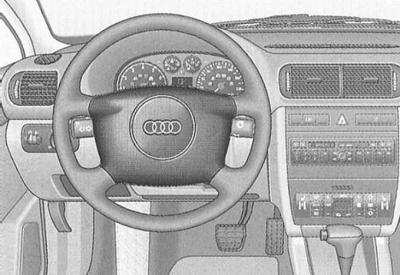
Driver's front airbag is located in the steering wheel trim panel. The location is marked "AIRBAG".
Warning: The maximum protective effect of the seat belts and airbag system is achieved only when correctly positioned in the seat.
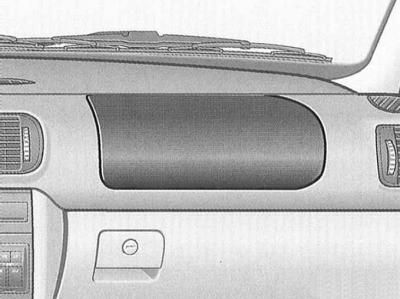
The front passenger airbag is located in the instrument panel above the glove compartment. The location is marked "AIRBAG".
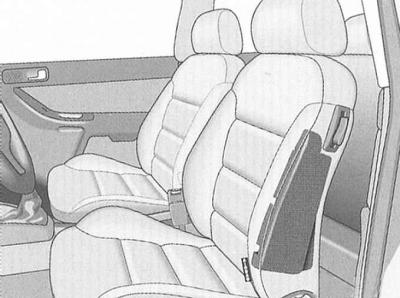
The side airbags are located in the upholstery of the front seatbacks (refer to illustration) seats. The location is marked "AIRBAG".
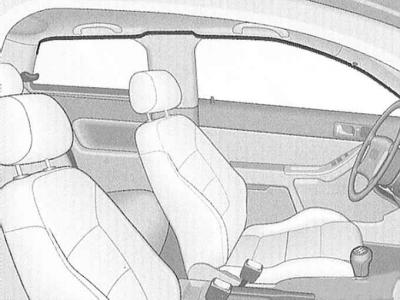
Head airbags* are located on the left and right above the doors in the ceiling. The installation locations are marked "AIRBAG".
When deployed, the head airbags cover the front and rear door glass area on both sides.
Under what conditions do airbags deploy?
The driver and front passenger airbags deploy in the event of a severe frontal collision.
In severe side impacts, the side airbags deploy together with the head* airbag on the corresponding side of the vehicle.
In extreme emergency situations, both front and side airbags may deploy together with the appropriate head* airbag.
Airbags do not deploy in minor frontal and side collisions, rear-end collisions, or rollovers. In these situations, occupants are traditionally protected by wearing seat belts.
There are no uniform criteria for triggering airbags in each specific situation. This is explained by the extremely different specifics of accidents. For example, such factors as the properties of the object of collision with the car play an important role (hard, soft), collision angle, vehicle speed, etc.
The decisive condition for the deployment of the airbag system in the event of a collision is the deceleration process recorded by the control unit. The airbags are not deployed in a collision when the vehicle deceleration values are lower than the programmed values of the control unit, although the accident may result in quite severe deformation of the vehicle.
Front airbags
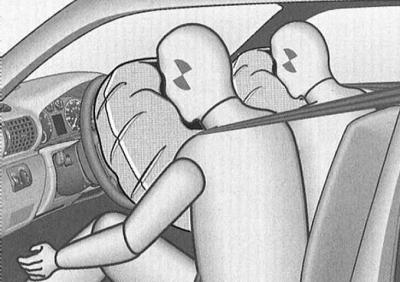
When the system is activated, the air cushions are filled with working gas and deploy, as shown in the illustration.
Contact with a fully inflated air bag dampens occupant movement and reduces the risk of injury to the head and upper torso.
The specially designed design of the inflatable cushion provides for a controlled release of the working gas under the influence of the driver or passenger in order to soften the reception of the head and body. As a result, the cushion is deflated after its deployment, as a result of which the forward view is again freed.
The airbags inflate in hundredths of a second and at high speed to provide additional protection in the event of an accident.
At the same time, the airbag develops a very high force, which can cause injuries to passengers who are not sitting upright in the seat or to objects in the airbag's area of effect.
When the airbag inflates, fine dust is produced. This is normal and does not indicate a vehicle fire.
Please be sure to take the following warnings into account:
Warning: Sit in a normal, upright position and maintain a safe distance from the steering wheel/dashboard to achieve maximum protection if the airbags deploy. Also, the seats should always be adjusted to your height (refer to subsection Seats).
Warning: If you do not fasten your seat belts, bend over while moving forward, or take an incorrect position in the seat, then in the event of an accident, when the airbag system is activated, you are exposed to an increased risk of injury.
Warning: Never transport children in the front seats without proper seat belt stowage and tensioning systems. If the airbag system deploys in a crash, it could cause serious injury or death. For more information, see the section "Safely Transporting Children".
Warning: There should be no other persons between the occupants in front and the airbag area (for example, children), animals or objects.
Warning: The steering wheel trim panel and the surface of the airbag module in the front passenger instrument panel must not be covered with paper, fabric or treated in any way. Wipe it only with a dry or damp cloth.
Warning: No objects, such as cup holders or telephone holders, may be attached to the airbag module trim.
Warning: The airbag system's protective effect is only sufficient for one accident. After a single deployment, the entire system must be replaced.
Warning: Do not make any modifications to the cushions.
All work in the airbag system, as well as dismantling and installation of its components as a result of other repair operations (for example, removing the steering wheel), perform only at Audi service stations.
Side airbags
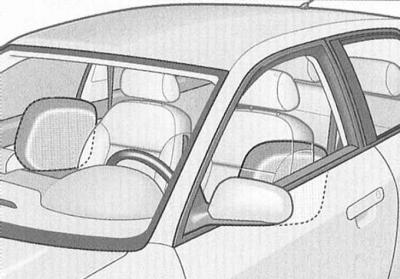
When the system is triggered, the airbags are filled with working gas.
The airbag inflates in hundredths of a second and at high speed to provide additional protection in the event of an accident.
A fully inflated cushion, due to the controlled release of working gas under the influence of load, dampens the lateral movements of passengers. As a result, the risk of damage to the upper body from the door side is reduced.
Please be sure to take the following warnings into account:
Warning: If you do not fasten your seat belts, bend over while driving forward, or take an incorrect position in the seat, then in the event of an accident, when the side airbag system is activated, you are exposed to an increased risk of injury.
Warning: To achieve maximum protection from the side airbags, always sit correctly in the seat with the seat belt fastened.
Warning: Your head should never be in the side airbag deployment area. Otherwise, you could be seriously injured in an accident. This is especially true for children.
Warning: There should be no other persons between the occupants in front and the airbag area (for example, children), animals or objects.
In addition, in order to trigger the side airbags, it is not permitted to attach foreign objects, such as cup holders with drinks, to the doors.
Warning: Only light clothing should be hung on coat hooks. Pockets should not contain heavy or sharp objects.
Warning: Under no circumstances may seat covers not approved by Audi be used. The cushion deploys from the seat back. Therefore, if you have seat covers or upholstery that are not approved, the protective function of your side airbag is significantly impaired.
Warning: Damage to the original seat upholstery or to the seams in the area of the side airbag module must be repaired immediately by an Audi service center.
Warning: Leaning forward or sitting incorrectly in the seat while driving puts children at increased risk of injury in the event of an accident. This applies in particular to children in the front passenger seat if the airbag system is deployed in the event of an accident. This can result in life-threatening injuries or even fatal injuries.
Warning: The airbag system's protective effect is only sufficient for one accident. After a single deployment, the system must be replaced.
Warning: Do not make any modifications to the airbag system components.
Warning: All work on the side airbag system, as well as dismantling and installation of its components due to other repair operations (for example, removing the front seat), perform only at an Audi service station. Otherwise, functional impairment of the safety system may occur.
Head airbags (SIDEQUARD)*
The deployment of the head airbag reduces the risk of head injuries when striking the glass, as well as the door pillars of passengers sitting near the doors. In addition, the head airbag protects against the penetration of any objects from the outside, such as glass fragments.
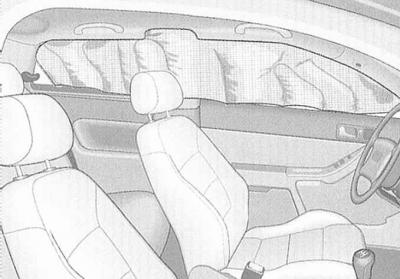
When the side airbags are deployed, the corresponding head airbag is automatically deployed.
In this case, the head airbag covers the side windows and door pillars, as shown in the illustration, and thus provides effective protection for both front and rear passengers.
To ensure this additional protective function, no objects are allowed within the airbag coverage area.
Please be sure to take the following warnings into account:
Warning: Only light clothing can be hung on the clothes hooks. The pockets should not contain heavy or sharp-angled objects. In addition, it is not allowed to use hangers (hangers) for clothes.
Warning: There should be no other persons between the seat in front and the cushion's effective area (for example, children), animals or objects.
In addition, passengers are not allowed to stick their heads and hands out of the windows. In addition, in order to ensure unimpeded deployment of head pillows, no objects are allowed in the area where they exit.
Warning: Do not move the sun visors toward the side windows if objects such as a ballpoint pen, garage opener, etc. are attached to the visors. These objects may cause injury to you if the head airbag deploys.
Warning: Only genuine Audi sunblinds may be installed on the rear door side.
Warning: Do not make any modifications to the airbag system components.
Warning: The protective effect of the airbags is only enough for one accident. After a single activation, the system must be replaced.
Warning: All work on the head airbag system, as well as dismantling and installation of its components due to other repair operations (for example, interior ceiling lining), perform only at an Audi service station. Otherwise, functional impairment of the safety system may occur.
It is also important to remember:
No more than 14 years after the date of manufacture, the airbag system must be replaced with a new one at an Audi service station. The date of manufacture (month/year) can be found on the data plate of the service book.
In order to maintain the system's functionality, it is imperative that you adhere to this period.
In case of replacement of airbag components (modules) before the established deadline (for example, as a result of an accident), the new date for replacing these components is determined and confirmed in the service book with the corresponding marks from the Audi service station servicing you.
When selling a car, give the buyer the full documentation of the car. Remember that this also includes documentation for the disabled front passenger airbag!
When cutting up a vehicle for scrap metal or disposing of individual components of the airbag system and pyrotechnic belt tensioners, it is essential to comply with the relevant safety regulations known to Audi service specialists.
Disabling airbags
Disabling airbags is only provided in certain cases, for example:
- if it is necessary, in exceptional cases, to install a child seat on the front passenger seat, in which the child is positioned with his back facing the direction of travel, if, despite the driver's seat being correctly installed, the minimum distance (25 cm) between the center of the steering wheel and the sternum is not maintained,
- if it is necessary to install special devices in the steering wheel area for physical disabilities,
- when installing other seats (for example, orthopedic seats without side airbags).
At the Audi service station you can find out about the options for disabling your car's airbags. Below is a description of the procedure for disabling the factory-fitted front passenger airbag.
At Audi service stations, a deactivated airbag is marked with a sticker in the instrument panel area (with the front passenger airbag deactivated).
When disabling the front passenger airbag using the key switch* (please refer to the following materials) the signal lamp is constantly on "PASSENGER AIRBAG OFF".
Return the disabled airbags to their working mode as soon as possible to perform their protective function.
Disabling the front passenger airbag when installing a child seat
Deactivate the front passenger airbag if there is an absolute need to install a rear-facing child seat in the front passenger seat.
However, we recommend that you only install the child seat in the rear seat to ensure that the front passenger airbag remains functional.
Have the front passenger airbag reset at an Audi service centre or using the key switch* as soon as the child seat is no longer needed.
When installing child seats, be sure to follow the recommendations in the section "Rules for the safe transportation of children."
Warning: If, in exceptional cases, it is necessary to transport a child in the front using a child seat with the child facing the direction of travel, first have the front passenger airbag switched off at an Audi service center or using the key switch located in the glove compartment. Otherwise, there is a risk of serious injury or death. For advice, contact an Audi service center.
Front Passenger Airbag Switch*
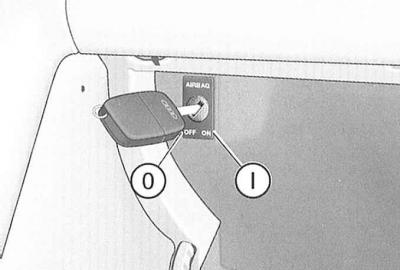
The front passenger airbag should be deactivated using the switch shown in the illustration and located in the glove compartment if, in exceptional cases, it is necessary to install a child seat on the front passenger seat with the child facing away from the direction of travel.
To deactivate the front passenger airbag, turn the vehicle key to position (0).
The airbag is activated by turning the key to position (I).
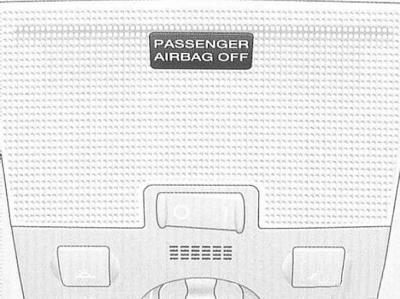
When the front passenger airbag is deactivated, the indicator lamp shown above is constantly illuminated.
Additionally, watch the "AIRBAG" indicator light on the instrument panel, refer to the subsection Control and measuring devices. Warning and diagnostic systems.
Warning: When the front passenger airbag is deactivated, all other airbags are operational.
Warning: Immediately return the front passenger airbag to its operating mode if it is no longer necessary to use the child seat for the airbag to perform its protective function.
Warning: It is the driver's responsibility to ensure that the key switch is in the correct position.
Warning: The front passenger airbag can be disabled at an Audi service station if your car is not equipped with a system for disabling this airbag at the factory. Refer to the materials presented above.
Rules for the safe transportation of children
Accident statistics show that the rear seat is safer for children than the front passenger seat. Children under 12 years of age should generally be transported in the rear seat. Depending on their age, height and body weight, special child seat belts or those already installed in the vehicle should be used when transporting them. For safety reasons, install the child seat belt system in the middle or outer rear seat furthest from the driver.
Warning: Everyone must wear a seat belt while driving. This especially applies to children.
Warning: Never allow a child to stand in the vehicle or kneel in the seat while the vehicle is moving. The child could be seriously injured in an accident.
Warning: Leaning forward or incorrectly positioning a child in a seat while driving puts children at increased risk of injury in the event of an accident. This applies in particular to children transported in the front passenger seat if the airbag system is deployed in an accident. This can result in life-threatening injuries or even fatal injuries.
Warning: To avoid injury to the abdomen and neck, children under 150 cm tall must not be secured with a standard seat belt without using a special child harness system.
Warning: Under no circumstances should children, including infants, be transported on an adult's lap.
Only child safety belt systems that are officially approved for use and are suitable for the specific child may be used.
The ECE-R 44 standard adopted by the United Nations Economic Commission for Europe applies to the systems for stowing and tensioning child seat belts, according to which such systems are divided into 5 groups:
- Group 0: up to 10 kg (up to about 9 months)
- Group 0+: up to 13 kg (up to about 18 months)
- Group 1: 9-18 kg (approximately 8 months to 4 years)
- Group 2: 15–25 kg (approximately 3 to 7 years old)
- Group 3: 22-36 kg (approximately 6 to 12 years old)
The child seat belt installation and tensioning systems tested according to the ECE-R 44 standard are provided with a confirmation mark (a large "E" in a circle with a control number below). The tag with the mark is firmly attached to the seat.
Group 0 / 0+
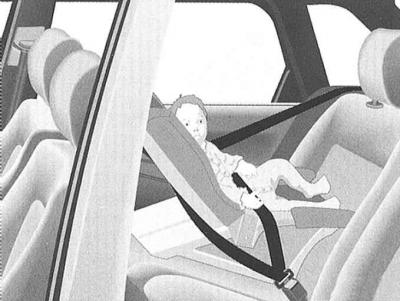
For babies up to approximately 9 months / 10 kg, and up to 18 months / 13 kg, child seats that can be converted to a lying position when needed are best suited (refer to illustration).
Warning: If, in exceptional cases, it is necessary to transport a child in the front passenger seat using a child seat with the child facing the direction of travel, first have the front passenger airbag switched off at an Audi service center or using the key switch located in the glove compartment. Otherwise, there is a risk of serious injury or death. For advice, contact an Audi service center.
Immediately return the front passenger airbag to working mode at an Audi service center or with the key switch* if you no longer need to use the child seat.
Group 1
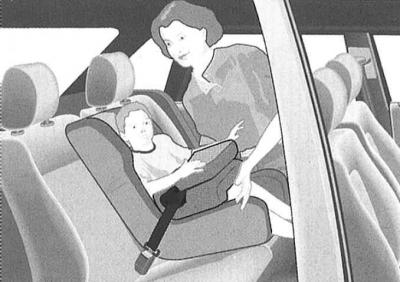
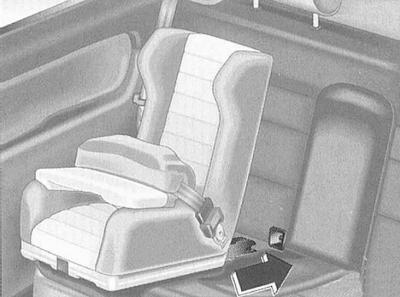
For infants and toddlers up to approximately 4 years / 18 kg, seats with a locking table are most suitable (refer to illustration) or those in which the child is positioned with his back to the direction of travel.
Warning: If, in exceptional cases, it is necessary to transport a child in the front passenger seat using a child seat with the child facing the direction of travel, first have the front passenger airbag switched off at an Audi service center or using the key switch located in the glove compartment. Otherwise, there is a risk of serious injury or death. For advice, contact an Audi service center.
Warning: Have the front passenger airbag reset immediately at an Audi service centre or via the key switch* if the child seat is no longer required.
Group 2
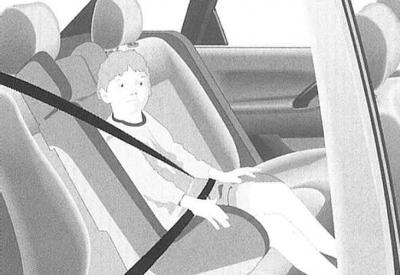
For children aged approximately 7 years / 25 kg, the most suitable combination is a child seat with diagonal-lap seat belts.
Warning: The diagonal strap of the belt should go approximately across the middle of the shoulder and under no circumstances around the neck, but should fit snugly across the chest. The lap strap of the belt should go around the child's hips, not the stomach.
Group 3
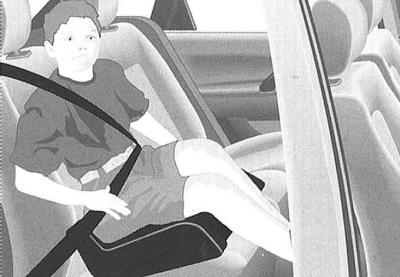
For children aged approximately 7 years and older, up to 150 cm tall, booster cushions in combination with diagonal lap seat belts are most convenient.
Warning: The diagonal strap of the belt should pass approximately through the middle of the shoulder and under no circumstances should it go around the neck, but should fit securely across the chest. The waist strap of the belt should go around the hips, not the stomach.
Warning: Children taller than 150 cm can use seat belts without booster cushions.
Warning: Use child seat belt systems that are part of the Audi Genuine Product range. Under the general name "Huckerpack" systems for all age groups are available. These systems comply with the ECE-R 44 standard and have also been developed and tested for use in Audi vehicles.
Warning: Take special care when using child safety belt systems that are threaded together with existing seat belts in the vehicle. Make sure that the bolts are fully wrapped with a force of 50 N·m.
Warning: Check that the belts are correctly applied. Also, make sure that the belt webbing cannot be damaged by the sharp edges of the buckles.
Warning: Only one child can be secured with one set of child safety belts at a time.
When installing and using child restraint systems, please comply with legal provisions and the instructions of the manufacturer of the specific system.
Child seat lock
To secure a child seat, the seat belts can be permanently locked using a three-point mount.
Implementation of blocking
Secure the child seat with a three-point harness according to the manufacturer's instructions.
Remove the diagonal strap of the belt completely after fastening.
Release the belt tape and make sure it fits snugly against the child seat. The tape should not come out again. Try to pull the belt sharply with your hand. It should not jerk!
Unlocking
Press the red button in the belt buckle. This will retract the belt and release the belt.
Installing child seats on the front passenger seat
For safety reasons, we recommend installing child seat belt stowage and tensioning systems on the rear seats. When installing child seats on the front passenger seat, due to the presence of an airbag, please note the following:
Warning: When the front passenger airbag is activated, do not install a rear-facing child seat in the front passenger seat. The child seat is within the front passenger airbag coverage area. Therefore, there is a risk of serious or fatal injury to the child if the airbag inflates.
Warning: When using a forward-facing child seat, the front passenger seat must be moved all the way back.
Warning: If, in exceptional cases, it is necessary to transport a child in the front passenger seat using a child seat in which the child is positioned with his or her back to the direction of travel, first switch off the front passenger airbag using the key switch located in the glove compartment or have it switched off at an Audi service center.
Warning: When the front passenger airbag is deactivated, the front passenger side airbag remains deployed.
Warning: Have the front passenger airbag reset immediately at an Audi service centre or via the key switch* if the child seat is no longer required.
Child safety and side airbag
Audi side airbags provide additional protection for vehicle occupants in the event of a side collision.
To provide this protective function in the event of a collision, the side airbag must deploy within milliseconds.
At the same time, the airbag develops a very high force, which can cause injuries to passengers who are not in an upright position or if there are any objects in the airbag's area of effect.
This is especially true for children if they are not transported in accordance with current regulations.
Warning: To avoid serious injury, always use the correct harness system for your child's age, height and weight.
Child seat mounting (ISOFIX system)*
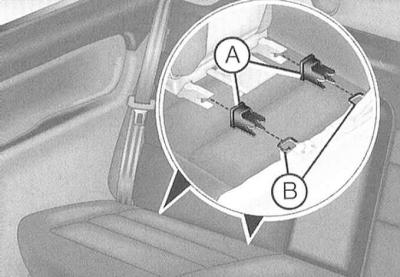
On each of the rear outboard seats, between the backrest and the seat, there are two holders (B) for attaching a child seat using the ISOFIX system.
Child seats with the ISOFIX fastening system can be purchased at Audi service stations.
Before installing the child seat, install the receiving sockets (A) supplied with the "child seat" onto the holders (B) (refer to illustration). This will prevent damage to the seat upholstery.
The illustration shows the already mounted receiving sockets with the child seat locking levers inserted into them.
Currently, child seats with the ISOFIX fastening system are offered for children weighing from 9 to 18 kg. This corresponds to an age from 9 months to 4 years.
Detailed installation instructions are included with the child seat.
Warning: It is possible to retrofit the ISOFIX child seat mounting system at an Audi service centre.
[Content source: the specified website: Audimanual.ru]