



Table of contents: Idea ↓ All-wheel drive concepts ↓ Torsen distribution differential ↓ Driving dynamics on dry roads ↓ Guidelines for 4WD vehicles ↓ Rear axle differential lock ↓
If a company is ordered to make a decent all-wheel drive in a personal production car, then this company is, without question, Audi.
Idea
On behalf of the Bundeswehr, Audi developed the all-terrain vehicle "VW litis" for VW, which can be called a good foundation for the idea of the fourth generation of cars. The legend tells it like this: at one of the winter tests in northern Sweden, it was precisely this litis that left the front-wheel drive Audi, faster and with a significantly more powerful engine, far behind. Since the then head of the chassis test was engaged in the initial ignition, thanks to which a "stable working car with all-wheel drive" will be obtained as a vehicle for all occasions. And after that, as we know, nothing is stronger than an idea whose time has come (and it seems to have come), it was developed for so long until the legendary fourth generation Audi car was finally created.
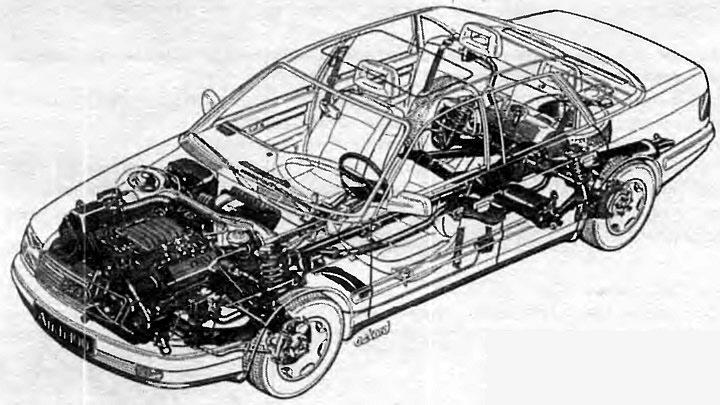
The diagram of the fourth generation Audi-100 clearly shows the transmission to the rear axle with a propeller shaft, rear axle drive and drive shafts to the rear axle.
All-wheel drive concepts
Until now, all-wheel drive has been almost inseparably linked to the concept of an all-terrain vehicle. The principle of all-wheel drive used in this was simple: to the standard drive mechanism (engine in front, drive mechanism in the back) there was simply "something added", namely that with the drive branch and the additional cardan shaft a second phase of the drive mechanism was added to the front axle.
Now the work with the standard drive mechanism has become normal, and only if the bullet conditions require it, the front transmission is engaged. This type of design with a plug-in all-wheel drive is also common today in off-road vehicles. Disadvantage: when driving on a hard surface, the all-wheel drive must be switched off. Because in turns the front wheels lie much further back than the rear wheels. Different wheel speeds lead to transmission failures. Effect: the vehicle is difficult to control, in turns the wheel with the slightest slip periodically wears out to the discharge of the drive mechanism - the car "slips".
With permanent all-wheel drive, which is consistently directed to all four wheels, it must have a balance that prevents malfunctions in both final drives. This problem is solved by the so-called center differential.
We have known the differential since the beginning of automobile manufacturing. It divides the forces between the right and left drive wheels. Also, balancing is necessary because - as we know - the wheel on the outside of the curve will always travel a longer distance back than the wheel on the inside. This balancing is created by the axle differential. This makes it possible in the drive mechanism of the bridge to simultaneously turn both drive wheels freely relative to each other.
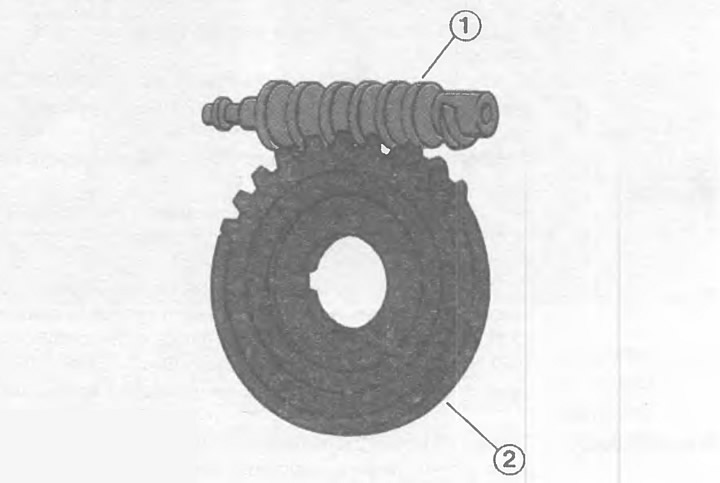
Torsen differential is based on the principle of worm final drive. Worm final drive can have high or low locking capacity. Designations: 1 - worm, 2 - worm wheel.
Anyone who has driven a car in winter knows the insidiousness of the object: when the wheel standing on the ice turns, the opposite wheel on more stable ground does not transmit any force and stands still. One thing is clear: a stable differential is not suitable for a center differential, since such a case is undesirable. The force must be where the wheels transmit it to the ground. Precisely where there is a stable road surface. And since nothing is ever known in advance, the distribution must take place automatically - namely, without delay! After various stages of development, the manually locking center differential is now equipped in fourth-generation Audi vehicles with the so-called Torsen distribution differential.
Torsen distribution differential
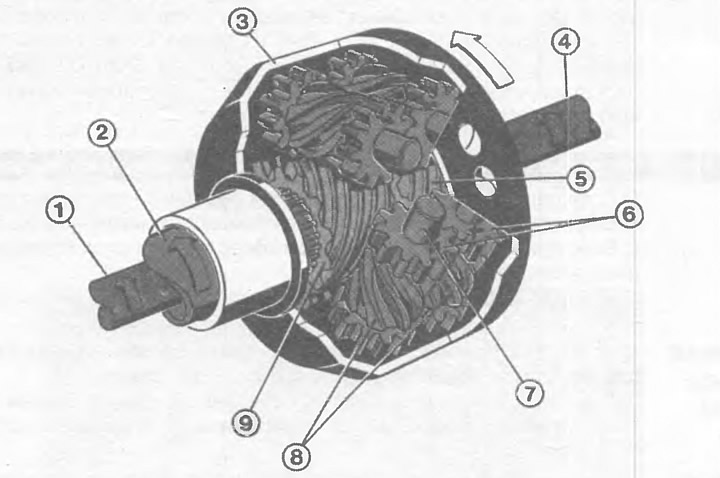
Shown here is a Torsen differential as a sectional model. Key:
1 - drive gear (drive mechanism to the front axle);
2 - hollow shaft (gearbox drive mechanism);
3 - differential box;
4 - flange / cardan shaft (for rear axle drive mechanism);
5 - worm gear for rear axle drive;
6 - cylindrical gears;
7 - worm wheel bridge;
8 - worm wheels;
9 - worm gear for driving the front axle.
As already mentioned, the distribution (or average) the differential serves to balance between the front and rear transmissions. (From this, the axle differentials at the front and rear operate independently.)
This is appropriate - from the outside you can't identify individual design elements - in the back in the manual drive. A technician would say: it's integrated. The name Torsen comes from the drive manufacturer Gleason, where this differential was invented. Derived from the English words Torque Sensing, which translates as "torque sensing". At the same time, the concept is already a description of the function. Because:
- This differential provides greater driving force to the axle with better traction on the ground or supporting surface.
- This happens - under rolling conditions - if the bridge can bear a force up to 3.5 times greater than the other.
- However, with uniform soil of good quality, the load of the drive mechanism is equally distributed on the front and rear axles - no absolute preference for one axle.
The Torsen differential is based on the principle of the worm drive mechanism and uses the following basic principles:
- The worm gear final drive can be laid out so that it has high or low locking capacity. (The locking capacity here is increased many times over, which the gearbox must be equipped with.)
- The amount of blocking ability depends on the worm's pitch angle - whether the worm has many flat turns or a few steep turns.
- An example of a flat worm with high locking capacity is a car jack, in which the crank - acting on the worm - although it lifts the car, the car with its entire mass never sets the crank in motion.
Optimum utilization with only 8 worm wheels and 12 toothed wheels is achieved in combination with differential box, hollow shaft, output shaft at the front and output shaft at the rear in the best possible way.
Driving dynamics on dry roads
There is no longer any doubt that the Torsen differential functions correctly and optimally when there is poor traction on the ground or supporting surface. This also explains what happens on dry roads in the fourth-generation Audi transmission. As already mentioned, the front wheels travel a longer distance backwards when cornering than the rear wheels, since the rear wheels describe a smaller radius. At the same time, the Torsen differential of the rear axle (due to the lower rotation frequency) releases a large driving force, which maintains the desired tendency to deflect in the turn. If it acts too quickly and turns one of the rear wheels, a large driving force is applied (at this moment) slower front wheels. The system's quick response causes the front wheels to now rotate more strongly, which stabilizes the car. The effect: the attitude towards cornering is significantly improved.
Guidelines for 4WD vehicles
General:
- If the front axle or front wheel is raised, no transmission occurs.
- If the rear axle is raised, no transmission occurs.
- If one of the rear wheels is lifted, no transmission occurs because the rear axle differential is not locked.
- If the drive cardan shaft is disassembled, no transmission occurs.
Brake system test bench:
- Brake testing can take place on a normal, slow-running brake test rig (maximum 6 km/h) by axes.
- At the same time, transfer to the test bench must take place.
- Neither gear nor differential lock can be set.
Test bench results:
- It is not possible to verify the results on a conventional two-wheel test rig.
- This must take place on a four-wheel test rig.
Wheels:
- All four wheels must travel the same distance per revolution of the tire (ideally equal profile depth).
- Wheel balancing in a car (dynamic balancing) is only possible if all four wheels are raised. The transmission must come from the vehicle's engine (not from the balancing machine). Important: release the manual lever for activating the parking brake system ("handbrake").
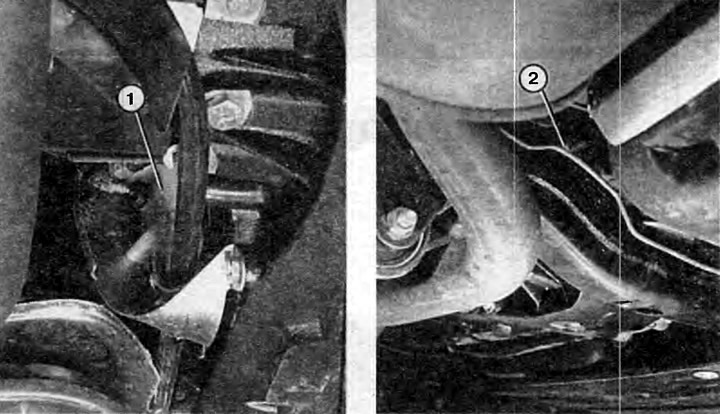
The photos show the differential lock parts for the rear axle. Designations:
1 - low pressure head for engaging differential lock;
2 - control switch for embedded differential lock.
Set of tires with winter tread pattern:
- Winter tyres are also used in fourth generation vehicles, less due to driving conditions but more due to braking conditions.
- Snow chains must be installed - where prescribed - also on fourth-generation models, namely on the front axle. Here, too, the best argument is the braking mode.
Towing:
- There are no special instructions for rolling when towing all four wheels of an Audi on the ground.
- If one of the bridges (after the accident) no longer applies, the vehicle must be loaded onto a low-deck trailer for towing defective vehicles.
- If there is no such vehicle available for towing broken-down vehicles, the Audi can also be towed with the axle raised. The condition is no further than 50 km and no faster than 50 km/h. The differential lock cannot be installed (it's already incredible). If the limit is exceeded, there is a risk of damage to the drive due to lack of lubrication.
Rear axle differential lock
The rear axle differential is equipped with a speed-dependent differential lock in fourth-generation vehicles. The lock keeps both rear wheels at the same speed, thus preventing the individual wheel from spinning. The device is mentioned, which increases the traction of the wheel with the road if the car gets stuck in snow, slush or mud, because the lock automatically switches off at speeds above 25 km / h. The differential lock is switched on with the vehicle stationary in the switch in the center console. The executing element is, however, the steering device under the seat back, which releases the pipeline, which is under vacuum to the lock, and accordingly locks them at speeds exceeding 25 km / h. The reduced pressure comes from the suction pipe of the engine.
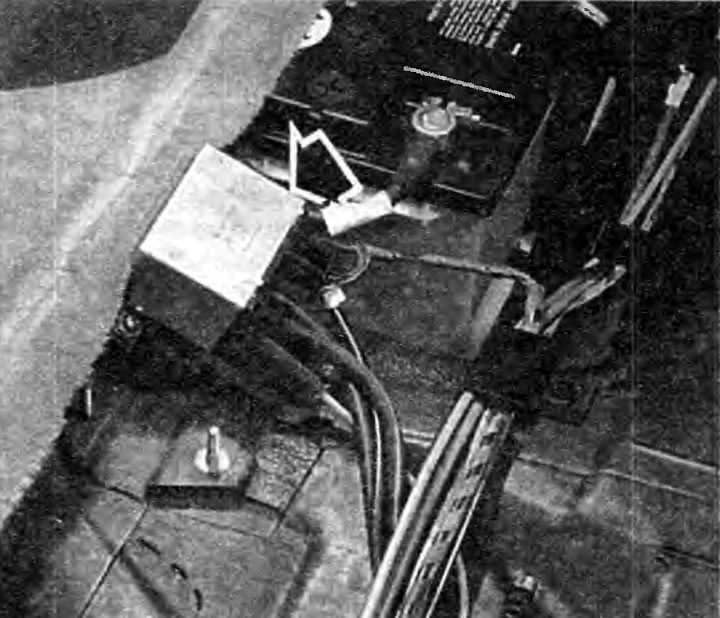
Also under the seat back are the working parts of the all-wheel drive. The arrow points to the control device for the differential lock.