



Table of contents: Engines ↓ Gearboxes ↓ Body ↓ Front suspension ↓ Rear suspension ↓ Steering ↓ Brake system ↓ Safety ↓ Eco-friendliness ↓ Self-diagnosis ↓
The Audi 100 is the fourth generation car and is a classic model from the entire Audi model range. The working title of this series of cars is the "C" series. And since it is the fourth series, it is also called "C4". In 1994, the 100 series was renamed to A6.
Engines
The Audi 100 can be equipped with one of five types of petrol engines as standard:
- two modifications of a 4-cylinder engine with a displacement of 2 liters and a power of 74 kW (101 hp) and 85 kW (115 hp);
- 5-cylinder engine with a capacity of 2.3 liters and a power of 98 kW (133 hp);
- two modifications of the 6-cylinder engine with volumes of 2.6 l and 2.8 l with a power of 110 kW (150 hp) and 128 kW (174 hp).
4-cylinder engines
The two-liter 4-cylinder engine has long been known from previous generations of cars. Its production began back in 1972 (at that time, the engines of Audi-80 cars had a volume of 1.3 liters and 1.5 liters). In 1988, a 2-liter engine was created on the basis of a 1.8-liter engine. At each stage of modernization of the 4-cylinder engine, its technical and operational characteristics were improved, for example, all engines are equipped with a temperature-compensating device for tensioning the timing belt, which allows maintaining the belt tension at the same level depending on the engine temperature, which ultimately leads to an increase in the service life of the drive belt. All engines use hydraulic valve clearance compensators. The difference between the 4-cylinder engines mainly lies in the type of injection system used. The 74 kW engine is equipped with the Mono-Motronic central injection system. The 85 kW engine was equipped with the KE-Motronic distributed injection system until 1992, and then with the Digifant injection system.
5-cylinder engine
The 5-cylinder 2.3-liter engine has been further developed over the years, and like the 4-cylinder engines, a temperature-compensating timing belt tensioner is installed. The KE-Jetronic distributed injection system has been modernized. The engine develops 98 kW at 5,500 rpm and a maximum torque of 186 Nm at 4,000 rpm.
V6 2.8L Engine
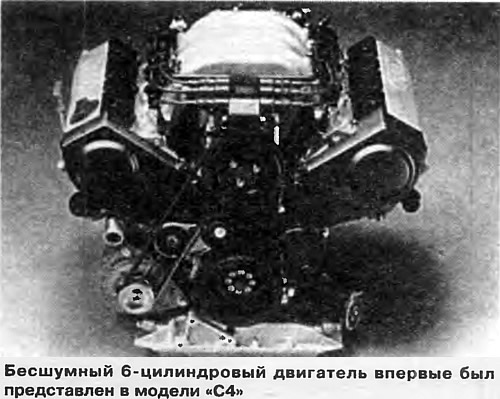
The six-cylinder engine is equipped with an electronic fuel injection system MPI with air mass measurement, which measures the fuel to each cylinder separately, and therefore produces less exhaust gases and works more efficiently. The combustion noise of the fuel is constantly monitored by two sensors. The eyes also belong to the selective fuel supply system. This eliminates harmful combustion products that can occur when using low-octane fuel.
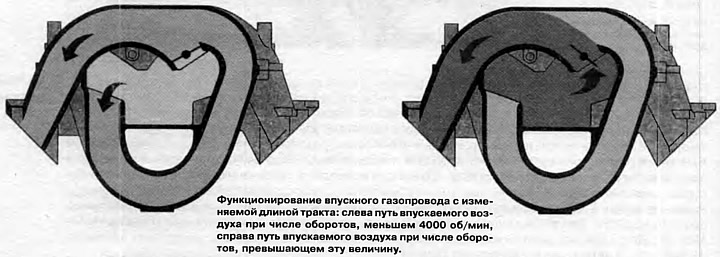
An interesting detail of this engine is the so-called variable geometry intake manifold, which serves to keep the frequency within the high engine speed range. Six valves operate in the ventilation pipe and are controlled depending on the engine speed: at a frequency of up to 4,000 rpm, they form long pipes to increase the engine speed. At a frequency of over 4,000 rpm, they form short pipes for good performance. The Audi 6 - cylinder engine reaches its maximum engine speed with a power of 245 Nm and a frequency of 3,000 rpm when using Euro Super gasoline. When using Super Plus, a power of 250 Nm is achieved.
The ignition system of the six-cylinder engine makes do with automation alone. The distribution of voltage during ignition from the steering mechanism to the fuel distribution system is controlled.
Both axles are driven by a single maintenance-free toothed belt. The exhaust gas flows from the right and left cylinder banks enter two catalytic converters, which operate independently of each other. Two heated sensors for each cylinder bank set the exhaust gas regulation.
Engine V6 2.6L
The 2.6-liter 6-cylinder engine was introduced as a slightly "slimmed down" model back in August 1992. The slightly modified injection system (MPFI) operates on the basis of a different method of measuring the amount of incoming air masses. In addition, the intake pipe is missing. At 5750 rpm, this engine reaches a power of 110 hp.
Gearboxes
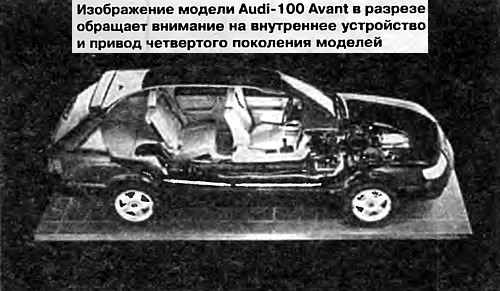
All Audi-100 models are equipped with a five-speed gearbox. Four modifications of the gearbox are produced, differing from each other in gear ratios. Cars can also be equipped with an automatic gearbox, depending on the version with two or five control programs.
Body
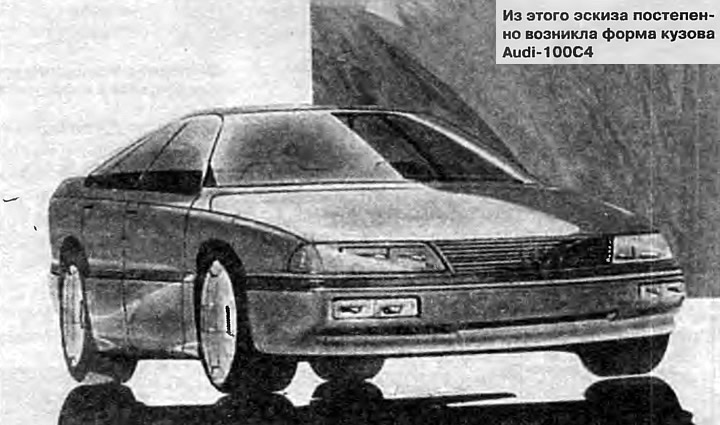
The car's appearance is determined by the typical appearance of Audi cars. The characteristic body with slightly rounded shapes, the exposed side wings form a single whole with the headlights. Both bumpers are painted in the body color. With its aerodynamic drag coefficient of 0.29, the Audi-100 traditionally occupies a leading place among cars of its class.
The size of the Audi-100, in accordance with the trend on the world market, has not increased. Contrary to the models of the previous generation, the length of the car (4.79 m) and track (2.69 m) have not changed. With a width of (1.78 m), the model of the "C4" series is already 37 mm with the same width of the cabin. This difference in width is obtained due to the lesser curvature of the forms than in the models of previous generations. The height of the Audi-100 is 10 mm higher, which increases the free space in the cabin.
To prevent sunlight from entering the cabin, the side windows are positioned more vertically. The wide roof and the groove above the doors prevent water from getting on the seats when the doors and windows are opened.
Front suspension
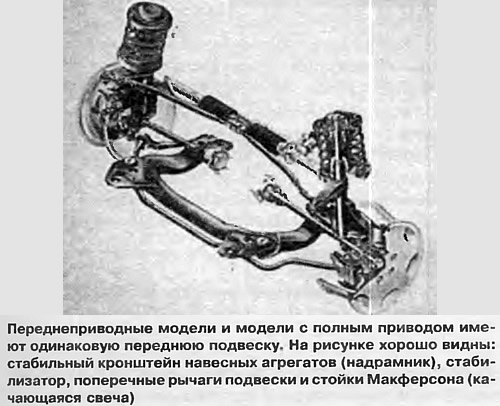
The load-bearing element of the front suspension is a beam fixed to the body by means of rubber-metal hinges. Two telescopic MacPherson shock absorbers with cylindrical coil springs and polyurethane compression dampers are fixed to it via levers and an anti-roll bar. The front wheel bearings are pressed into the hubs of the struts.
Rear suspension
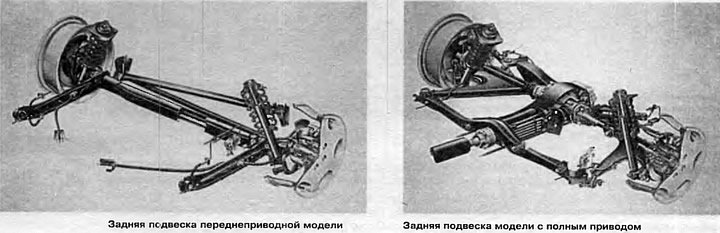
Front-wheel drive model. The rear suspension, familiar to us from previous models, is a dependent lever-spring suspension with longitudinal levers and a transverse rod (panhard rod), torsion-type stabilizer and telescopic hydraulic shock absorbers. Audi-100 cars with 5- and 6-cylinder engines have an additional anti-roll bar, which improves the car's turning ability.
All-wheel drive model. On the fourth generation models, the rear suspension is designed completely differently. Independent wheel suspension with two trapezoidal levers, fixed to the crossbar by transverse rods, telescopic hydraulic shock absorbers - this design is due to the need to place the rear axle differential with drive shafts in the rear suspension.
Steering
Steering with rack and pinion mechanism and hydraulic booster, the gain of which changes depending on the speed of the vehicle.
A set of 15-inch tires measuring 195/65 is characterized by good rolling smoothness and reliable grip on the road. Along with them, 16-inch tires are common, and there are also 17-inch tires measuring 205/60 and 215/60.
Brake system
15-inch wheels and optimal use of space in the wheel rim allowed to place brake mechanisms with a larger friction area, which affected the improvement of braking efficiency. The car is serially equipped with a brake drive vacuum booster, its progressive characteristic ensures easy control of the brakes.
All cars produced have a brake fluid pressure regulator installed in the rear wheel brake mechanisms, preventing the rear wheels from locking during sudden braking. The fourth generation models use a pressure regulator that takes into account both longitudinal and lateral acceleration of the car, which helps prevent the rear wheels from locking during straight-line driving and cornering. Since 1993, Audi models with 4-cylinder engines have also been equipped with such an anti-lock device.
Safety
Optimized with the help of mathematical modeling programs, the body structure is designed for high passenger protection. Energy-intensive deformation zones are located in the front and rear parts of the body. The layout of the units and their mutual arrangement are selected based on the conditions of maximum protection of the passenger compartment in the event of an accident.
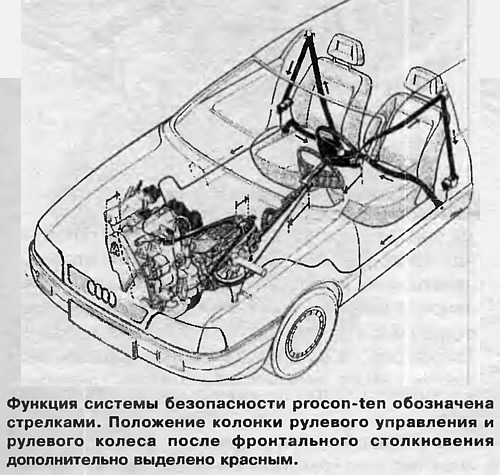
The Audi 100 is equipped with the standard safety system procon-ten. The function of the procon system is that in the event of a frontal collision, the steering column, connected to a high-grade steel cable, is pulled towards the dashboard in a fraction of a second. As a result, the risk of head injuries is significantly reduced. The function of ten is that in the event of a collision, the seat belts, into which steel cables are also woven, are tightened and securely hold the driver and passenger, thereby significantly reducing the risk of injury.
Cars may be equipped with an inflatable airbag located in the steering wheel, which is triggered in high-speed collisions.
Precautions in Audi-100:
- The power beams built into the doors and the use of high-strength plastics significantly increase the protection of passengers.
- The multi-layer B-pillars with reinforced fastening to the sills and roof also contribute to this. The doors overlap the B-pillars and follow the shape of the body in the event of a side impact.
- The front seats - made of a stable tubular frame design - have, in addition to high resistance to supporting forces, a ramp in the seat frame - the front edge. This ramp prevents passengers from sliding out from under the lap belt in the event of a frontal collision (the "submarine" effect).
- Glass bonded to the body at the front and rear of the body increases the stability of the roof. In the event of a vehicle collision, the glass remains in the body frame and therefore improves internal and external safety
- Thanks to the volumetric transmission and the flexibility of the impact points in the interior of the vehicle, the risk of injury to passengers is significantly reduced. This is important in particular for contact with the instrument panel, roof lining, sun visors, controls, side panels and head restraints. The rear-view mirror falls out of its mounting in a collision.
- The fuel tank, which holds up to 80 litres, is located in the rear axle area. At the same time, a high level of collision safety is achieved.
- The easy five-step front seat belt height adjustment allows you to individually adjust the seat belt position in the upper torso.
- The front seat belts are equipped with mechanical pretensioners.
- The rear belts can be adjusted to three different horizontal positions at the exit angle. When adjusted correctly, the adjustable seat belt hinge prevents tall passengers from having the seat belt slip off their shoulders and prevents short people from having the seat belt too close to their necks.
Eco-friendliness
Audi cars are manufactured using environmentally friendly materials, components and parts do not contain asbestos, the varnishes and plastics used are cadmium-free, all foam plastics in the seat cushions, instrument panel and decorative panels are free of fluorochlorohydrocarbons.
Self-diagnosis
Electronic engine management systems and automatic transmissions are equipped with built-in control systems (diagnostics). If an error or failure occurs in the operation of the systems, they are stored in the electronic memory of the systems in the form of codes. Using a special tester connected to the electrical connector of the car diagnostics, it is possible to quickly and effectively search for failures and malfunctions.