
Repair Chevrolet Repair Toyota Repair Honda Repair AvtoVAZ Repair Mercedes-Benz Repair BMW Repair Opel
Home  |  Contacts  |  Sitemap  |    
English Русский
Български
Беларускі
Український
Српски
Hrvatski
Română
Polski
Slovenský
Magyar
AudiManual.ru


  • AUDI 80
  • AUDI 100
  • AUDI A3
  • AUDI A4
  • AUDI A6
  • AUDI A8
  • AUDI Q
  • OTHER
  • ARTICLES
C4 (1990-1994) C4 (1990-1994, petrol) C3 (1982-1990) C3 (1982-1990, petrol) C3 (1982-1990, diesel)

Checking and adjusting the position of the air flow meter plate (Audi 100 C3)

  • Home
  • Audi 100
  • C3 (1982-1990)
  • Power unit
  • Power system (injector)
  • Checking and adjusting the position of the air flow meter plate
            0

Fuel injection control system of the RT engine with catalytic converter
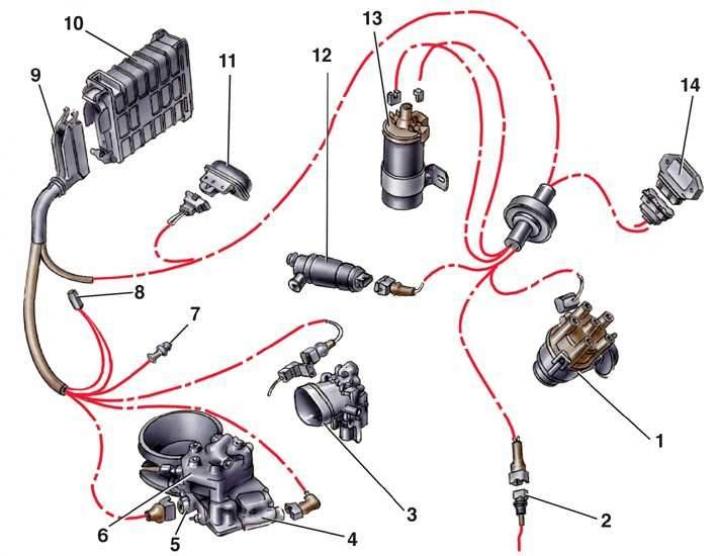


Fuel injection control system of the RT engine with catalytic converter

  • 1 - ignition distributor;
  • 2 - coolant temperature sensor;
  • 3 - air throttle body;
  • 4 - pressure regulator;
  • 5 - potentiometer G7;
  • 6 - fuel distributor;
  • 7 - lambda probe connector block;
  • 8 - diagnostic connector;
  • 9 - junction block;
  • 10 - KE-Jetronic control unit;
  • 11 - altitude sensor;
  • 12 - idle speed stabilizer valve;
  • 13 - ignition coil;
  • 14 - ignition switch

Location of the KEIII-Jetronic system installed on NF engines of cars produced since 1989
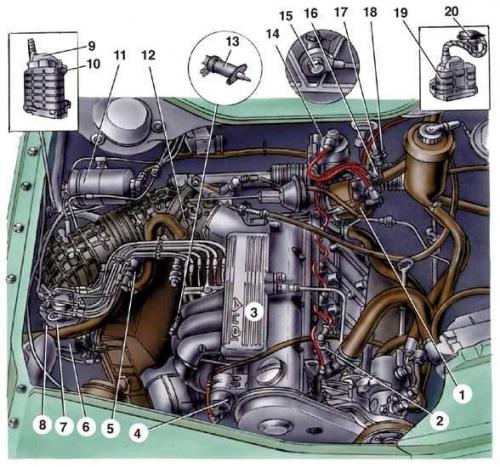


Location of the KEIII-Jetronic system installed on NF engines of cars produced since 1989

  • 1 - ignition distributor;
  • 2 - coolant temperature sensor;
  • 3 - inlet pipe;
  • 4 - idle speed stabilizer valve;
  • 5 - carbon filter valve;
  • 6 - pressure regulator;
  • 7 - fuel distributor;
  • 8 - potentiometer;
  • 9 - junction block;
  • 10 - KEIII-Jetronic control unit;
  • 11 - fuel filter;
  • 12 - air throttle body;
  • 13 - starting nozzle;
  • 14 - ignition coil;
  • 15 - knock sensor;
  • 16 - Lambda probe connector block;
  • 17 - Lambda probe heating connector;
  • 18 - knock sensor connector;
  • 19 - ignition switch;
  • 20 - altitude sensor

Fuel Shutoff Circuit
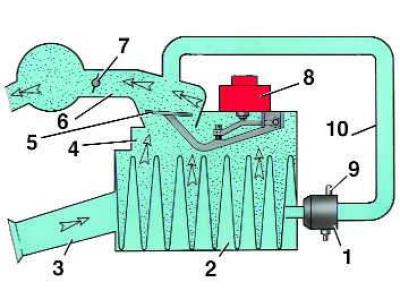


Fuel Shutoff Circuit

  • 1 - engine braking valve;
  • 2 - air filter;
  • 3 - air intake pipe;
  • 4 - air flow meter;
  • 5 - measuring plate;
  • 6 - air duct;
  • 7 - throttle valve;
  • 8 - fuel distributor;
  • 9 - vacuum tube connection branch pipe;
  • 10 - bypass hose

The height of the plate lift depends on the amount of air supplied to the engine cylinders: the greater the air flow, the higher the plate rises. In this case, the plate lever presses the plunger of the fuel distributor, which leads to an increase in the amount of fuel supplied to the cylinders. When the air flow decreases, the plate goes down, the plate lever in turn lowers the plunger and the fuel supply decreases. At an engine speed of no more than 1400 min⁻¹, a coolant temperature of no more than 30°C and the throttle valve in the idle position, the valve is turned on and air goes through the bypass hose, bypassing the air flow meter. The plate goes down, releasing the plunger, and the fuel supply is turned off until the valve closes. For better mixture formation, the plate should be located exactly in the center of the diffuser.


Execution order


1. Loosen the clamps and remove the air duct (see Fig. Main elements of the fuel injection system).
1. Loosen the clamps and remove the air duct (see Fig. Main elements of the fuel injection system).


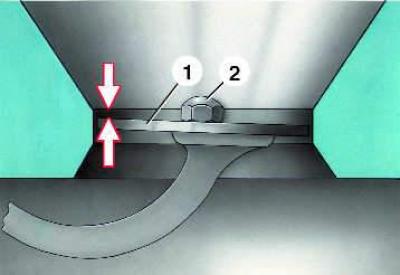
2. If the plate (1) is displaced, loosen the screw (2). Center the plate using a 0.1 mm thick feeler gauge, inserting it around the plate. Tighten the screw.

3. Raise and quickly lower the plate. There should be no resistance when moving downwards. If resistance is felt, the air flow meter is faulty and needs to be replaced.

4. If resistance is felt when the plate moves up, you need to remove the fuel distributor, take out and wash the plunger in gasoline. If this does not help, replace the fuel distributor.
4. If resistance is felt when the plate moves up, you need to remove the fuel distributor, take out…


4. If resistance is felt when the plate moves up, you need to remove the fuel distributor, take out…


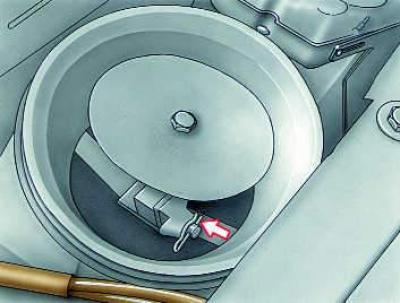
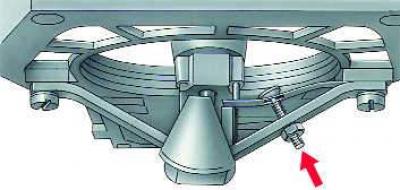
5. Check the height of the plate relative to the diffuser. The gap between the upper edge of the plate and the edge of the cylindrical part of the diffuser (marked with arrows) should be: for engines with the K-Jetronic system 0–0.5 mm, for engines of the KZ models 1.75–2.05 mm, for engines with the high-pressure K-Jetronic system and KE-Jetronic (in these engines, fuel is supplied to the injectors through metal tubes) 1.9–3.0 mm. To adjust the height of the plate for engines with the K-Jetronic and KZ systems, remove the air duct (see Fig. Main elements of the fuel injection system), lift the plate and bend or compress the wire clip located underneath it, as shown in the figure on the left. For other engines, remove the filter cover with the filter element and adjust the position of the plate by turning the nut on the plate stop screw, as shown in the figure on the right.
The article was checked by auto expert Daniil Ushakov
This article is available at russian, bulgarian, belarusian, ukrainian, serbian, croatian, romanian, polish, slovak, hungarian

Share information:
Previous articles
Audi 100 C3: Power system (injector)
Next articles

Checking the pressure regulator
Checking the starting injector
Adjusting engine idle speed
Checking the thermostat


Similar articles on other Audi car models:
Adjusting the position of the air flow meter pressure disc Audi 80 B2 (1979-1986)
Checking and adjusting idle speed / ignition timing / CO… Audi A3 Type 8L (1996-2003)
Checking and adjusting the initial position of the sliding roof… Audi A4 B6 (2000-2006)
Checking and adjusting the initial position of the sliding… Audi A6 C5 (1997-2004)
Adjusting the position of the cardan shaft Audi A8 D2 (1994-2002)
Removal the air flow meter Audi Q5 Type 8R (2008-2017)
Headlights — checking adjustment, adjusting if necessary Audi A2 (1999-2005)
Link to this page in different formats


Visitor comments

No comments yet


How much will 50 + 49 =


100(C4, 1990-1994) 
  • General information
  • User manual
  • Power unit
  • Engine repair
  • Ignition system
  • Fuel system (gasoline)
  • Fuel system (diesel)
  • Lubrication system
  • Cooling system
  • Exhaust system
  • Transmission
  • Clutch
  • Car gearbox
  • Drive shafts
  • Chassis
  • Car suspension
  • Steering
  • Wheels and tires
  • Brake system
  • Body
  • Ventilation and heating
  • Body repair
  • Electrical equipment
  • Power devices
  • Lighting and appliances
  • Electrical circuits
 
100(C4, 1990-1994, petrol) 
  • General information
  • Operation and maintenance
  • Power unit
  • Engine repair
  • Exhaust system
  • Cooling system
  • Supply system
  • Air filter
  • Mono-Motronic injection system
  • Digifant injection system
  • KE-III-Jetronic and KE-Motronic
  • MPI and MPFI injection system
  • Transmission
  • Clutch
  • Car gearbox
  • Chassis
  • Suspension and steering
  • Brake system
  • Wheels and tires
  • Body
  • Exterior
  • Interior
  • Electrical equipment
  • Fuses and relays
  • Power devices
  • Ignition system
  • Lighting and signaling
  • Equipment and devices
  • Electrical circuits
 
100(C3, 1982-1990) 
  • General information
  • User manual
  • Maintenance
  • Specifications
  • Power unit
  • Engines 4-cylinder
  • Engines 5-cylinder
  • Diesel engine
  • Cooling system
  • Power system (carburetor)
  • Power system (injector)
  • Fuel system (diesel)
  • Transistor ignition system
  • Electronic ignition system
  • Transmission
  • Clutch
  • 4 speed gearbox 014
  • 5 speed gearbox 013 and 093
  • 5 speed gearbox 016 and 012
  • Shift mechanism KP 016
  • Automatic transmission
  • Front wheel drive
  • Chassis
  • Front suspension
  • Rear suspension
  • Steering
  • Brake system
  • Body
  • Body elements
  • Electrical equipment
  • Lighting and appliances
  • Power devices
  • Electrical circuits
 
100(C3, 1982-1990, petrol) 
  • General information
  • Maintenance and operation
  • 4 cylinder engine
  • Engine repair
  • Cooling and lubrication system
  • Supply system
  • Ignition system
  • 5 cylinder engine
  • Engine repair
  • Cooling and lubrication system
  • Supply system
  • Ignition system
  • Transmission
  • Clutch and drive shafts
  • 4 speed gearbox 014
  • 5 speed gearbox 013 and 093
  • 5 speed gearbox 016 and 012
  • Automatic gearbox
  • Chassis
  • Steering
  • Front suspension
  • Rear suspension
  • Brake system
  • Body
  • Body elements
  • Doors, locks and windows
  • Body repair
  • Electrical equipment
  • Equipment and devices
  • Power devices
  • Electrical circuits
 
100(C3, 1982-1990, diesel) 
  • General information
  • User manual
  • Maintenance
  • Troubleshooting
  • Power unit
  • Engine in a car
  • Engine removed
  • Cooling system
  • Fuel system
  • Exhaust system
  • Starting and charging
  • Preheating
  • Transmission
  • Clutch
  • Mechanical gearbox
  • Automatic gearbox
  • Drive shafts
  • Chassis
  • Brake system
  • Suspension
  • Steering
  • Body
  • Exterior
  • Interior
  • Electrical equipment
  • Equipment and devices
  • Electrical circuits
 
AudiManual.ru © 2017-2026 · Mobile version · Feedback · Sitemap: EN BG BY UA RS HR RO PL SK HU · Site search · News and articles
80 B2 · 80 B3 petrol · 80 B3 · 80 B4 · 100 C3 diesel · 100 C3 petrol · 100 C3 · 100 C4 petrol · 100 C4 · A3 Type 8L · A4 B5 petrol · A4 B5 · A4 B6 petrol · A4 B6 · A4 B7 · A4 B8 · A6 C4 · A6 C5 · A6 C5 Allroad · A8 D2 · Q5 Type 8R · Q7 Typ 4L · Audi A2 ·
This site uses cookies 🍪. Click the button to accept this fact.