



Table of contents: Checking the supply voltage of the… ↓ Checking the output signal to the… ↓ Checking the output signal to the… ↓ Checking the output signal to the… ↓ Checking the output signal of the… ↓
Socket "10" contact numbers on the relay and fuse box board
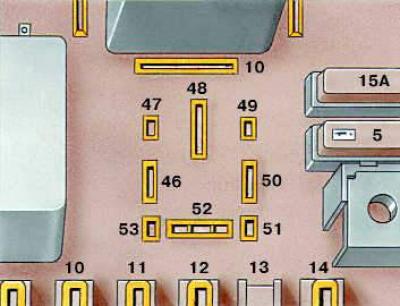
Checking the supply voltage of the unit
1. Disconnect the connector block with wires from the block.
2. Turn on the ignition and measure the voltage between contacts "35" and "18", then between "35" and "9". The voltage should be about 12 V. Turn off the ignition.
3. On a car with an automatic transmission, connect a voltmeter to terminals "9" and "32". Turn on the ignition and press the brake pedal. The voltage should be about 12 V. If the voltage is different, there may be a break in the wiring or a faulty brake pedal position sensor.
Checking the output signal to the fuel pump relay
1. Remove the fuel pump relay from its socket in the relay and fuse box.
2. Connect a voltmeter to contacts "46" and "47". Turn the crankshaft with the starter, the voltage should be about 9.5 V. Turn off the ignition. If the voltage differs from the specified, connect the voltmeter to contact "46" and "ground" and turn on the ignition. The voltage should be about 12 V. If the voltage differs from the specified, there is a break in the wiring.
3. Disconnect the connector block with wires from the control unit.
4. Connect the ohmmeter to contacts "47" and contact "21" of the control unit connector. The device should show zero, otherwise the wiring is damaged. If the wiring is not damaged, the control unit is faulty and must be replaced.
Checking the output signal to the engine braking valve
(only on vehicles with manual transmission)
1. Warm up the engine, the coolant temperature should be at least +50°C.
2. Disconnect the connecting block with wires from the valve.
3. Connect a voltmeter to the connector terminals. Start the engine and rev it up to 2000 rpm. Close the throttle valve, the voltmeter should show a voltage of approximately 12 V.
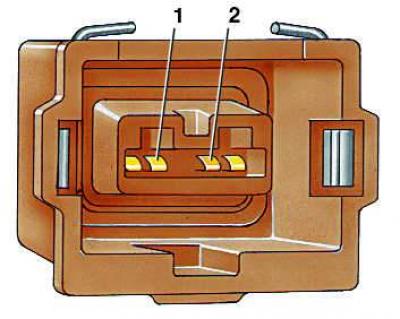
4. If the voltmeter readings differ, you need to check the wiring from the control unit to the valve. To do this, connect the ohmmeter to contact "2" of the valve block (for cars manufactured before 1985, connect the ohmmeter to contact "1") and contact "14".
5. The ohmmeter should show zero, otherwise the wiring is damaged. If the wiring is not damaged, and the ohmmeter shows some resistance, replace the control unit.
Checking the output signal to the bypass valve
The test is carried out on a warm engine with a coolant temperature of at least +50°C.
1. Start the engine and let it idle.
2. Manually turn on the full throttle switch and check by ear for the operation of the bypass valve.
3. If you do not hear the valve operate, turn off the engine and disconnect the connector block with wires from the valve.
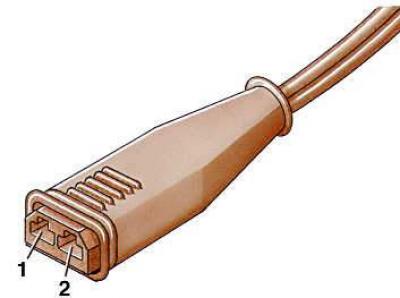
4. Connect the voltmeter to contacts "1" and "2". If the voltmeter shows a voltage of about 12 V, replace the valve. If the voltage differs from the specified one, connect the voltmeter to contact "2" and "ground".
5. Turn on the ignition, the voltmeter should show 12 V, otherwise you need to check the wires going to the valve block. To do this, connect the ohmmeter to contact "2" of the block and to contact "8" of the control unit block. The ohmmeter should show zero. If the ohmmeter shows infinity, there is a break in the wiring.
Checking the output signal of the control unit to the tachometer
1. Connect the voltmeter to contact "7", sliding the protective cover off the control unit connector, since the connector must be connected to the control unit and to ground.
2. Connect the control tachometer.
3. Start the engine, increase the rotation speed to 2000 min⁻¹. The voltmeter should show a voltage of about 1.3 V, otherwise replace the control unit. If the measured voltage is 1.3 V, but the readings of the car tachometer do not match the readings of the control tachometer, this means that either there is a break in the wiring from contact "7" to the instrument panel, or the car tachometer is faulty.