
Repair Chevrolet Repair Toyota Repair Honda Repair AvtoVAZ Repair Mercedes-Benz Repair BMW Repair Opel
Home  |  Contacts  |  Sitemap  |    
English Русский
Български
Беларускі
Український
Српски
Hrvatski
Română
Polski
Slovenský
Magyar
AudiManual.ru


  • AUDI 80
  • AUDI 100
  • AUDI A3
  • AUDI A4
  • AUDI A6
  • AUDI A8
  • AUDI Q
  • OTHER
  • ARTICLES
C4 (1990-1994) C4 (1990-1994, petrol) C3 (1982-1990) C3 (1982-1990, petrol) C3 (1982-1990, diesel)

Engine assembly (Audi 100 C3)

  • Home
  • Audi 100
  • C3 (1982-1990, petrol)
  • 4 cylinder engine
  • Engine repair
  • Engine assembly
            0
Table of contents: Checking cylinder diameters ↓ Checking the clearances between the… ↓ Checking the axial clearance of the… ↓ Checking the dimensions of pistons… ↓ Engine assembly ↓

Checking cylinder diameters


Make precise measurements of the cylinder diameters. Use a bore gauge in three zones, both in the transverse direction "A" and in the longitudinal direction "B", as shown in the diagram.
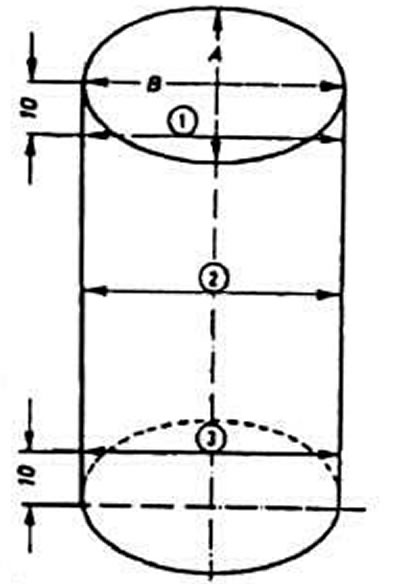
Cylinder diameter welding diagram:

Cylinder diameter welding diagram:
A and B are the directions of measurements
1, 2, 3 — measurement belts


In cases where wear exceeds the permissible value by more than 0.08 mm, repair the cylinders to the nearest repair size and install pistons of the corresponding repair size.

Checking the clearances between the bearings and the crankshaft journals


Thoroughly clean the working surfaces of the bearings and the corresponding crankshaft journal. Place a piece of plastic calibrated wire equal in width to the bearing on the journal surface.

Depending on the type of journal being checked, install the connecting rod with the cap or the main bearing cap on the journal and tighten the nuts or mounting bolts accordingly. First tighten the connecting rod bolt nuts to a torque of 3.0 kgf·m, and then tighten them 180°. Tighten the main bearing cap bolts to a torque of 6.5 kgf·m. Do not allow the engine crankshaft to turn.


Carefully remove the lid and determine the gap size using the school marked on the package, the scale marked on the package, and the flattening of the wire. More detailed information is provided in the accompanying documentation from the manufacturer of the calibrated wire.

The nominal design gap is 0.030-0.080 mm (maximum permissible 0.17 mm) for root and 0.015-0.062 mm (maximum permissible 0.12 mm) for connecting rod journals.

If the clearance is greater than the maximum, replace the bearings or grind the crankshaft journals.

Checking the axial clearance of the crankshaft


Check the axial clearance of the crankshaft using a feeler gauge on the middle support, which should be no more than 0.25 mm.

If necessary, achieve the proper clearance by installing thicker thrust washers.

Checking the dimensions of pistons and piston rings


Determine the degree of piston wear by measuring the diameter 10 mm from the edge of the piston skirt perpendicular to the axis of the piston pin. The piston must be replaced if its diameter differs by more than 0.04 mm from the permissible values (see subsection "Detailed technical specifications").
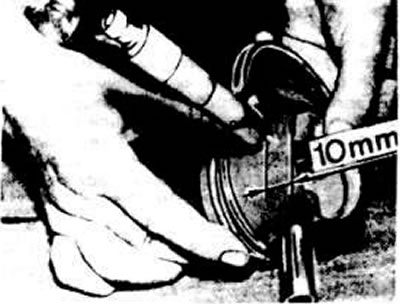
Place of measurement of the piston outer diameter

Place of measurement of the piston outer diameter


Replace piston rings or pistons if the clearances between piston rings and grooves exceed the permissible values (see subsection "Detailed technical specifications").
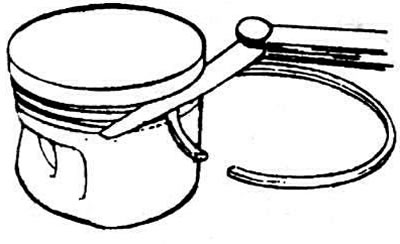
Checking the clearance between the piston rings and the grooves

Checking the clearance between the piston rings and the grooves


Engine assembly


The liners of the 1st, 2nd and 5th main bearings do not have lubrication grooves. The liners of the 3rd bearing supplied as spare parts have flanges. On the thrust half rings from the axial displacement of the crankshaft from the cylinder block side there is a projection directed towards the liners.

Install three piston rings into the corresponding grooves in the pistons, arranging their locks at 120° intervals.

Orient the piston ring locks forward or backward as the vehicle moves. The lower compression and oil release rings are marked "top" or "oben" ("top"), which should be turned up when installing the ring in the groove.

Install the pistons by orienting the arrow stamped on the piston bottom forward in the direction of vehicle travel (towards the camshaft drive).

Lubricate the pistons and piston rings with engine oil, compress the piston rings in the grooves with the appropriate mounting sleeve and insert the pistons with connecting rods into the cylinders.


Install the bearings into the connecting rods and connecting rod caps in accordance with the marks made during disassembly if worn bearings are used.

Install the connecting rods and caps onto the crankshaft journals, with the ridges on the caps and the locking protrusions on the liners facing towards the intermediate shaft.

Lightly tighten the connecting rod bolt nuts, then tighten them to the final torque specification.

Install the rear seal retainer with a new cardboard gasket. Press the seal into the retainer using mandrel 2003/1.

Install the flywheel, ensuring that the surface under the driven clutch disc protrudes relative to the cylinder block within 30.50-32.10 mm.

If necessary, install a spacer washer between the flywheel and the crankshaft flange. Install a lock washer on the flywheel with the beveled edge facing the flywheel. Apply a layer of adhesive to the mounting bolts beforehand.

Install the front crankshaft oil seal retainer with a new cardboard gasket. Press the new oil seal into the retainer using tool 3083.

Insert the intermediate shaft into the cylinder block. Install the holder with the pressed-in oil seal and the sealing gasket onto the intermediate shaft.

Install the oil pump, having first checked its technical condition (see below).

Install the oil pan with a new gasket.

Install the cylinder head.

Install the camshaft drive belt.

Install the coolant pump.

(Text provided by the online resource «AudiManual.ru»)
The article was checked by auto expert Maxim Rybakov
This article is available at russian, bulgarian, belarusian, ukrainian, serbian, croatian, romanian, polish, slovak, hungarian

Share information:
Previous articles
Audi 100 C3: Engine repair
Next articles

Disassembling the engine
Crank mechanism parts
Removal and installation the engine
Powertrain and gearbox suspension parts


Similar articles on other Audi car models:
Engine assembly — general description Audi 80 B3 (1986-1991, petrol)
Starting the engine from an auxiliary power source Audi A3 Type 8L (1996-2003)
Engine Repair — Assembly Sequence Audi A4 B5 (1994-2001)
Draining engine oil Audi A6 C5 (1997-2004)
Starting the engine Audi A8 D2 (1994-2002)
Disassembly and assembly of the engine Audi Q5 Type 8R (2008-2017)
Towing to start the engine Audi A2 (1999-2005)
Link to this page in different formats


Visitor comments

No comments yet


How much will 18 + 41 =


100(C4, 1990-1994) 
  • General information
  • User manual
  • Power unit
  • Engine repair
  • Ignition system
  • Fuel system (gasoline)
  • Fuel system (diesel)
  • Lubrication system
  • Cooling system
  • Exhaust system
  • Transmission
  • Clutch
  • Car gearbox
  • Drive shafts
  • Chassis
  • Car suspension
  • Steering
  • Wheels and tires
  • Brake system
  • Body
  • Ventilation and heating
  • Body repair
  • Electrical equipment
  • Power devices
  • Lighting and appliances
  • Electrical circuits
 
100(C4, 1990-1994, petrol) 
  • General information
  • Operation and maintenance
  • Power unit
  • Engine repair
  • Exhaust system
  • Cooling system
  • Supply system
  • Air filter
  • Mono-Motronic injection system
  • Digifant injection system
  • KE-III-Jetronic and KE-Motronic
  • MPI and MPFI injection system
  • Transmission
  • Clutch
  • Car gearbox
  • Chassis
  • Suspension and steering
  • Brake system
  • Wheels and tires
  • Body
  • Exterior
  • Interior
  • Electrical equipment
  • Fuses and relays
  • Power devices
  • Ignition system
  • Lighting and signaling
  • Equipment and devices
  • Electrical circuits
 
100(C3, 1982-1990) 
  • General information
  • User manual
  • Maintenance
  • Specifications
  • Power unit
  • Engines 4-cylinder
  • Engines 5-cylinder
  • Diesel engine
  • Cooling system
  • Power system (carburetor)
  • Power system (injector)
  • Fuel system (diesel)
  • Transistor ignition system
  • Electronic ignition system
  • Transmission
  • Clutch
  • 4 speed gearbox 014
  • 5 speed gearbox 013 and 093
  • 5 speed gearbox 016 and 012
  • Shift mechanism KP 016
  • Automatic transmission
  • Front wheel drive
  • Chassis
  • Front suspension
  • Rear suspension
  • Steering
  • Brake system
  • Body
  • Body elements
  • Electrical equipment
  • Lighting and appliances
  • Power devices
  • Electrical circuits
 
100(C3, 1982-1990, petrol) 
  • General information
  • Maintenance and operation
  • 4 cylinder engine
  • Engine repair
  • Cooling and lubrication system
  • Supply system
  • Ignition system
  • 5 cylinder engine
  • Engine repair
  • Cooling and lubrication system
  • Supply system
  • Ignition system
  • Transmission
  • Clutch and drive shafts
  • 4 speed gearbox 014
  • 5 speed gearbox 013 and 093
  • 5 speed gearbox 016 and 012
  • Automatic gearbox
  • Chassis
  • Steering
  • Front suspension
  • Rear suspension
  • Brake system
  • Body
  • Body elements
  • Doors, locks and windows
  • Body repair
  • Electrical equipment
  • Equipment and devices
  • Power devices
  • Electrical circuits
 
100(C3, 1982-1990, diesel) 
  • General information
  • User manual
  • Maintenance
  • Troubleshooting
  • Power unit
  • Engine in a car
  • Engine removed
  • Cooling system
  • Fuel system
  • Exhaust system
  • Starting and charging
  • Preheating
  • Transmission
  • Clutch
  • Mechanical gearbox
  • Automatic gearbox
  • Drive shafts
  • Chassis
  • Brake system
  • Suspension
  • Steering
  • Body
  • Exterior
  • Interior
  • Electrical equipment
  • Equipment and devices
  • Electrical circuits
 
AudiManual.ru © 2017-2026 · Mobile version · Feedback · Sitemap: EN BG BY UA RS HR RO PL SK HU · Site search · News and articles
80 B2 · 80 B3 petrol · 80 B3 · 80 B4 · 100 C3 diesel · 100 C3 petrol · 100 C3 · 100 C4 petrol · 100 C4 · A3 Type 8L · A4 B5 petrol · A4 B5 · A4 B6 petrol · A4 B6 · A4 B7 · A4 B8 · A6 C4 · A6 C5 · A6 C5 Allroad · A8 D2 · Q5 Type 8R · Q7 Typ 4L · Audi A2 ·
This site uses cookies 🍪. Click the button to accept this fact.